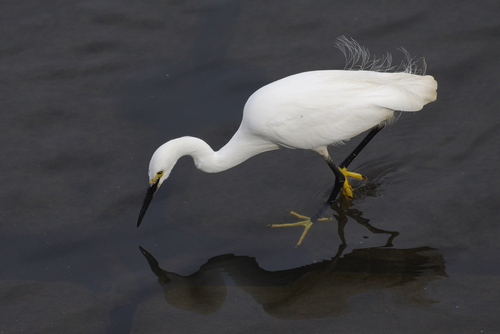
Straw-necked Ibis

Straw-necked Ibis

Threskiornis spinicollis

Silhouette: PhyloPic

LCLeast ConcernNTVUENCR
Daily sighting probability <5% · Rare
at Wilsons Promontory National Park

In 3 days ~10% in a week ~30%

25 Verified sightings at Wilsons Promontory National Park From 2019 to 2026
1,602 In all 12 parks
August Best month
☀️ Diurnal When it's spotted

About the Straw-necked Ibis

The straw-necked ibis (Threskiornis spinicollis) is a bird of the ibis and spoonbill family Threskiornithidae. It can be found throughout Australia, New Guinea, and parts of Indonesia. Adults have distinctive straw-like feathers on their necks.

Straw-necked ibises are large birds, around 59–76 cm (23–30 in) long, with a bare black head and a long, downcurved black bill. They have a distinctive, highly iridescent plumage, which can appear fairly uniform dirty dark brown in indifferent light; the wings are dark, with an iridescent, multicoloured sheen in sunlight. They have a shiny blue-black back, with a metallic purple, green and bronze glow, and a dark collar. The upper neck is white, as are the underparts and the undertail; their legs are usually red near the top and dark grey toward the feet. Adults have straw-colored feathers on the neck, giving the bird its common name. Their wingspan is about 100–120 cm (39.5–47 in) and weight is generally 1.1–1.5 kg (2.5–3.5 lb).

Sexes are similar, although males have longer bills and females have a dark band across their upper breast. Juveniles have duller colors and shorter bills with less curvature, and lack the straw-like... Wikipedia →

Sounds

Call0:09

Australia · 2018

© Marc Anderson · XC434099 · CC BY-NC-ND 4.0

Flight call0:28

Australia · 2014

© Nigel Jackett · XC184702 · CC BY-NC-SA 4.0

Call0:24

Australia · 2022

© James Lambert · XC729270 · CC BY-NC-ND 4.0

Global Distribution

Parks Where Found

# Park Country Daily sighting probability
1 Kakadu National Park 🇦🇺 Australia
~50%
2 Litchfield National Park 🇦🇺 Australia
~30%
3 Daintree National Park 🇦🇺 Australia
~10%
4 Nitmiluk National Park 🇦🇺 Australia
~10%
5 Grampians National Park 🇦🇺 Australia
~10%
6 Wilsons Promontory National Park 🇦🇺 Australia
<5%
7 Springbrook National Park 🇦🇺 Australia
<5%
8 Great Otway National Park 🇦🇺 Australia
<5%
9 Hattah-Kulkyne National Park 🇦🇺 Australia
<5%
10 Lamington National Park 🇦🇺 Australia
<5%
11 Blue Mountains National Park 🇦🇺 Australia
<5%
12 Royal National Park 🇦🇺 Australia
<5%

Cities Where Found

# City Country Daily sighting probability
1 Perth 🇦🇺 Australia
~20%
2 Brisbane 🇦🇺 Australia
~10%
3 Melbourne 🇦🇺 Australia
~10%
4 Sydney 🇦🇺 Australia
<5%

Zoos & Centres Where Found

# Zoo / Centre Country
1 Pairi Daiza 🇧🇪 Belgium In captivity
2 Prague Zoo 🇨🇿 Czechia In captivity
3 Tierpark Berlin 🇩🇪 Germany In captivity
4 Zoo Pilsen 🇨🇿 Czechia In captivity
5 Parc des oiseaux 🇫🇷 France In captivity
6 Zoo Miami 🇺🇸 United States In captivity
7 Columbus Zoo and Aquarium 🇺🇸 United States In captivity
8 Kansas City Zoo 🇺🇸 United States In captivity
9 Sedgwick County Zoo 🇺🇸 United States In captivity
10 Omaha’s Henry Doorly Zoo and Aquarium 🇺🇸 United States In captivity
11 Selwo Aventura 🇪🇸 Spain In captivity
12 Parco Natura Viva 🇮🇹 Italy In captivity
13 Audubon Zoo 🇺🇸 United States In captivity
14 Hellabrunn Zoo 🇩🇪 Germany In captivity
15 Kyiv Zoo 🇺🇦 Ukraine In captivity
16 Healesville Sanctuary 🇦🇺 Australia In captivity
17 Taronga Zoo 🇦🇺 Australia In captivity
18 Singapore Zoo 🇸🇬 Singapore In captivity
19 Fort Wayne Children's Zoo 🇺🇸 United States In captivity
20 San Antonio Zoo 🇺🇸 United States In captivity
21 Bad Mergentheim Wildlife Park 🇩🇪 Germany In captivity
22 Bird Paradise 🇸🇬 Singapore In captivity
23 Rainforest Wild Asia 🇸🇬 Singapore In captivity
24 Seville Zoo 🇪🇸 Spain In captivity
25 Monkeyland 🇿🇦 South Africa In captivity
26 Las Águilas Jungle Park 🇪🇸 Spain In captivity
27 Salisbury Zoo 🇺🇸 United States In captivity
28 World of Birds Wildlife Sanctuary and Monkey Park 🇿🇦 South Africa In captivity
29 Parc zoologique des Sables d'Olonnes 🇫🇷 France In captivity
30 Featherdale Sydney Wildlife Park 🇦🇺 Australia In captivity
31 Zoo Koki (Parque zoológico y botánico) 🇪🇸 Spain In captivity
32 Birds of Eden 🇿🇦 South Africa In captivity
33 National Aviary 🇺🇸 United States In captivity
34 Sobela Ocean Aquarium 🇺🇸 United States In captivity
35 Rákosův pavilon 🇨🇿 Czechia In captivity
36 Velemlokárium 🇨🇿 Czechia In captivity
37 Tierpark Schlichtweg 15 in München 🇩🇪 Germany In captivity
38 Zoo Schlichtweg 11 in München 🇩🇪 Germany In captivity
39 Zoo Siebenbrunner Straße 6 in München 🇩🇪 Germany In captivity

Before you go

What are the chances of seeing a Straw-necked Ibis in Wilsons Promontory National Park?

Rare

Under 5% of wildlife watchers report a Straw-necked Ibis sighting in Wilsons Promontory National Park on a given day, based on 25 verified sightings from GBIF citizen-science data from 2019 to 2026. It is the 83rd most-seen of the 138 birds we can rate there. Over three days the chance rises to about 10%, and over a week to about 30%, if each day is a fresh chance.

When is the best time to see a Straw-necked Ibis in Wilsons Promontory National Park?

April, July–August and October–January

In those months about 10% of wildlife watchers report a Straw-necked Ibis in Wilsons Promontory National Park on a given day, against under 5% in February–March, May–June and September, the lowest months.

What time of day is best to see a Straw-necked Ibis?

Between 11 am and 2 pm

Across all the parks we cover, that three-hour window holds the most Straw-necked Ibis sightings with a recorded time, and nearly all of them come between 6 am and 6 pm: it is a daytime animal.

Is Wilsons Promontory National Park the best place to see a Straw-necked Ibis?

6th of 12

Of the 12 parks where we can rate Straw-necked Ibis sightings, Wilsons Promontory National Park ranks 6th at under 5%. The best odds are in Kakadu National Park (Australia, about 50%), Litchfield National Park (Australia, about 30%) and Daintree National Park (Australia, about 10%).

Where does the Straw-necked Ibis sighting chance come from?

GBIF citizen-science records

It is estimated from how often the Straw-necked Ibis is recorded against all the birds logged in Wilsons Promontory National Park (25 verified sightings from 2019 to 2026), calibrated against known sighting rates. Figures are rounded to the nearest 10% because citizen-science data supports honest approximations, not decimals, and months with records from fewer than five people show "—". How it works.

← Back to Wilsons Promontory National Park