Buff-breasted Wren

Buff-breasted Wren

Cantorchilus leucotis

Silhouette: Matt Wilkins · PhyloPic

LCLeast ConcernNTVUENCR
Daily sighting probability <5% · Rare
at Yasuní National Park

In 3 days <5% in a week ~10%

44 Verified sightings at Yasuní National Park From 2019 to 2026
4,643 In all 16 parks
August Best month
☀️ Diurnal When it's spotted

About the Buff-breasted Wren

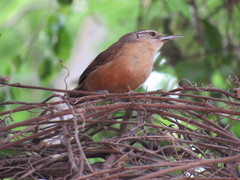
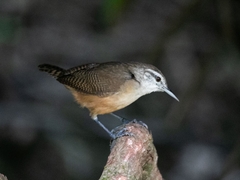
The buff-breasted wren (Cantorchilus leucotis) is a species of bird in the family Troglodytidae. It is found in the Amazon Basin of northern Brazil and Amazonian Colombia, Ecuador, Peru and northern-border Bolivia, and also the Guianan countries of Guyana, Suriname, and French Guiana. It occurs in non-Amazonian regions of Venezuela and Colombia and its range extends into eastern Panama.

As the buff-breasted wren is understood in 2021, it has 11 subspecies. However, there are suggestions that some of them might not be valid, that some might be separate species, and on a larger scale, that the taxonomy of the entire genus Cantorchilus has not been completely resolved.

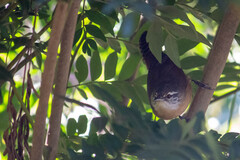
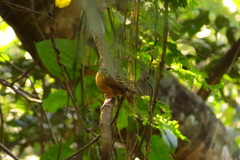
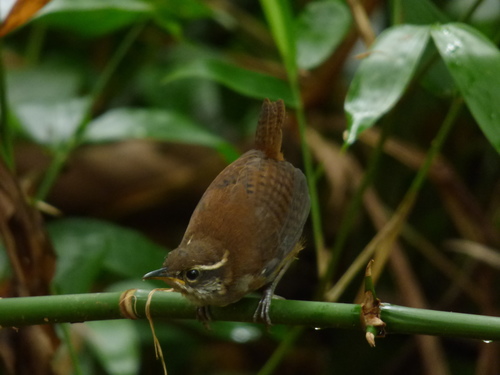
Male buff-breasted wrens weigh 18.5 to 22.8 g (0.65 to 0.80 oz) and females are lighter at 16.0 to 19.5 g (0.56 to 0.69 oz), but the sexes are otherwise similar. There is considerable variation in plumage across the species' wide range. Adults' head, nape, shoulders, tail, and back are rufescent to grayish brown; the tail is heavily barred. The throat, supercilium, and the rest of the face range from whitish through gray to gray-brown. The chest is buffy and the belly more... Wikipedia →

Sounds

Call0:27

Brazil · 2026

© JAYRSON ARAUJO DE OLIVEIRA · XC1186261 · CC BY-NC-SA 4.0

Song0:45

French Guiana · 2024

© Tristan Guillebot de Nerville · XC1147163 · CC BY-NC-SA 4.0

Alarm call0:26

Brazil · 2025

© Robson Silva e Silva · XC1018879 · CC BY-NC-SA 4.0

Global Distribution

Parks Where Found

# Park Country Daily sighting probability
1 Tayrona National Natural Park 🇨🇴 Colombia
~50%
2 Soberanía National Park 🇵🇦 Panama
~20%
3 Anavilhanas National Park 🇧🇷 Brazil
~20%
4 Amacayacu National Natural Park 🇨🇴 Colombia
~20%
5 Parque Estadual Encontro das Águas 🇧🇷 Brazil
~20%
6 San Lorenzo Protected Forest 🇵🇦 Panama
~10%
7 Tambopata National Reserve 🇵🇪 Peru
~10%
8 Sierra de la Macarena National Park 🇨🇴 Colombia
~10%
9 Manu National Park 🇵🇪 Peru
<5%
10 Henri Pittier National Park 🇻🇪 Venezuela
<5%
11 Parque Natural Metropolitano 🇵🇦 Panama
<5%
12 Chapada dos Guimarães National Park 🇧🇷 Brazil
<5%
13 Darién National Park 🇵🇦 Panama
<5%
14 Chagres National Park 🇵🇦 Panama
<5%
15 Cuyabeno Wildlife Reserve 🇪🇨 Ecuador
<5%
16 Yasuní National Park 🇪🇨 Ecuador
<5%

Cities Where Found

# City Country Daily sighting probability
1 Goiânia 🇧🇷 Brazil
~40%
2 Manaus 🇧🇷 Brazil
~10%
3 Campo Grande 🇧🇷 Brazil
~10%
4 Brasilia 🇧🇷 Brazil
<5%
5 Valencia 🇻🇪 Venezuela
<5%
6 Panama City 🇵🇦 Panama
<5%
7 Caracas 🇻🇪 Venezuela
<5%

Before you go

What are the chances of seeing a Buff-breasted Wren in Yasuní National Park?

Rare

Under 5% of wildlife watchers report a Buff-breasted Wren sighting in Yasuní National Park on a given day, based on 44 verified sightings from GBIF citizen-science data from 2019 to 2026. It is the 398th most-seen of the 533 birds we can rate there. Over three days the chance rises to under 5%, and over a week to about 10%, if each day is a fresh chance.

When is the best time to see a Buff-breasted Wren in Yasuní National Park?

August

In that month about 10% of wildlife watchers report a Buff-breasted Wren in Yasuní National Park on a given day, against under 5% in September to July, the lowest months.

What time of day is best to see a Buff-breasted Wren?

Between 7 and 10 am

Across all the parks we cover, that three-hour window holds the most Buff-breasted Wren sightings with a recorded time, and about 8 in 10 of them come between 6 am and 6 pm: it is a daytime animal.

Which relatives of the Buff-breasted Wren live in Yasuní National Park?

Same family: Troglodytidae

The closest relatives of the Buff-breasted Wren that you can see in Yasuní National Park (family Troglodytidae, Wrens) are Thrush-like Wren (about 30%), Southern House Wren (about 20%) and Coraya Wren (about 20%), with each one's daily chance of a sighting.

Where does the Buff-breasted Wren sighting chance come from?

GBIF citizen-science records

It is estimated from how often the Buff-breasted Wren is recorded against all the birds logged in Yasuní National Park (44 verified sightings from 2019 to 2026), calibrated against known sighting rates. Figures are rounded to the nearest 10% because citizen-science data supports honest approximations, not decimals, and months with records from fewer than five people show "—". How it works.

← Back to Yasuní National Park