Blue-capped Manakin

Blue-capped Manakin

Lepidothrix coronata

Silhouette: Edwin Price · PhyloPic

LCLeast ConcernNTVUENCR
Daily sighting probability <5% · Rare
at Anavilhanas National Park

In 3 days <5% in a week ~10%

6 Verified sightings at Anavilhanas National Park From 2019 to 2026
6,961 In all 19 parks
January Best month
☀️ Diurnal When it's spotted

About the Blue-capped Manakin

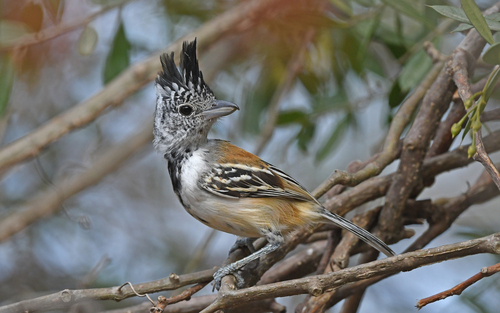
The blue-capped manakin (Lepidothrix coronata) is a species of bird in the family Pipridae. The males have a brilliant blue cap; some have black, others have green body plumage, but the relationship between the subspecies is not well understood.

It is found in Bolivia, Brazil, Colombia, Ecuador, Peru, and Venezuela. Its natural habitats are subtropical or tropical moist lowland forest and heavily degraded former forest. The blue-capped manakin was formally described in 1825 by the German naturalist Johann Baptist von Spix under the binomial name Pipra coronata. The type locality is the state of São Paulo de Olivença in western Brazil. The specific epithet is from Latin coronatus meaning "crowned". The blue-capped manakin is now the type species of the genus Lepidothrix that was introduced by the French naturalist Charles Lucien Bonaparte in 1854.

Phylogeny based on Ohlson et al. 2013. Six subspecies are recognised, but see the text below the table. With the exception of L. c. carbonata, the subspecies categories listed above are not supported phylogenetically. They were instead named based on differences in male plumage. Blue-capped manakins differ genetically... Wikipedia →

Sounds

Call0:49

Brazil · 2026

© JAYRSON ARAUJO DE OLIVEIRA · XC1186075 · CC BY-NC-SA 4.0

Song0:15

Panama · 2025

© Charlie Vogt · XC989641 · CC BY-NC-SA 4.0

Uncertain0:32

Costa Rica · 2022

© Finca Cántaros · XC715198 · CC BY-NC-SA 4.0

Global Distribution

Parks Where Found

# Park Country Daily sighting probability
1 Soberanía National Park 🇵🇦 Panama
~30%
2 Utría National Natural Park 🇨🇴 Colombia
~20%
3 Amacayacu National Natural Park 🇨🇴 Colombia
~20%
4 Corcovado National Park 🇨🇷 Costa Rica
~20%
5 Carara National Park 🇨🇷 Costa Rica
~10%
6 Yasuní National Park 🇪🇨 Ecuador
~10%
7 Sierra de la Macarena National Park 🇨🇴 Colombia
~10%
8 Chagres National Park 🇵🇦 Panama
~10%
9 San Lorenzo Protected Forest 🇵🇦 Panama
~10%
10 Marino Ballena National Park 🇨🇷 Costa Rica
<5%
11 Manu National Park 🇵🇪 Peru
<5%
12 Darién National Park 🇵🇦 Panama
<5%
13 Piedras Blancas National Park 🇨🇷 Costa Rica
<5%
14 Tambopata National Reserve 🇵🇪 Peru
<5%
15 Manuel Antonio National Park 🇨🇷 Costa Rica
<5%
16 Chirripó National Park 🇨🇷 Costa Rica
<5%
17 Anavilhanas National Park 🇧🇷 Brazil
<5%
18 La Amistad International Park (Panama) 🇵🇦 Panama
<5%
19 Farallones de Cali National Natural Park 🇨🇴 Colombia
<5%

Before you go

What are the chances of seeing a Blue-capped Manakin in Anavilhanas National Park?

Rare

Under 5% of wildlife watchers report a Blue-capped Manakin sighting in Anavilhanas National Park on a given day, based on 6 verified sightings from GBIF citizen-science data from 2019 to 2026. It is the 275th most-seen of the 291 birds we can rate there. Over three days the chance rises to under 5%, and over a week to about 10%, if each day is a fresh chance.

When is the best time to see a Blue-capped Manakin in Anavilhanas National Park?

January

In that month about 10% of wildlife watchers report a Blue-capped Manakin in Anavilhanas National Park on a given day, against under 5% in February to December, the lowest months.

What time of day is best to see a Blue-capped Manakin?

Between 9 am and noon

Across all the parks we cover, that three-hour window holds the most Blue-capped Manakin sightings with a recorded time, and about 7 in 10 of them come between 6 am and 6 pm: it is a daytime animal.

Which relatives of the Blue-capped Manakin live in Anavilhanas National Park?

Same family: Pipridae

The closest relatives of the Blue-capped Manakin that you can see in Anavilhanas National Park (family Pipridae, Manakins) are Wire-tailed Manakin (about 30%), Dwarf Tyrant-Manakin (about 10%) and White-crowned Manakin (about 10%), with each one's daily chance of a sighting.

Where does the Blue-capped Manakin sighting chance come from?

GBIF citizen-science records

It is estimated from how often the Blue-capped Manakin is recorded against all the birds logged in Anavilhanas National Park (6 verified sightings from 2019 to 2026), calibrated against known sighting rates. Figures are rounded to the nearest 10% because citizen-science data supports honest approximations, not decimals, and months with records from fewer than five people show "—". How it works.

← Back to Anavilhanas National Park