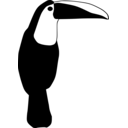


Completed



Black-mandibled Toucan
Ramphastos ambiguus
Silhouette: Edwin Price · PhyloPic
- KingdomAnimalia (Animals)
- PhylumChordata (Chordates)
- ClassAves (Birds)
- OrderPiciformes (Woodpeckers and Allies)
- FamilyRamphastidae (Toucans)
- GenusRamphastos (Large Toucans)
- SpeciesRamphastos ambiguus (Black-mandibled Toucan)
In 3 days ~30% in a week ~50%
134 Verified sightings at Chirripó National Park From 2019 to 2026
36,834 In all 25 parks
March Best month
☀️ Diurnal When it's spotted



Completed
About the Black-mandibled Toucan
The yellow-throated toucan (Ramphastos ambiguus) is a Least Concern species of bird in the family Ramphastidae, the toucans, toucanets, and aracaris. It is found from Honduras south into northern South America and beyond to Peru.
The yellow-throated toucan is 47 to 61 cm (19 to 24 in) long and weighs 584 to 746 g (1.3 to 1.6 lb). The three subspecies differ little in their dimensions, though females' bills are shorter than males' in all three. Bill lengths vary between 15.1 and 19.8 cm (5.9 and 7.8 in) in males and 12.9 and 16.0 cm (5.1 and 6.3 in) in females. Other measurements differ little by sex. Their wing chord is 20.4 to 24.8 cm (8.0 to 9.8 in), their tail length is 14.0 to 16.2 cm (5.5 to 6.4 in), and their tarsus is 4.7 to 5.5 cm (1.9 to 2.2 in) long.
The yellow... Wikipedia →
Recent sightings of Black-mandibled Toucan in Chirripó National Park
LIVEiNaturalistGlobal Distribution
Parks Where Found
Cities Where Found
| # | City | Country | Daily sighting probability |
|---|---|---|---|
| 1 | San José | 🇨🇷 Costa Rica |
Zoos & Centres Where Found
Closest Relatives at Chirripó National Park




Before you go
What are the chances of seeing a Black-mandibled Toucan in Chirripó National Park?
With luck
About 10% of wildlife watchers report a Black-mandibled Toucan sighting in Chirripó National Park on a given day, based on 134 verified sightings from GBIF citizen-science data from 2019 to 2026. It is the 112th most-seen of the 332 birds we can rate there. Over three days the chance rises to about 30%, and over a week to about 50%, if each day is a fresh chance.
When is the best time to see a Black-mandibled Toucan in Chirripó National Park?
March
In that month about 20% of wildlife watchers report a Black-mandibled Toucan in Chirripó National Park on a given day, against under 5% in February, June–July and September–November, the lowest months. That is one of Chirripó National Park's driest months, with about 120 mm of rain against 690 mm in October.
What time of day is best to see a Black-mandibled Toucan?
Between 2 and 5 pm
Across all the parks we cover, that three-hour window holds the most Black-mandibled Toucan sightings with a recorded time, and about 9 in 10 of them come between 6 am and 6 pm: it is a daytime animal.
Is Chirripó National Park the best place to see a Black-mandibled Toucan?
19th of 25
Of the 25 parks where we can rate Black-mandibled Toucan sightings, Chirripó National Park ranks 19th at about 10%. The best odds are in Corcovado National Park (Costa Rica, about 60%), Tenorio Volcano National Park (Costa Rica, about 60%) and Piedras Blancas National Park (Costa Rica, about 60%). All parks ranked.
Which relatives of the Black-mandibled Toucan live in Chirripó National Park?
Same family: Ramphastidae
The closest relatives of the Black-mandibled Toucan that you can see in Chirripó National Park (family Ramphastidae, Toucans) are Northern Emerald-Toucanet (about 40%) and Fiery-billed Aracari (about 20%), with each one's daily chance of a sighting.
Where does the Black-mandibled Toucan sighting chance come from?
GBIF citizen-science records
It is estimated from how often the Black-mandibled Toucan is recorded against all the birds logged in Chirripó National Park (134 verified sightings from 2019 to 2026), calibrated against known sighting rates. Figures are rounded to the nearest 10% because citizen-science data supports honest approximations, not decimals, and months with records from fewer than five people show "—". How it works.
