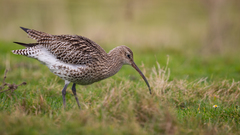
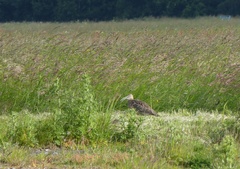
Eurasian Curlew

Eurasian Curlew

Numenius arquata

Silhouette: Rebecca Groom (based on Photo by Andreas Trepte) · PhyloPic

LCNTNear ThreatenedVUENCR
Daily sighting probability <5% · Rare
at Amsterdam

In 3 days <5%

8 Verified sightings at Amsterdam
10,460 In all 23 parks From 2019 to 2026
October Best month
☀️ Diurnal When it's spotted

About the Eurasian Curlew

The Eurasian curlew or common curlew (Numenius arquata) is a very large wader in the family Scolopacidae. It is one of the most widespread of the curlews, breeding across temperate Europe and Asia. In Europe, this species is often referred to just as the "curlew", and in Scotland known as the "whaup" in Scots.

The Eurasian curlew was formally described by the Swedish naturalist Carl Linnaeus in 1758 in the tenth edition of his Systema Naturae under the binomial name Scolopax arquata. It is now placed with eight other curlews in the genus Numenius that was introduced by the French ornithologist Mathurin Jacques Brisson in 1760. The genus name Numenius is from Ancient Greek νουμήνιος, noumēnios, a bird mentioned by Hesychius. It is associated with the curlew because it appears to be derived from neos, "new" and mene "moon", referring to the crescent-shaped bill. The species name arquata is the Medieval Latin name for this bird, derived from Latin arcuatus, "bow-shaped", and again referring to the shape of the bill.

The English name "curlew" is imitative of the Eurasian curlew's call, but may have been influenced by the Old French corliu, "messenger", from courir, "to run... Wikipedia →

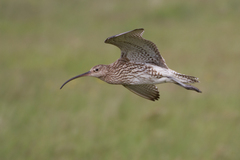
Sounds

Flight call0:39

Netherlands · 2026

© Joost van Bruggen · XC1181345 · CC BY-NC-ND 4.0

Song0:58

Sweden · 2026

© Lars Edenius · XC1140522 · CC BY-NC-SA 4.0

Call0:23

Sweden · 2025

© Ulf Elman · XC1006101 · CC BY-NC-ND 4.0

Global Distribution

Parks Where Found

# Park Country Daily sighting probability
1 Sundarbans National Park 🇮🇳 India
~60%
2 Wadden Sea National Park 🇩🇪 Germany
~50%
3 Kiskunság National Park 🇭🇺 Hungary
~50%
4 Hortobágy National Park 🇭🇺 Hungary
~40%
5 Camargue 🇫🇷 France
~40%
6 Fertő-Hanság National Park 🇭🇺 Hungary
~40%
7 Snowdonia National Park 🇬🇧 United Kingdom
~40%
8 West Coast National Park 🇿🇦 South Africa
~20%
9 Cairngorms National Park 🇬🇧 United Kingdom
~20%
10 Biebrza National Park 🇵🇱 Poland
~10%
11 Bako National Park 🇲🇾 Malaysia
~10%
12 Bavarian Forest National Park 🇩🇪 Germany
~10%
13 Doñana National Park 🇪🇸 Spain
<5%
14 Ranthambore National Park 🇮🇳 India
<5%
15 Białowieża National Park 🇵🇱 Poland
<5%
16 Yala National Park 🇱🇰 Sri Lanka
<5%
17 Garden Route National Park 🇿🇦 South Africa
<5%
18 Bali Barat National Park 🇮🇩 Indonesia
<5%
19 Ngorongoro Conservation Area 🇹🇿 Tanzania
<5%
20 Keoladeo National Park 🇮🇳 India
<5%
21 Kaziranga National Park 🇮🇳 India
<5%
22 Serengeti National Park 🇹🇿 Tanzania
<5%
23 Monfragüe National Park 🇪🇸 Spain
<5%

Cities Where Found

# City Country Daily sighting probability
1 Kuwait City 🇰🇼 Kuwait
~40%
2 Liverpool 🇬🇧 United Kingdom
~40%
3 Karachi 🇵🇰 Pakistan
~20%
4 Dublin 🇮🇪 Ireland
~20%
5 Abu Dhabi 🇦🇪 United Arab Emirates
~20%
6 Manama 🇧🇭 Bahrain
~20%
7 Dammam 🇸🇦 Saudi Arabia
~10%
8 Izmir 🇹🇷 Turkey
~10%
9 Quanzhou 🇨🇳 China
~10%
10 Naha 🇯🇵 Japan
~10%

Zoos & Centres Where Found

# Zoo / Centre Country
1 Moscow Zoo 🇷🇺 Russia In captivity
2 Pairi Daiza 🇧🇪 Belgium In captivity
3 Prague Zoo 🇨🇿 Czechia In captivity
4 Zoo Pilsen 🇨🇿 Czechia In captivity
5 Wildgehege Moritzburg 🇩🇪 Germany In captivity
6 Budapest Zoo & Botanical Garden 🇭🇺 Hungary In captivity
7 Oasi Naturalistica di Sant'Alessio 🇮🇹 Italy In captivity
8 Aquarium Wilhelmshaven 🇩🇪 Germany In captivity
9 Rákosův pavilon 🇨🇿 Czechia In captivity
10 Velemlokárium 🇨🇿 Czechia In captivity
11 akwarium warszawskiego ZOO 🇵🇱 Poland In captivity
12 hipopotamiarnia i akwarium morskie warszawskiego ZOO 🇵🇱 Poland In captivity

Before you go

What are the chances of seeing a Eurasian Curlew in Amsterdam?

Rare

Under 5% of wildlife watchers report a Eurasian Curlew sighting in Amsterdam on a given day, based on 8 verified sightings from GBIF citizen-science data. It is the 117th most-seen of the 132 birds we can rate there. Over three days the chance rises to under 5%, if each day is a fresh chance.

When is the best time to see a Eurasian Curlew in Amsterdam?

Any time of year

In every month with enough records, under 5% of wildlife watchers report a Eurasian Curlew in Amsterdam on a given day, so our monthly data shows no clear season.

What time of day is best to see a Eurasian Curlew?

Between 9 am and noon

Across all the parks we cover, that three-hour window holds the most Eurasian Curlew sightings with a recorded time, and about 8 in 10 of them come between 6 am and 6 pm: it is a daytime animal.

Is Amsterdam the best place to see a Eurasian Curlew?

37th of 41

Of the 41 cities where we can rate Eurasian Curlew sightings, Amsterdam ranks 37th at under 5%. The best odds are in Kuwait City (Kuwait, about 40%), Liverpool (United Kingdom, about 40%) and Karachi (Pakistan, about 20%).

Where does the Eurasian Curlew sighting chance come from?

GBIF citizen-science records

It is estimated from how often the Eurasian Curlew is recorded against all the birds logged in Amsterdam (8 verified sightings), calibrated against known sighting rates. Figures are rounded to the nearest 10% because citizen-science data supports honest approximations, not decimals, and months with records from fewer than five people show "—". How it works.

← Back to Amsterdam