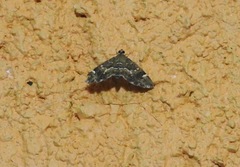
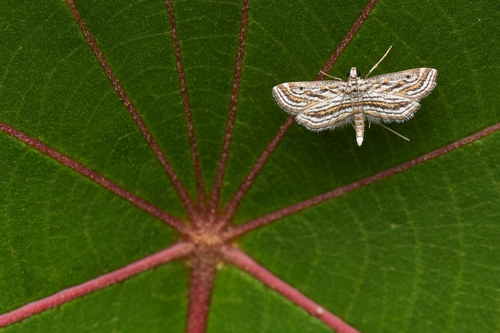
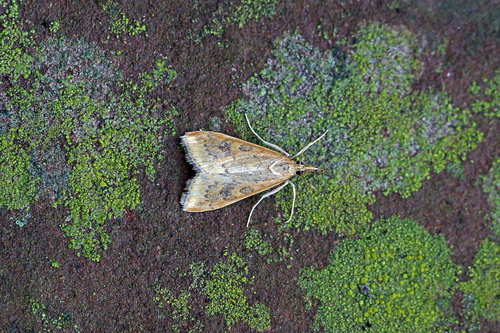
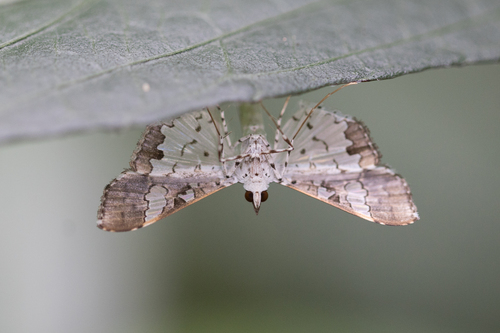
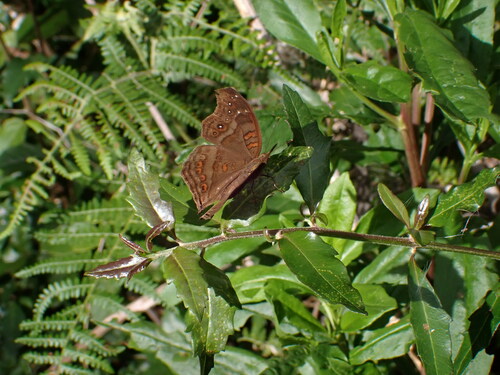
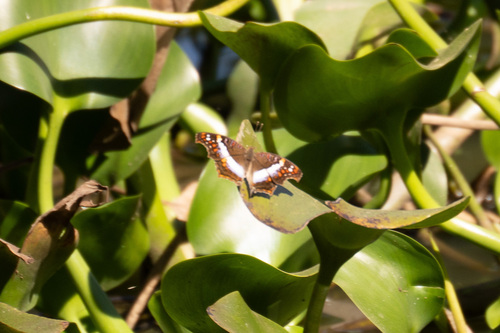
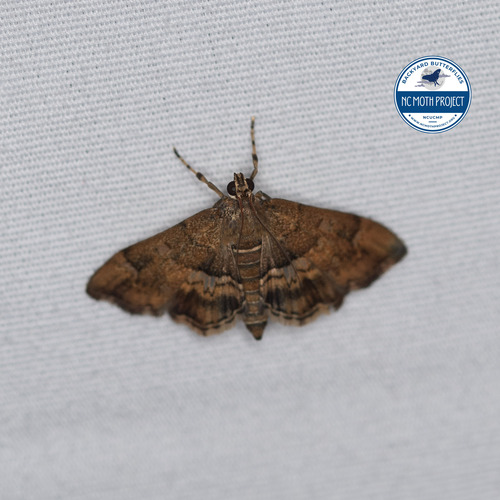
Spotted Beet Webworm Moth

Spotted Beet Webworm Moth

Hymenia perspectalis

Daily sighting probability ~10% · With luck
at Antananarivo

In 3 days ~40% in a week ~60%

5 Verified sightings at Antananarivo
195 In all 18 parks From 2019 to 2026
July Best month
🌙 Nocturnal When it's spotted

About the Spotted Beet Webworm Moth

Hymenia perspectalis, the spotted beet webworm moth, is a species of moth of the family Crambidae. It is found in various parts of the world, including North America, where it is found from Maine to Florida, west to Texas and north to Michigan and Ontario. It is also found in Belize, Hong Kong, Jamaica, Australia (Queensland), the Comoros, Equatorial Guinea, Réunion and South Africa. The species was described by Jacob Hübner in 1796.

The wingspan is 16–22 mm. They are on wing from April to November. Wikipedia →

Global Distribution

Parks Where Found

# Park Country Daily sighting probability
1 Monteverde Cloud Forest Reserve 🇨🇷 Costa Rica
~20%
2 Main Ridge Forest Reserve 🇹🇹 Trinidad and Tobago
~10%
3 Serra dos Órgãos National Park 🇧🇷 Brazil
~10%
4 Lago de Yojoa 🇭🇳 Honduras
~10%
5 Iguazú National Park 🇦🇷 Argentina
~10%
6 Padre Island National Seashore 🇺🇸 United States
~10%
7 Chirripó National Park 🇨🇷 Costa Rica
~10%
8 Iguaçu National Park 🇧🇷 Brazil
~10%
9 Point Pelee National Park 🇨🇦 Canada
~10%
10 Braulio Carrillo National Park 🇨🇷 Costa Rica
~10%
11 Manu National Park 🇵🇪 Peru
~10%
12 La Amistad International Park (Panama) 🇵🇦 Panama
~10%
13 Shenandoah National Park 🇺🇸 United States
~10%
14 Soberanía National Park 🇵🇦 Panama
~10%
15 Everglades National Park 🇺🇸 United States
~10%
16 Blue Mountains National Park 🇦🇺 Australia
<5%
17 Great Smoky Mountains National Park 🇺🇸 United States
<5%
18 Cumbres de Monterrey National Park 🇲🇽 Mexico
<5%

Cities Where Found

# City Country Daily sighting probability
1 Valencia 🇻🇪 Venezuela
~30%
2 Antananarivo 🇲🇬 Madagascar
~10%
3 Austin 🇺🇸 United States
~10%
4 João Pessoa 🇧🇷 Brazil
~10%
5 Dehradun 🇮🇳 India
~10%
6 São Luís 🇧🇷 Brazil
~10%
7 Kolkata 🇮🇳 India
~10%
8 Dallas 🇺🇸 United States
~10%
9 Pune 🇮🇳 India
~10%
10 Medellín 🇨🇴 Colombia
~10%

Before you go

What are the chances of seeing a Spotted Beet Webworm Moth in Antananarivo?

With luck

About 10% of wildlife watchers report a Spotted Beet Webworm Moth sighting in Antananarivo on a given day, based on 5 verified sightings from GBIF citizen-science data. It is the 48th most-seen of the 59 insects we can rate there. Over three days the chance rises to about 40%, and over a week to about 60%, if each day is a fresh chance.

When is the best time to see a Spotted Beet Webworm Moth in Antananarivo?

July

In that month about 40% of wildlife watchers report a Spotted Beet Webworm Moth in Antananarivo on a given day, against under 5% in August and October–April, the lowest months. That is one of Antananarivo's driest months, with about 85 mm of rain against 480 mm in January.

What time of day is best to see a Spotted Beet Webworm Moth?

Between 7 and 10 pm

Across all the parks we cover, that three-hour window holds the most Spotted Beet Webworm Moth sightings with a recorded time, and about 8 in 10 of them come between 6 pm and 6 am: it is mostly seen at night.

Is Antananarivo the best place to see a Spotted Beet Webworm Moth?

2nd of 30

Of the 30 cities where we can rate Spotted Beet Webworm Moth sightings, Antananarivo ranks 2nd at about 10%. The best odds are in Valencia (Venezuela, about 30%).

Which relatives of the Spotted Beet Webworm Moth live in Antananarivo?

Same family: Crambidae

The closest relatives of the Spotted Beet Webworm Moth that you can see in Antananarivo (family Crambidae, Crambid Snout Moths) are Waved China-Mark (about 20%), Rusty Dot Pearl (about 20%) and Hawaiian Beet Webworm Moth (about 20%), with each one's daily chance of a sighting.

Where does the Spotted Beet Webworm Moth sighting chance come from?

GBIF citizen-science records

It is estimated from how often the Spotted Beet Webworm Moth is recorded against all the insects logged in Antananarivo (5 verified sightings), calibrated against known sighting rates. Figures are rounded to the nearest 10% because citizen-science data supports honest approximations, not decimals, and months with records from fewer than five people show "—". How it works.
← Back to Antananarivo