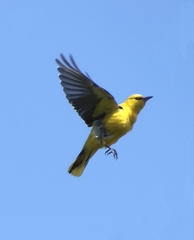
Eurasian Golden Oriole

Eurasian Golden Oriole

Oriolus oriolus

Silhouette: Kookaburra 81 · PhyloPic

LCLeast ConcernNTVUENCR
Daily sighting probability ~10% · With luck
at Budapest

In 3 days ~30% in a week ~50%

182 Verified sightings at Budapest
4,867 In all 38 parks From 2019 to 2026
May Best month
☀️ Diurnal When it's spotted

About the Eurasian Golden Oriole

The Eurasian golden oriole (Oriolus oriolus), also known as the common golden oriole, is a species of passerine bird, measuring approximately 24cm in length with a wingspan of 44-45cm, and the only Old World oriole breeding in Northern Hemisphere temperate regions. It is a summer migrant in Europe and the Palearctic and spends the winter season in central and southern Africa.

The Eurasian golden oriole was formally described by Carl Linnaeus in 1758 in the tenth edition of his Systema Naturae. He named the species Coracias oriolus, assigning it to the genus Coracias, which now contains only rollers. The species is now placed in the genus Oriolus that Linnaeus introduced in 1766, creating a tautonym.

The Eurasian golden oriole and the Indian golden oriole were formerly considered conspecific, but in 2005 they were treated as separate species by the ornithologists Pamela Rasmussen and John Anderton, in the first edition of their Birds of South Asia. Support for this split was provided by a molecular phylogenetic study published in 2010, and most ornithologists now treat the Indian golden oriole as a separate species. Alternate names for the Eurasian golden... Wikipedia →

Sounds

Song0:53

Netherlands · 2026

© Joost van Bruggen · XC1138099 · CC BY-NC-ND 4.0

Alarm call0:14

Latvia · 2025

© Kaspars Funts · XC1012172 · CC BY-NC-SA 4.0

Call1:29

France · 2023

© Dominique Guillerme · XC818688 · CC BY-NC-SA 4.0

Global Distribution

Parks Where Found

# Park Country Daily sighting probability
1 Białowieża National Park 🇵🇱 Poland
~30%
2 Kiskunság National Park 🇭🇺 Hungary
~30%
3 Biebrza National Park 🇵🇱 Poland
~30%
4 Hortobágy National Park 🇭🇺 Hungary
~30%
5 Sierra Nevada National Park 🇪🇸 Spain
~20%
6 Meru National Park 🇰🇪 Kenya
~20%
7 Fertő-Hanság National Park 🇭🇺 Hungary
~20%
8 Monfragüe National Park 🇪🇸 Spain
~20%
9 Sierra de Guadarrama National Park 🇪🇸 Spain
~20%
10 Tsavo West National Park 🇰🇪 Kenya
~10%
11 Cévennes National Park 🇫🇷 France
~10%
12 Plitvice Lakes National Park 🇭🇷 Croatia
~10%
13 Bavarian Forest National Park 🇩🇪 Germany
~10%
14 Mkomazi National Park 🇹🇿 Tanzania
~10%
15 Doñana National Park 🇪🇸 Spain
~10%
16 Tsavo East National Park 🇰🇪 Kenya
~10%
17 Aigüestortes National Park 🇪🇸 Spain
<5%
18 Mana Pools National Park 🇿🇼 Zimbabwe
<5%
19 Pyrénées National Park 🇫🇷 France
<5%
20 Kruger National Park 🇿🇦 South Africa
<5%
21 Gauja National Park 🇱🇻 Latvia
<5%
22 Hwange National Park 🇿🇼 Zimbabwe
<5%
23 Tarangire National Park 🇹🇿 Tanzania
<5%
24 Ruaha National Park 🇹🇿 Tanzania
<5%
25 Lower Zambezi National Park 🇿🇲 Zambia
<5%
26 uMkhuze Game Reserve 🇿🇦 South Africa
<5%
27 Camargue 🇫🇷 France
<5%
28 Arusha National Park 🇹🇿 Tanzania
<5%
29 Nairobi National Park 🇰🇪 Kenya
<5%
30 Samburu National Reserve 🇰🇪 Kenya
<5%
31 Picos de Europa National Park 🇪🇸 Spain
<5%
32 Etosha National Park 🇳🇦 Namibia
<5%
33 Masai Mara National Reserve 🇰🇪 Kenya
<5%
34 Ngorongoro Conservation Area 🇹🇿 Tanzania
<5%
35 Amboseli National Park 🇰🇪 Kenya
<5%
36 Chobe National Park 🇧🇼 Botswana
<5%
37 Wadden Sea National Park 🇩🇪 Germany
<5%
38 Serengeti National Park 🇹🇿 Tanzania
<5%

Cities Where Found

# City Country Daily sighting probability
1 Tehran 🇮🇷 Iran
~10%
2 Budapest 🇭🇺 Hungary
~10%
3 Bujumbura 🇧🇮 Burundi
~10%
4 Novosibirsk 🇷🇺 Russia
~10%
5 Bucharest 🇷🇴 Romania
~10%
6 Zanzibar City 🇹🇿 Tanzania
~10%
7 Kyiv 🇺🇦 Ukraine
~10%
8 Isfahan 🇮🇷 Iran
~10%
9 Turin 🇮🇹 Italy
~10%
10 Mashhad 🇮🇷 Iran
<5%

Zoos & Centres Where Found

# Zoo / Centre Country
1 Zoo Pilsen 🇨🇿 Czechia In captivity
2 Yaroslavl Zoo 🇷🇺 Russia In captivity
3 Leningrad Zoo 🇷🇺 Russia In captivity
4 Alpenzoo Innsbruck 🇦🇹 Austria In captivity
5 Tiergarten Delitzsch 🇩🇪 Germany In captivity

Before you go

What are the chances of seeing a Eurasian Golden Oriole in Budapest?

With luck

About 10% of wildlife watchers report a Eurasian Golden Oriole sighting in Budapest on a given day, based on 182 verified sightings from GBIF citizen-science data. It is the 50th most-seen of the 136 birds we can rate there. Over three days the chance rises to about 30%, and over a week to about 50%, if each day is a fresh chance.

When is the best time to see a Eurasian Golden Oriole in Budapest?

May

In that month about 40% of wildlife watchers report a Eurasian Golden Oriole in Budapest on a given day, against under 5% in September to April, the lowest months.

What time of day is best to see a Eurasian Golden Oriole?

Between 5 and 8 pm

Across all the parks we cover, that three-hour window holds the most Eurasian Golden Oriole sightings with a recorded time, and about 7 in 10 of them come between 6 am and 6 pm: it is a daytime animal.

Is Budapest the best place to see a Eurasian Golden Oriole?

Among the best

Of the 41 cities where we can rate Eurasian Golden Oriole sightings, Budapest ranks 2nd at about 10%, level with the leaders once rounded. The best odds are in Tehran (Iran, about 10%).

Which relatives of the Eurasian Golden Oriole live in Budapest?

Same order: Passeriformes

The closest relatives of the Eurasian Golden Oriole that you can see in Budapest (order Passeriformes, Perching Birds) are Hooded Crow (about 90%), Great Tit (about 90%) and Eurasian Blackbird (about 80%), with each one's daily chance of a sighting.

Where does the Eurasian Golden Oriole sighting chance come from?

GBIF citizen-science records

It is estimated from how often the Eurasian Golden Oriole is recorded against all the birds logged in Budapest (182 verified sightings), calibrated against known sighting rates. Figures are rounded to the nearest 10% because citizen-science data supports honest approximations, not decimals, and months with records from fewer than five people show "—". How it works.

← Back to Budapest