Bluethroat

Bluethroat

Luscinia svecica

Silhouette: Stephan Sprinz · PhyloPic

LCLeast ConcernNTVUENCR
Daily sighting probability ~10% · With luck
at Karachi

In 3 days ~20% in a week ~40%

9 Verified sightings at Karachi
3,025 In all 23 parks From 2019 to 2026
November Best month
☀️ Diurnal When it's spotted

About the Bluethroat

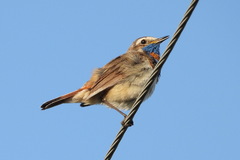
The bluethroat (Luscinia svecica) is a small passerine bird in the Old World flycatcher family. It is a migratory insectivorous species breeding in wet birch wood or bushy swamp in Europe and across the Palearctic with a foothold in western Alaska. It nests in tussocks or low in dense bushes. It winters in the Iberian Peninsula, the northern half of Africa, and in southern Asia (among others including the Indian subcontinent). The bluethroat, and similar small European flycatchers, are often called chats.

The bluethroat is similar in size to the European robin at 13–14 cm. It is plain brown above except for the distinctive tail, brown with black outer corners and red basal side patches. It has a strong white supercilium. The males have a striking throat pattern, with a vivid glossy blue throat bordered below with (usually) a narrow black band (but see subspecies, below), and a broad brick-red band below that; additionally there is often a central spot, either red or white, in the middle of the blue throat; see subspecies below for details. Despite the distinctive appearance of the males, recent genetic studies show only limited variation between the forms, and confirm that this is a single species. Moult begins in July after breeding and is completed in 40–45 days, before the birds migrate.

The male has a varied and very imitative song. Its call is a typical chat chack noise. Wikipedia →

Sounds

Song0:46

Sweden · 2026

© Kasper Wieck · XC1141987 · CC BY-NC-SA 4.0

Imitation1:04

Sweden · 2026

© Lars Edenius · XC1140021 · CC BY-NC-SA 4.0

Dawn song0:47

Netherlands · 2025

© Susanne Kuijpers · XC1003240 · CC BY-NC-SA 4.0

Global Distribution

Parks Where Found

# Park Country Daily sighting probability
1 Keoladeo National Park 🇮🇳 India
~40%
2 Biebrza National Park 🇵🇱 Poland
~20%
3 Hortobágy National Park 🇭🇺 Hungary
~20%
4 Jim Corbett National Park 🇮🇳 India
~10%
5 Manas National Park 🇮🇳 India
~10%
6 Hemis National Park 🇮🇳 India
~10%
7 Royal Bardia National Park 🇳🇵 Nepal
~10%
8 Wadden Sea National Park 🇩🇪 Germany
~10%
9 Monfragüe National Park 🇪🇸 Spain
~10%
10 Kiskunság National Park 🇭🇺 Hungary
<5%
11 Chitwan National Park 🇳🇵 Nepal
<5%
12 Doñana National Park 🇪🇸 Spain
<5%
13 Bavarian Forest National Park 🇩🇪 Germany
<5%
14 Fertő-Hanság National Park 🇭🇺 Hungary
<5%
15 Białowieża National Park 🇵🇱 Poland
<5%
16 Ranthambore National Park 🇮🇳 India
<5%
17 Sierra Nevada National Park 🇪🇸 Spain
<5%
18 Camargue 🇫🇷 France
<5%
19 Kaziranga National Park 🇮🇳 India
<5%
20 Sierra de Guadarrama National Park 🇪🇸 Spain
<5%
21 Bandhavgarh National Park 🇮🇳 India
<5%
22 Satpura National Park 🇮🇳 India
<5%
23 Kanha National Park 🇮🇳 India
<5%

Cities Where Found

# City Country Daily sighting probability
1 Vasai-Virar 🇮🇳 India
~30%
2 Novosibirsk 🇷🇺 Russia
~30%
3 Kazan 🇷🇺 Russia
~10%
4 Kalyan-Dombivli 🇮🇳 India
~10%
5 Jerusalem 🇮🇱 Israel
~10%
6 Kuwait City 🇰🇼 Kuwait
~10%
7 Indore 🇮🇳 India
~10%
8 Tel Aviv 🇮🇱 Israel
~10%
9 Karachi 🇵🇰 Pakistan
~10%
10 Ramallah 🇵🇸 Palestine
~10%

Before you go

What are the chances of seeing a Bluethroat in Karachi?

With luck

About 10% of wildlife watchers report a Bluethroat sighting in Karachi on a given day, based on 9 verified sightings from GBIF citizen-science data. It is the 66th most-seen of the 97 birds we can rate there. Over three days the chance rises to about 20%, and over a week to about 40%, if each day is a fresh chance.

When is the best time to see a Bluethroat in Karachi?

November

In that month about 20% of wildlife watchers report a Bluethroat in Karachi on a given day, against under 5% in March to August, the lowest months. That is one of Karachi's driest months, with almost no rain against 75 mm in August.

What time of day is best to see a Bluethroat?

Between 8 and 11 am

Across all the parks we cover, that three-hour window holds the most Bluethroat sightings with a recorded time, and about 9 in 10 of them come between 6 am and 6 pm: it is a daytime animal.

Is Karachi the best place to see a Bluethroat?

9th of 65

Of the 65 cities where we can rate Bluethroat sightings, Karachi ranks 9th at about 10%. The best odds are in Vasai-Virar (India, about 30%), Novosibirsk (Russia, about 30%) and Kazan (Russia, about 10%).

Which relatives of the Bluethroat live in Karachi?

Same family: Muscicapidae

The closest relatives of the Bluethroat that you can see in Karachi (family Muscicapidae, Old World Flycatchers, Robins, and Chats) are Ultramarine Flycatcher (about 10%) and Red-breasted Flycatcher (about 10%), with each one's daily chance of a sighting.

Where does the Bluethroat sighting chance come from?

GBIF citizen-science records

It is estimated from how often the Bluethroat is recorded against all the birds logged in Karachi (9 verified sightings), calibrated against known sighting rates. Figures are rounded to the nearest 10% because citizen-science data supports honest approximations, not decimals, and months with records from fewer than five people show "—". How it works.

← Back to Karachi