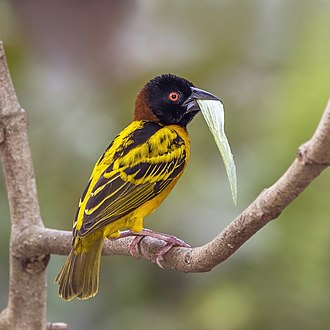
Green-backed Camaroptera

Green-backed Camaroptera

Camaroptera brachyura

Silhouette: Sheatherius · PhyloPic

LCLeast ConcernNTVUENCR
Daily sighting probability ~10% · With luck
at Lagos

In 3 days ~20% in a week ~40%

6 Verified sightings at Lagos
15,512 In all 50 parks From 2019 to 2026
March Best month
☀️ Diurnal When it's spotted

About the Green-backed Camaroptera

The green-backed camaroptera (Camaroptera brachyura), also known as the bleating camaroptera, is a small bird in the family Cisticolidae. This bird is a resident breeder in Africa south of the Sahara Desert. Recent studies suggest this species and the grey-backed camaroptera may be the same species.

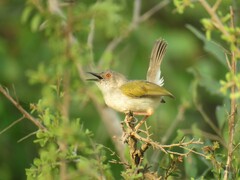
This skulking passerine is typically found low in dense cover. The green-backed camaroptera binds large leaves together low in a bush and builds a grass nest within the leaves. The normal clutch is two or three eggs. These 11.5 cm long warblers have green upperparts. The wings are olive and the underparts whitish grey. The sexes are similar, but juveniles are paler yellow on the breast.

Like most members in the group, green-backed camaroptera is insectivorous. The green-backed camaroptera was described by the French ornithologist Louis Pierre Vieillot in 1821 under the binomial name Sylvia brachyura. The type locality is the Cape of Good Hope. The specific epithet brachyura is from the Ancient Greek brakhus for "short" and -ouros for "-tailed".

There are five subspecies: Camaroptera brachyura pileata Reichenow, 1891 – southeast Kenya to southeast Tanzania Camaroptera brachyura fugglescouchmani Moreau, 1939 – northeast Zambia, north Malawi and east Tanzania Camaroptera brachyura bororensis Gunning & Roberts, 1911 – south Tanzania, south Malawi and north Mozambique

Camaroptera brachyura constans Clancey, 1952 – southeast Zimbabwe, south Mozambique and northeast South Africa Camaroptera brachyura brachyura (Vieillot, 1821) – south and east South Africa Wikipedia →

Sounds

Song0:26

Ivory Coast · 2026

© Étienne Leroy · XC1186886 · CC BY-NC-SA 4.0

Call0:49

Congo (Democratic Republic) · 2025

© Deville Tanguy · XC1182347 · CC BY-NC-SA 4.0

Alarm call0:09

Gambia · 2025

© Romuald Mikusek · XC1018847 · CC BY-NC-SA 4.0

Global Distribution

Parks Where Found

# Park Country Daily sighting probability
1 Waterberg Plateau Park 🇳🇦 Namibia
~70%
2 Gonarezhou National Park 🇿🇼 Zimbabwe
~50%
3 iSimangaliso Wetland Park 🇿🇦 South Africa
~50%
4 Arusha National Park 🇹🇿 Tanzania
~50%
5 uMkhuze Game Reserve 🇿🇦 South Africa
~50%
6 Semuliki National Park 🇺🇬 Uganda
~50%
7 Niokolo-Koba National Park 🇸🇳 Senegal
~50%
8 Kibale National Park 🇺🇬 Uganda
~50%
9 Ruaha National Park 🇹🇿 Tanzania
~40%
10 Nairobi National Park 🇰🇪 Kenya
~40%
11 Mana Pools National Park 🇿🇼 Zimbabwe
~40%
12 Lake Manyara National Park 🇹🇿 Tanzania
~40%
13 Lower Zambezi National Park 🇿🇲 Zambia
~40%
14 Lake Mburo National Park 🇺🇬 Uganda
~40%
15 Akagera National Park 🇷🇼 Rwanda
~30%
16 Ngorongoro Conservation Area 🇹🇿 Tanzania
~30%
17 Mkomazi National Park 🇹🇿 Tanzania
~30%
18 Kidepo Valley National Park 🇺🇬 Uganda
~30%
19 Lake Nakuru National Park 🇰🇪 Kenya
~30%
20 Bwindi Impenetrable National Park 🇺🇬 Uganda
~30%
21 Queen Elizabeth National Park 🇺🇬 Uganda
~30%
22 South Luangwa National Park 🇿🇲 Zambia
~30%
23 Garden Route National Park 🇿🇦 South Africa
~30%
24 Meru National Park 🇰🇪 Kenya
~30%
25 Kruger National Park 🇿🇦 South Africa
~30%
26 Virunga National Park 🇨🇩 Democratic Republic of the Congo
~30%
27 Murchison Falls National Park 🇺🇬 Uganda
~30%
28 Tarangire National Park 🇹🇿 Tanzania
~30%
29 Serengeti National Park 🇹🇿 Tanzania
~30%
30 Tsavo West National Park 🇰🇪 Kenya
~20%
31 Moremi Game Reserve 🇧🇼 Botswana
~20%
32 Hluhluwe-Imfolozi Park 🇿🇦 South Africa
~20%
33 Kafue National Park 🇿🇲 Zambia
~20%
34 Odzala-Kokoua National Park 🇨🇬 Republic of the Congo
~20%
35 Etosha National Park 🇳🇦 Namibia
~20%
36 Masai Mara National Reserve 🇰🇪 Kenya
~20%
37 Chobe National Park 🇧🇼 Botswana
~20%
38 Hwange National Park 🇿🇼 Zimbabwe
~20%
39 Aberdare National Park 🇰🇪 Kenya
~20%
40 Liwonde National Park 🇲🇼 Malawi
~10%
41 Awash National Park 🇪🇹 Ethiopia
~10%
42 Nyungwe National Park 🇷🇼 Rwanda
~10%
43 Gorongosa National Park 🇲🇿 Mozambique
~10%
44 Pilanesberg National Park 🇿🇦 South Africa
~10%
45 Mikumi National Park 🇹🇿 Tanzania
~10%
46 Addo Elephant National Park 🇿🇦 South Africa
~10%
47 Amboseli National Park 🇰🇪 Kenya
~10%
48 Samburu National Reserve 🇰🇪 Kenya
<5%
49 Volcanoes National Park 🇷🇼 Rwanda
<5%
50 Tsavo East National Park 🇰🇪 Kenya
<5%

Cities Where Found

# City Country Daily sighting probability
1 Ouagadougou 🇧🇫 Burkina Faso
~70%
2 Mombasa 🇰🇪 Kenya
~60%
3 Kampala 🇺🇬 Uganda
~50%
4 Abuja 🇳🇬 Nigeria
~50%
5 Zanzibar City 🇹🇿 Tanzania
~40%
6 Yaoundé 🇨🇲 Cameroon
~30%
7 Nairobi 🇰🇪 Kenya
~30%
8 Maiduguri 🇳🇬 Nigeria
~20%
9 Serrekunda 🇬🇲 Gambia
~20%
10 Dar es-Salaam 🇹🇿 Tanzania
~20%

Before you go

What are the chances of seeing a Green-backed Camaroptera in Lagos?

With luck

About 10% of wildlife watchers report a Green-backed Camaroptera sighting in Lagos on a given day, based on 6 verified sightings from GBIF citizen-science data. It is the 59th most-seen of the 72 birds we can rate there. Over three days the chance rises to about 20%, and over a week to about 40%, if each day is a fresh chance.

When is the best time to see a Green-backed Camaroptera in Lagos?

March

In that month about 20% of wildlife watchers report a Green-backed Camaroptera in Lagos on a given day, against under 5% in May, July, October and December–February, the lowest months. That is one of Lagos's driest months, with about 70 mm of rain against 250 mm in September. June, August–September and November have too few records to rate.

What time of day is best to see a Green-backed Camaroptera?

Between 7 and 10 am

Across all the parks we cover, that three-hour window holds the most Green-backed Camaroptera sightings with a recorded time, and about 9 in 10 of them come between 6 am and 6 pm: it is a daytime animal.

Is Lagos the best place to see a Green-backed Camaroptera?

20th of 26

Of the 26 cities where we can rate Green-backed Camaroptera sightings, Lagos ranks 20th at about 10%. The best odds are in Ouagadougou (Burkina Faso, about 70%), Mombasa (Kenya, about 60%) and Kampala (Uganda, about 50%).

Which relatives of the Green-backed Camaroptera live in Lagos?

Same family: Cisticolidae

The closest relatives of the Green-backed Camaroptera that you can see in Lagos (family Cisticolidae, Cisticolas and Allies) are Winding Cisticola (about 10%), Oriole Warbler (about 10%) and Zitting Cisticola (about 10%), with each one's daily chance of a sighting.

Where does the Green-backed Camaroptera sighting chance come from?

GBIF citizen-science records

It is estimated from how often the Green-backed Camaroptera is recorded against all the birds logged in Lagos (6 verified sightings), calibrated against known sighting rates. Figures are rounded to the nearest 10% because citizen-science data supports honest approximations, not decimals, and months with records from fewer than five people show "—". How it works.

← Back to Lagos