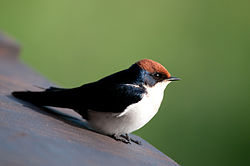
Wire-tailed Swallow

Wire-tailed Swallow

Hirundo smithii

Silhouette: Matt Wilkins · PhyloPic

LCLeast ConcernNTVUENCR
Daily sighting probability ~10% · With luck
at Lusaka

In 3 days ~20% in a week ~50%

23 Verified sightings at Lusaka
11,709 In all 50 parks From 2019 to 2026
February Best month
☀️ Diurnal When it's spotted

About the Wire-tailed Swallow

The wire-tailed swallow (Hirundo smithii) is a small passerine bird in the swallow family. It is mainly resident, but populations in Pakistan and northern India migrate further south in winter. The genus name Hirundo is the Latin word for swallow. The species name smithii commemorates Christen Smith, a Norwegian botanist and geologist.

The wire-tailed swallow is a small swallow, measuring 18 cm (7.1 in) in length. It has bright blue upperparts, bright white underparts and a chestnut cap. Immature birds lack tail wires, and have dull brown (rather than chestnut) caps. The species is named for the very long filamentous outermost tail feathers, which trail behind like two wires. The sexes are similar in appearance, but the female has shorter "wires". Juveniles have a brown crown, back and tail.

This bird is found in open country near water and human habitation. Wire-tailed swallows are fast flyers and they generally feed... Wikipedia →

Sounds

Call1:07

India · 2023

© Barry Edmonston · XC808566 · CC BY-NC-SA 4.0

Song1:13

Ethiopia · 2015

© Peter Boesman · XC300347 · CC BY-NC-ND 4.0

Call0:18

Malawi · 2015

© Frank Lambert · XC366181 · CC BY-NC-ND 4.0

Global Distribution

Parks Where Found

# Park Country Daily sighting probability
1 Gonarezhou National Park 🇿🇼 Zimbabwe
~40%
2 Lower Zambezi National Park 🇿🇲 Zambia
~40%
3 uMkhuze Game Reserve 🇿🇦 South Africa
~40%
4 South Luangwa National Park 🇿🇲 Zambia
~40%
5 Kafue National Park 🇿🇲 Zambia
~40%
6 Mana Pools National Park 🇿🇼 Zimbabwe
~40%
7 Keoladeo National Park 🇮🇳 India
~30%
8 Chobe National Park 🇧🇼 Botswana
~30%
9 Masai Mara National Reserve 🇰🇪 Kenya
~30%
10 Amboseli National Park 🇰🇪 Kenya
~30%
11 Liwonde National Park 🇲🇼 Malawi
~30%
12 Kruger National Park 🇿🇦 South Africa
~30%
13 Murchison Falls National Park 🇺🇬 Uganda
~30%
14 Mikumi National Park 🇹🇿 Tanzania
~30%
15 Gir National Park 🇮🇳 India
~30%
16 Ruaha National Park 🇹🇿 Tanzania
~30%
17 Queen Elizabeth National Park 🇺🇬 Uganda
~20%
18 Serengeti National Park 🇹🇿 Tanzania
~20%
19 Satpura National Park 🇮🇳 India
~20%
20 Meru National Park 🇰🇪 Kenya
~20%
21 Arusha National Park 🇹🇿 Tanzania
~20%
22 Nairobi National Park 🇰🇪 Kenya
~20%
23 Bandhavgarh National Park 🇮🇳 India
~20%
24 Ranthambore National Park 🇮🇳 India
~20%
25 Awash National Park 🇪🇹 Ethiopia
~10%
26 Tsavo West National Park 🇰🇪 Kenya
~10%
27 Hluhluwe-Imfolozi Park 🇿🇦 South Africa
~10%
28 Tsavo East National Park 🇰🇪 Kenya
~10%
29 Gorongosa National Park 🇲🇿 Mozambique
~10%
30 Lake Manyara National Park 🇹🇿 Tanzania
~10%
31 Samburu National Reserve 🇰🇪 Kenya
~10%
32 Lake Nakuru National Park 🇰🇪 Kenya
~10%
33 iSimangaliso Wetland Park 🇿🇦 South Africa
~10%
34 Virunga National Park 🇨🇩 Democratic Republic of the Congo
~10%
35 Ngorongoro Conservation Area 🇹🇿 Tanzania
~10%
36 Semuliki National Park 🇺🇬 Uganda
~10%
37 Hwange National Park 🇿🇼 Zimbabwe
~10%
38 Mkomazi National Park 🇹🇿 Tanzania
~10%
39 Kanha National Park 🇮🇳 India
~10%
40 Tarangire National Park 🇹🇿 Tanzania
~10%
41 Mudumalai National Park 🇮🇳 India
~10%
42 Akagera National Park 🇷🇼 Rwanda
<5%
43 Doi Inthanon National Park 🇹🇭 Thailand
<5%
44 Nagarhole National Park 🇮🇳 India
<5%
45 Moremi Game Reserve 🇧🇼 Botswana
<5%
46 Bandipur National Park 🇮🇳 India
<5%
47 Jim Corbett National Park 🇮🇳 India
<5%
48 Aberdare National Park 🇰🇪 Kenya
<5%
49 Lake Mburo National Park 🇺🇬 Uganda
<5%
50 Bwindi Impenetrable National Park 🇺🇬 Uganda
<5%

Cities Where Found

# City Country Daily sighting probability
1 Zanzibar City 🇹🇿 Tanzania
~70%
2 Kota 🇮🇳 India
~30%
3 Serrekunda 🇬🇲 Gambia
~30%
4 Indore 🇮🇳 India
~30%
5 Kigali 🇷🇼 Rwanda
~20%
6 Nashik 🇮🇳 India
~20%
7 Lucknow 🇮🇳 India
~20%
8 Bhopal 🇮🇳 India
~20%
9 Kalyan-Dombivli 🇮🇳 India
~20%
10 Chandigarh 🇮🇳 India
~20%

Before you go

What are the chances of seeing a Wire-tailed Swallow in Lusaka?

With luck

About 10% of wildlife watchers report a Wire-tailed Swallow sighting in Lusaka on a given day, based on 23 verified sightings from GBIF citizen-science data. It is the 44th most-seen of the 87 birds we can rate there. Over three days the chance rises to about 20%, and over a week to about 50%, if each day is a fresh chance.

When is the best time to see a Wire-tailed Swallow in Lusaka?

February

In that month about 20% of wildlife watchers report a Wire-tailed Swallow in Lusaka on a given day, against under 5% in July–August and November–December, the lowest months. That is one of Lusaka's wettest months, with about 150 mm of rain against almost none in August.

What time of day is best to see a Wire-tailed Swallow?

Between 8 and 11 am

Across all the parks we cover, that three-hour window holds the most Wire-tailed Swallow sightings with a recorded time, and about 9 in 10 of them come between 6 am and 6 pm: it is a daytime animal.

Is Lusaka the best place to see a Wire-tailed Swallow?

30th of 58

Of the 58 cities where we can rate Wire-tailed Swallow sightings, Lusaka ranks 30th at about 10%. The best odds are in Zanzibar City (Tanzania, about 70%), Kota (India, about 30%) and Serrekunda (Gambia, about 30%).

Which relatives of the Wire-tailed Swallow live in Lusaka?

Same order: Passeriformes

The closest relatives of the Wire-tailed Swallow that you can see in Lusaka (order Passeriformes, Perching Birds) are Common Bulbul (about 90%), Pied Crow (about 90%) and Variable Sunbird (about 80%), with each one's daily chance of a sighting.

Where does the Wire-tailed Swallow sighting chance come from?

GBIF citizen-science records

It is estimated from how often the Wire-tailed Swallow is recorded against all the birds logged in Lusaka (23 verified sightings), calibrated against known sighting rates. Figures are rounded to the nearest 10% because citizen-science data supports honest approximations, not decimals, and months with records from fewer than five people show "—". How it works.

← Back to Lusaka