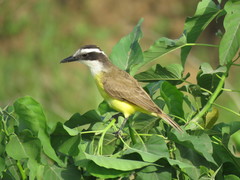
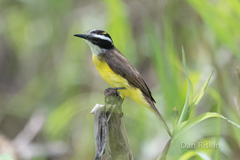
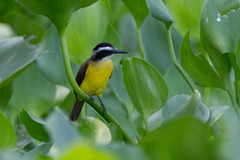
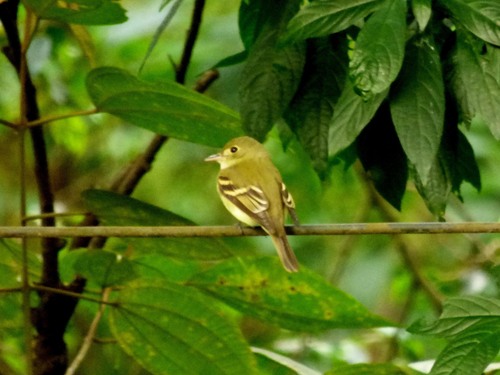
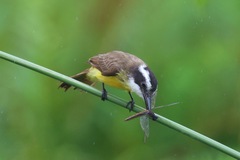
Lesser Kiskadee

Lesser Kiskadee

Pitangus lictor

Silhouette: Kai Caspar · PhyloPic

Daily sighting probability <5% · Rare
at Medellín

In 3 days <5%

21 Verified sightings at Medellín
6,840 In all 16 parks From 2019 to 2026
September Best month
☀️ Diurnal When it's spotted

About the Lesser Kiskadee

The lesser kiskadee (Philohydor lictor) is a species of passerine bird in the family Tyrannidae, the tyrant flycatchers. It is found in Panama and every mainland South American country except Chile, Paraguay, and Uruguay, though only as a vagrant in Argentina.

The lesser kiskadee was described by the German naturalist and explorer Hinrich Lichtenstein in 1823 and given the binomial name Lanius lictor, mistakenly placing it with the shrikes. It was later moved to genus Pitangus to join the great kiskadee (P. sulphuratus). As early as 1957 one author suggested that it belonged in its own genus. Its present genus Philohydor was introduced by the American ornithologist Wesley Edwin Lanyon in 1984. By 2001 some authors had adopted the movement of the lesser kiskadee to that genus. BirdLife International's Handbook of the Birds of the World adopted it in 2016 and the IOC by 2018. The North American Classification Committee of the American Ornithological Society and the Clements taxonomy adopted it in 2022 and the AOS South American Classification Committee in early 2023.

The genus name Philohydor is from Ancient Greek philos for "-loving" and hudōr, "water"... Wikipedia →

Sounds

Recording0:23

Brazil · 2015

© Luciano Bernardes · iNaturalist · CC BY-NC 4.0

Recording0:20

Brazil · 2021

© Marllus Rafael Almeida · iNaturalist · CC BY-NC 4.0

Global Distribution

Parks Where Found

# Park Country Daily sighting probability
1 Parque Estadual Encontro das Águas 🇧🇷 Brazil
~50%
2 Cuyabeno Wildlife Reserve 🇪🇨 Ecuador
~50%
3 Yasuní National Park 🇪🇨 Ecuador
~40%
4 Soberanía National Park 🇵🇦 Panama
~30%
5 Amacayacu National Natural Park 🇨🇴 Colombia
~10%
6 Manu National Park 🇵🇪 Peru
~10%
7 Anavilhanas National Park 🇧🇷 Brazil
~10%
8 San Lorenzo Protected Forest 🇵🇦 Panama
~10%
9 Tambopata National Reserve 🇵🇪 Peru
~10%
10 Chapada Diamantina National Park 🇧🇷 Brazil
<5%
11 Sierra de la Macarena National Park 🇨🇴 Colombia
<5%
12 Chapada dos Guimarães National Park 🇧🇷 Brazil
<5%
13 Parque Natural Metropolitano 🇵🇦 Panama
<5%
14 Tayrona National Natural Park 🇨🇴 Colombia
<5%
15 Chagres National Park 🇵🇦 Panama
<5%
16 Tijuca National Park 🇧🇷 Brazil
<5%

Cities Where Found

# City Country Daily sighting probability
1 Maceió 🇧🇷 Brazil
~10%
2 Belém 🇧🇷 Brazil
~10%
3 Barranquilla 🇨🇴 Colombia
<5%
4 Santa Cruz de la Sierra 🇧🇴 Bolivia
<5%
5 Panama City 🇵🇦 Panama
<5%
6 Goiânia 🇧🇷 Brazil
<5%
7 Medellín 🇨🇴 Colombia
<5%
8 Rio de Janeiro 🇧🇷 Brazil
<5%
9 São Paulo 🇧🇷 Brazil
<5%

Before you go

What are the chances of seeing a Lesser Kiskadee in Medellín?

Rare

Under 5% of wildlife watchers report a Lesser Kiskadee sighting in Medellín on a given day, based on 21 verified sightings from GBIF citizen-science data. It is the 174th most-seen of the 244 birds we can rate there. Over three days the chance rises to under 5%, if each day is a fresh chance.

When is the best time to see a Lesser Kiskadee in Medellín?

Any time of year

In every month with enough records, under 5% of wildlife watchers report a Lesser Kiskadee in Medellín on a given day, so our monthly data shows no clear season.

What time of day is best to see a Lesser Kiskadee?

Between 2 and 5 pm

Across all the parks we cover, that three-hour window holds the most Lesser Kiskadee sightings with a recorded time, and about 9 in 10 of them come between 6 am and 6 pm: it is a daytime animal.

Is Medellín the best place to see a Lesser Kiskadee?

7th of 9

Of the 9 cities where we can rate Lesser Kiskadee sightings, Medellín ranks 7th at under 5%. The best odds are in Maceió (Brazil, about 10%), Belém (Brazil, about 10%) and Barranquilla (Colombia, under 5%).

Where does the Lesser Kiskadee sighting chance come from?

GBIF citizen-science records

It is estimated from how often the Lesser Kiskadee is recorded against all the birds logged in Medellín (21 verified sightings), calibrated against known sighting rates. Figures are rounded to the nearest 10% because citizen-science data supports honest approximations, not decimals, and months with records from fewer than five people show "—". How it works.

← Back to Medellín