Veery

Veery

Catharus fuscescens

Silhouette: Sharon Wegner-Larsen · PhyloPic

LCLeast ConcernNTVUENCR
Daily sighting probability <5% · Rare
at Orlando

In 3 days ~10%

241 Verified sightings at Orlando
6,726 In all 34 parks From 2019 to 2026
September Best month
☀️ Diurnal When it's spotted

About the Veery

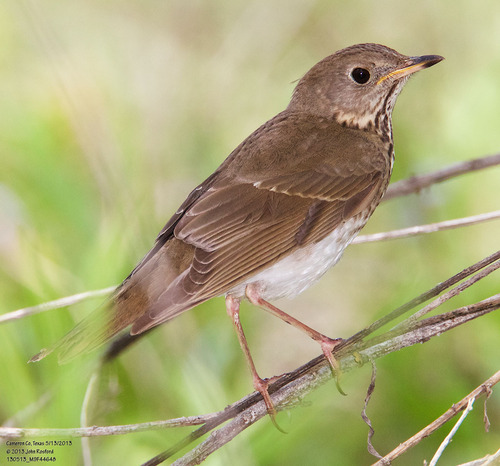
The veery (Catharus fuscescens) is a small North American thrush species, a member of a group of closely related and similar species in the genus Catharus, also including the gray-cheeked thrush (C. minimus), Bicknell's thrush (C. bicknelli), Swainson's thrush (C. ustulatus), and hermit thrush (C. guttatus). Alternate names for this species include Wilson's thrush (named so after Alexander Wilson) and tawny thrush. Up to six subspecies exist, which are grouped into the eastern veery (C. fuscescens fuscescens), the western veery or willow thrush (C. fuscescens salicicolus), and the Newfoundland veery (C. fuscescens fuliginosus).

The specific name fuscescens is Neo-Latin for "blackish", from Latin fuscus, "dark". The English name may imitate the call. This species measures 16–19.5 cm (6.3–7.7 in) in length. Its mass is 26–39 g (0.92–1.38 oz), exceptionally up to 54 g (1.9 oz). The wingspan averages 28.5 cm (11.2 in). Each wing measures 8.9–10.4 cm (3.5–4.1 in), the bill measures 1.2–1.9 cm (0.47–0.75 in) and the tarsus is 2.7–3.25 cm (1.06–1.28 in). The veery shows the characteristic under-wing stripe of Catharus thrushes. Adults are mainly light brown on the upperparts... Wikipedia →

Sounds

Nocturnal flight call0:38

United States · 2025

© Paul Driver · XC1044662 · CC BY-NC-SA 4.0

Song0:15

United States · 2024

© Oscar Gordo · XC924425 · CC BY-NC-SA 4.0

Call0:17

United States · 2024

© Valerie Heemstra · XC919159 · CC BY-NC-SA 4.0

Global Distribution

Parks Where Found

# Park Country Daily sighting probability
1 Point Pelee National Park 🇨🇦 Canada
~30%
2 Voyageurs National Park 🇺🇸 United States
~20%
3 Riding Mountain National Park 🇨🇦 Canada
~10%
4 Shenandoah National Park 🇺🇸 United States
~10%
5 Henri Pittier National Park 🇻🇪 Venezuela
~10%
6 Isle Royale National Park 🇺🇸 United States
~10%
7 Great Smoky Mountains National Park 🇺🇸 United States
~10%
8 Elk Island National Park 🇨🇦 Canada
~10%
9 Bastimentos Island National Marine Park 🇵🇦 Panama
~10%
10 Glacier National Park 🇺🇸 United States
<5%
11 Gandoca-Manzanillo Wildlife Refuge 🇨🇷 Costa Rica
<5%
12 Congaree National Park 🇺🇸 United States
<5%
13 Cahuita National Park 🇨🇷 Costa Rica
<5%
14 La Amistad International Park (Panama) 🇵🇦 Panama
<5%
15 Pico Bonito National Park 🇭🇳 Honduras
<5%
16 Sian Ka'an Biosphere Reserve 🇲🇽 Mexico
<5%
17 Celestún Biosphere Reserve 🇲🇽 Mexico
<5%
18 Cockscomb Basin Wildlife Sanctuary 🇧🇿 Belize
<5%
19 Parque Natural Metropolitano 🇵🇦 Panama
<5%
20 Acadia National Park 🇺🇸 United States
<5%
21 Tayrona National Natural Park 🇨🇴 Colombia
<5%
22 Soberanía National Park 🇵🇦 Panama
<5%
23 Tortuguero National Park 🇨🇷 Costa Rica
<5%
24 Arrecifes de Cozumel National Park 🇲🇽 Mexico
<5%
25 Everglades National Park 🇺🇸 United States
<5%
26 Banff National Park 🇨🇦 Canada
<5%
27 Poás Volcano National Park 🇨🇷 Costa Rica
<5%
28 Merritt Island National Wildlife Refuge 🇺🇸 United States
<5%
29 Braulio Carrillo National Park 🇨🇷 Costa Rica
<5%
30 Great Bear Rainforest 🇨🇦 Canada
<5%
31 Tenorio Volcano National Park 🇨🇷 Costa Rica
<5%
32 Arenal Volcano National Park 🇨🇷 Costa Rica
<5%
33 Rocky Mountain National Park 🇺🇸 United States
<5%
34 Tapantí-Macizo de la Muerte National Park 🇨🇷 Costa Rica
<5%

Cities Where Found

# City Country Daily sighting probability
1 New York City 🇺🇸 United States
~10%
2 Chicago 🇺🇸 United States
~10%
3 Detroit 🇺🇸 United States
<5%
4 Baltimore 🇺🇸 United States
<5%
5 Philadelphia 🇺🇸 United States
<5%
6 Montreal 🇨🇦 Canada
<5%
7 Toronto 🇨🇦 Canada
<5%
8 Washington 🇺🇸 United States
<5%
9 Havana 🇨🇺 Cuba
<5%
10 Orlando 🇺🇸 United States
<5%

Zoos & Centres Where Found

# Zoo / Centre Country
1 Aviario Nacional de Colombia 🇨🇴 Colombia In captivity

Before you go

What are the chances of seeing a Veery in Orlando?

Rare

Under 5% of wildlife watchers report a Veery sighting in Orlando on a given day, based on 241 verified sightings from GBIF citizen-science data. It is the 121st most-seen of the 205 birds we can rate there. Over three days the chance rises to about 10%, if each day is a fresh chance.

When is the best time to see a Veery in Orlando?

September

In that month about 10% of wildlife watchers report a Veery in Orlando on a given day, against under 5% in October to August, the lowest months. That is one of Orlando's wettest months, with about 170 mm of rain against 50 mm in November.

What time of day is best to see a Veery?

Between 8 and 11 am

Across all the parks we cover, that three-hour window holds the most Veery sightings with a recorded time, and about 9 in 10 of them come between 6 am and 6 pm: it is a daytime animal.

Is Orlando the best place to see a Veery?

10th of 22

Of the 22 cities where we can rate Veery sightings, Orlando ranks 10th at under 5%. The best odds are in New York City (United States, about 10%), Chicago (United States, about 10%) and Detroit (United States, under 5%).

Where does the Veery sighting chance come from?

GBIF citizen-science records

It is estimated from how often the Veery is recorded against all the birds logged in Orlando (241 verified sightings), calibrated against known sighting rates. Figures are rounded to the nearest 10% because citizen-science data supports honest approximations, not decimals, and months with records from fewer than five people show "—". How it works.

← Back to Orlando