Wood Thrush

Wood Thrush

Hylocichla mustelina

Silhouette: Francesco "Architetto" Rollandin · PhyloPic

LCLeast ConcernNTVUENCR
Daily sighting probability <5% · Rare
at Orlando

In 3 days <5%

47 Verified sightings at Orlando
16,785 In all 48 parks From 2019 to 2026
October Best month
☀️ Diurnal When it's spotted

About the Wood Thrush

The wood thrush (Hylocichla mustelina) is a North American passerine bird in the family Turdidae and is the only species placed in the genus Hylocichla. It is closely related to other thrushes such as the American robin and is widely distributed across North America, wintering in Central America and southern Mexico. The wood thrush is the official bird of the District of Columbia.

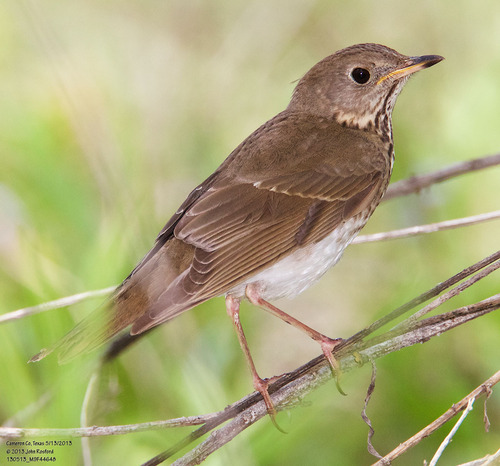
The wood thrush is a medium-sized thrush, with brown upper parts with mottled brown and white underparts. The male and female are similar in appearance. The song of the male is often cited as being the most beautiful in North America.

The wood thrush is an omnivore, and feeds preferentially on soil invertebrates and larvae, but will also eat fruits. In the summer, it feeds on insects continuously in order to meet daily metabolic needs. It is solitary, but sometimes forms mixed-species flocks. The wood thrush defends a territory that ranges in size from 800 to 28,000 m2 (960 to 33,490 sq yd). The wood thrush is monogamous, and its breeding season begins in the spring; about 50% of all mated pairs are able to raise two broods, ranging in size from two to four chicks.

The wood thrush was formally... Wikipedia →

Sounds

Alarm call0:14

Guatemala · 2024

© Brendan Sloan · XC1044899 · CC BY-NC-ND 4.0

Song0:44

United States · 2025

© Rory Nefdt · XC1001801 · CC BY-NC-SA 4.0

Call0:12

United States · 2023

© Richard E. Webster · XC827235 · CC BY-NC-SA 4.0

Global Distribution

Parks Where Found

# Park Country Daily sighting probability
1 Tikal National Park 🇬🇹 Guatemala
~50%
2 Cockscomb Basin Wildlife Sanctuary 🇧🇿 Belize
~40%
3 Pico Bonito National Park 🇭🇳 Honduras
~40%
4 Calakmul Biosphere Reserve 🇲🇽 Mexico
~30%
5 Point Pelee National Park 🇨🇦 Canada
~30%
6 Shenandoah National Park 🇺🇸 United States
~30%
7 Montes Azules Biosphere Reserve 🇲🇽 Mexico
~30%
8 Cerro Azul Meámbar National Park 🇭🇳 Honduras
~30%
9 Lago de Yojoa 🇭🇳 Honduras
~20%
10 Biotopo Cerro Cahuí 🇬🇹 Guatemala
~20%
11 Tenorio Volcano National Park 🇨🇷 Costa Rica
~20%
12 Sian Ka'an Biosphere Reserve 🇲🇽 Mexico
~20%
13 Great Smoky Mountains National Park 🇺🇸 United States
~20%
14 Arenal Volcano National Park 🇨🇷 Costa Rica
~10%
15 Cusuco National Park 🇭🇳 Honduras
~10%
16 Braulio Carrillo National Park 🇨🇷 Costa Rica
~10%
17 El Triunfo 🇲🇽 Mexico
~10%
18 La Tigra National Park 🇭🇳 Honduras
~10%
19 Rincón de la Vieja National Park 🇨🇷 Costa Rica
~10%
20 Poás Volcano National Park 🇨🇷 Costa Rica
~10%
21 Monteverde Cloud Forest Reserve 🇨🇷 Costa Rica
~10%
22 Voyageurs National Park 🇺🇸 United States
~10%
23 Cañón del Sumidero National Park 🇲🇽 Mexico
~10%
24 Congaree National Park 🇺🇸 United States
~10%
25 Carara National Park 🇨🇷 Costa Rica
<5%
26 Celaque National Park 🇭🇳 Honduras
<5%
27 Bastimentos Island National Marine Park 🇵🇦 Panama
<5%
28 Arrecifes de Cozumel National Park 🇲🇽 Mexico
<5%
29 Cabo Blanco Absolute Nature Reserve 🇨🇷 Costa Rica
<5%
30 La Amistad International Park (Panama) 🇵🇦 Panama
<5%
31 Acadia National Park 🇺🇸 United States
<5%
32 Chirripó National Park 🇨🇷 Costa Rica
<5%
33 Celestún Biosphere Reserve 🇲🇽 Mexico
<5%
34 Tortuguero National Park 🇨🇷 Costa Rica
<5%
35 Tapantí-Macizo de la Muerte National Park 🇨🇷 Costa Rica
<5%
36 Death Valley National Park 🇺🇸 United States
<5%
37 Los Quetzales National Park 🇨🇷 Costa Rica
<5%
38 Cahuita National Park 🇨🇷 Costa Rica
<5%
39 Corcovado National Park 🇨🇷 Costa Rica
<5%
40 Ciénaga de Zapata 🇨🇺 Cuba
<5%
41 Masaya Volcano National Park 🇳🇮 Nicaragua
<5%
42 Gandoca-Manzanillo Wildlife Refuge 🇨🇷 Costa Rica
<5%
43 Soberanía National Park 🇵🇦 Panama
<5%
44 Volcán Barú National Park 🇵🇦 Panama
<5%
45 Manuel Antonio National Park 🇨🇷 Costa Rica
<5%
46 Piedras Blancas National Park 🇨🇷 Costa Rica
<5%
47 Everglades National Park 🇺🇸 United States
<5%
48 Merritt Island National Wildlife Refuge 🇺🇸 United States
<5%

Cities Where Found

# City Country Daily sighting probability
1 Philadelphia 🇺🇸 United States
~10%
2 New York City 🇺🇸 United States
~10%
3 Washington 🇺🇸 United States
~10%
4 Baltimore 🇺🇸 United States
~10%
5 San Pedro Sula 🇭🇳 Honduras
<5%
6 Detroit 🇺🇸 United States
<5%
7 Chicago 🇺🇸 United States
<5%
8 Boston 🇺🇸 United States
<5%
9 Houston 🇺🇸 United States
<5%
10 Havana 🇨🇺 Cuba
<5%

Zoos & Centres Where Found

# Zoo / Centre Country
1 National Zoological Park 🇺🇸 United States In captivity
2 Columbus Zoo and Aquarium 🇺🇸 United States In captivity
3 Fort Worth Zoo 🇺🇸 United States In captivity
4 Parque museo La Venta 🇲🇽 Mexico In captivity
5 Florida Aquarium 🇺🇸 United States In captivity
6 Ralph Perkins II Wildlife Center and Woods Garden 🇺🇸 United States In captivity

Before you go

What are the chances of seeing a Wood Thrush in Orlando?

Rare

Under 5% of wildlife watchers report a Wood Thrush sighting in Orlando on a given day, based on 47 verified sightings from GBIF citizen-science data. It is the 155th most-seen of the 205 birds we can rate there. Over three days the chance rises to under 5%, if each day is a fresh chance.

When is the best time to see a Wood Thrush in Orlando?

Any time of year

In every month with enough records, under 5% of wildlife watchers report a Wood Thrush in Orlando on a given day, so our monthly data shows no clear season.

What time of day is best to see a Wood Thrush?

Between 8 and 11 am

Across all the parks we cover, that three-hour window holds the most Wood Thrush sightings with a recorded time, and about 8 in 10 of them come between 6 am and 6 pm: it is a daytime animal.

Is Orlando the best place to see a Wood Thrush?

18th of 23

Of the 23 cities where we can rate Wood Thrush sightings, Orlando ranks 18th at under 5%. The best odds are in Philadelphia (United States, about 10%), New York City (United States, about 10%) and Washington (United States, about 10%).

Which relatives of the Wood Thrush live in Orlando?

Same family: Turdidae

The closest relatives of the Wood Thrush that you can see in Orlando (family Turdidae, Thrushes) are American Robin (about 10%) and Eastern Bluebird (about 10%), with each one's daily chance of a sighting.

Where does the Wood Thrush sighting chance come from?

GBIF citizen-science records

It is estimated from how often the Wood Thrush is recorded against all the birds logged in Orlando (47 verified sightings), calibrated against known sighting rates. Figures are rounded to the nearest 10% because citizen-science data supports honest approximations, not decimals, and months with records from fewer than five people show "—". How it works.

← Back to Orlando