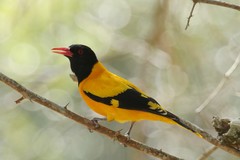
Black-hooded Oriole

Black-hooded Oriole

Oriolus xanthornus

Silhouette: PhyloPic

LCLeast ConcernNTVUENCR
Daily sighting probability <5% · Rare
at Vasai-Virar

In 3 days <5%

9 Verified sightings at Vasai-Virar
23,656 In all 24 parks From 2019 to 2026
June Best month
☀️ Diurnal When it's spotted

About the Black-hooded Oriole

The black-hooded oriole (Oriolus xanthornus) is a member of the oriole family of passerine birds and is a resident breeder in tropical southern Asia from India and Sri Lanka east to Indonesia. It is a bird of open woodland and cultivation. The nest is built in a tree, and contains two eggs. Its food is insects and fruit, especially figs, found in the tree canopies where they spend much of their time.

The black-hooded oriole was formally described by the Swedish naturalist Carl Linnaeus in 1758 in the tenth edition of his Systema Naturae under the binomial name Coracias xanthornus. Linnaeus was confused by the similar appearance of the unrelated New World orioles and the Old World orioles. In his entry for Coracias xanthornus he cited descriptions of birds occurring in Jamaica by Mark Catesby and Patrick Browne as well as an illustration by George Edwards of a bird occurring in Bengal. Linnaeus specified the habitat as "America" but Bengal is now the recognised type location. Also in the 10th edition Linnaeus listed Sturnus luteolus among the starlings and cited another illustration by Edwards. He renamed this species as Oriolus melanocephalus in the 12th... Wikipedia →

Sounds

Subsong0:55

Vietnam · 2026

© Ding Li Yong · XC1107588 · CC BY-NC-ND 4.0

Song0:12

China · 2023

© JJSUN · XC1079670 · CC BY-NC-SA 4.0

Call0:12

India · 2025

© Prakash · XC1057266 · CC BY-NC-SA 4.0

Global Distribution

Parks Where Found

# Park Country Daily sighting probability
1 Kanha National Park 🇮🇳 India
~70%
2 Royal Bardia National Park 🇳🇵 Nepal
~60%
3 Cat Tien National Park 🇻🇳 Vietnam
~60%
4 Wilpattu National Park 🇱🇰 Sri Lanka
~60%
5 Chitwan National Park 🇳🇵 Nepal
~60%
6 Bandhavgarh National Park 🇮🇳 India
~50%
7 Kaziranga National Park 🇮🇳 India
~50%
8 Udawalawe National Park 🇱🇰 Sri Lanka
~50%
9 Manas National Park 🇮🇳 India
~40%
10 Yala National Park 🇱🇰 Sri Lanka
~40%
11 Minneriya National Park 🇱🇰 Sri Lanka
~40%
12 Sinharaja Forest Reserve 🇱🇰 Sri Lanka
~40%
13 Jim Corbett National Park 🇮🇳 India
~40%
14 Satpura National Park 🇮🇳 India
~30%
15 Sundarbans National Park 🇮🇳 India
~20%
16 Mudumalai National Park 🇮🇳 India
~20%
17 Periyar National Park 🇮🇳 India
~20%
18 Bandipur National Park 🇮🇳 India
~20%
19 Nagarhole National Park 🇮🇳 India
~10%
20 Kaeng Krachan National Park 🇹🇭 Thailand
~10%
21 Namdapha National Park 🇮🇳 India
~10%
22 Doi Inthanon National Park 🇹🇭 Thailand
~10%
23 Royal Manas National Park 🇧🇹 Bhutan
~10%
24 Keoladeo National Park 🇮🇳 India
<5%

Cities Where Found

# City Country Daily sighting probability
1 Savar 🇧🇩 Bangladesh
~80%
2 Asansol 🇮🇳 India
~80%
3 Bhubaneshwar 🇮🇳 India
~70%
4 Tamluk 🇮🇳 India
~60%
5 Colombo [Sri Jayawardenepura Kotte] 🇱🇰 Sri Lanka
~60%
6 Dhaka 🇧🇩 Bangladesh
~60%
7 Thrissur 🇮🇳 India
~50%
8 Kolkata 🇮🇳 India
~50%
9 Guwahati 🇮🇳 India
~50%
10 Jabalpur 🇮🇳 India
~50%

Zoos & Centres Where Found

# Zoo / Centre Country
1 Vinpearl Safari 🇻🇳 Vietnam In captivity
2 Kadoorie Farm and Botanic Garden 🇭🇰 Hong Kong SAR China In captivity
3 Hong Kong Zoological and Botanical Gardens 🇨🇳 China In captivity
4 Edward Youde Aviary 🇭🇰 Hong Kong SAR China In captivity

Before you go

What are the chances of seeing a Black-hooded Oriole in Vasai-Virar?

Rare

Under 5% of wildlife watchers report a Black-hooded Oriole sighting in Vasai-Virar on a given day, based on 9 verified sightings from GBIF citizen-science data. It is the 200th most-seen of the 217 birds we can rate there. Over three days the chance rises to under 5%, if each day is a fresh chance.

When is the best time to see a Black-hooded Oriole in Vasai-Virar?

Any time of year

In every month with enough records, under 5% of wildlife watchers report a Black-hooded Oriole in Vasai-Virar on a given day, so our monthly data shows no clear season.

What time of day is best to see a Black-hooded Oriole?

Between 8 and 11 am

Across all the parks we cover, that three-hour window holds the most Black-hooded Oriole sightings with a recorded time, and about 9 in 10 of them come between 6 am and 6 pm: it is a daytime animal.

Is Vasai-Virar the best place to see a Black-hooded Oriole?

33rd of 37

Of the 37 cities where we can rate Black-hooded Oriole sightings, Vasai-Virar ranks 33rd at under 5%. The best odds are in Savar (Bangladesh, about 80%), Asansol (India, about 80%) and Bhubaneshwar (India, about 70%).

Where does the Black-hooded Oriole sighting chance come from?

GBIF citizen-science records

It is estimated from how often the Black-hooded Oriole is recorded against all the birds logged in Vasai-Virar (9 verified sightings), calibrated against known sighting rates. Figures are rounded to the nearest 10% because citizen-science data supports honest approximations, not decimals, and months with records from fewer than five people show "—". How it works.

← Back to Vasai-Virar