Blackpoll Warbler

Blackpoll Warbler

Setophaga striata

Silhouette: Ekytza · PhyloPic

LCNTNear ThreatenedVUENCR
Daily sighting probability <5% · Rare
at Arrecifes de Cozumel National Park

In 3 days <5%

8 Verified sightings at Arrecifes de Cozumel National Park From 2019 to 2026
5,201 In all 32 parks
April Best month
☀️ Diurnal When it's spotted

About the Blackpoll Warbler

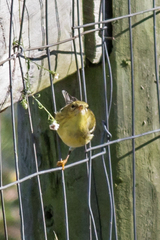
The blackpoll warbler (Setophaga striata) is a New World warbler. Breeding males are mostly black and white. They have a prominent black cap, white cheeks, and white wing bars. The blackpoll breeds in forests of northern North America, from Alaska throughout most of Canada, to the Adirondack Mountains of New York as well as New England in the Northeastern United States. They are a common migrant throughout much of North America. In fall, they fly south to the Greater Antilles and the northeastern coasts of South America in a non-stop long-distance migration over open water, averaging 2,500 km (1,600 mi), one of the longest-distance non-stop overwater flights ever recorded for a migratory songbird. Rare vagrants to western Europe, they are one of the more frequent transatlantic passerine wanderers.

The blackpoll warbler was formally described in 1772 by the German naturalist Johann Reinhold Forster based on specimens collected near the Severn River on the west coast of Hudson Bay in Ontario, Canada. Forster placed the species in the genus Muscicapa and coined the binomial name Muscicapa striata. The specific epithet is Latin meaning "striated". The blackpoll warbler is... Wikipedia →

Sounds

Song1:25

United States · 2021

© Christopher McPherson · XC690983 · CC BY-NC-SA 4.0

Call0:28

Portugal · 2017

© Marcin Sołowiej · XC390831 · CC BY-NC-SA 4.0

Alarm call0:58

Canada · 2016

© Lucas Berrigan · XC328835 · CC BY-NC-SA 4.0

Global Distribution

Parks Where Found

# Park Country Daily sighting probability
1 Gros Morne National Park 🇨🇦 Canada
~50%
2 Katmai National Park 🇺🇸 United States
~20%
3 Denali National Park 🇺🇸 United States
~20%
4 Point Pelee National Park 🇨🇦 Canada
~20%
5 Sierra de la Macarena National Park 🇨🇴 Colombia
~10%
6 Kluane National Park 🇨🇦 Canada
~10%
7 Henri Pittier National Park 🇻🇪 Venezuela
~10%
8 Riding Mountain National Park 🇨🇦 Canada
~10%
9 Wrangell-St. Elias National Park 🇺🇸 United States
~10%
10 Jasper National Park 🇨🇦 Canada
<5%
11 Yasuní National Park 🇪🇨 Ecuador
<5%
12 Isle Royale National Park 🇺🇸 United States
<5%
13 Shenandoah National Park 🇺🇸 United States
<5%
14 Acadia National Park 🇺🇸 United States
<5%
15 Everglades National Park 🇺🇸 United States
<5%
16 Banff National Park 🇨🇦 Canada
<5%
17 Voyageurs National Park 🇺🇸 United States
<5%
18 Cape Breton Highlands National Park 🇨🇦 Canada
<5%
19 Elk Island National Park 🇨🇦 Canada
<5%
20 Celestún Biosphere Reserve 🇲🇽 Mexico
<5%
21 Tayrona National Natural Park 🇨🇴 Colombia
<5%
22 Big Cypress National Preserve 🇺🇸 United States
<5%
23 Merritt Island National Wildlife Refuge 🇺🇸 United States
<5%
24 Ciénaga de Zapata 🇨🇺 Cuba
<5%
25 Great Smoky Mountains National Park 🇺🇸 United States
<5%
26 Chagres National Park 🇵🇦 Panama
<5%
27 Arrecifes de Cozumel National Park 🇲🇽 Mexico
<5%
28 Soberanía National Park 🇵🇦 Panama
<5%
29 Sian Ka'an Biosphere Reserve 🇲🇽 Mexico
<5%
30 Parque Natural Metropolitano 🇵🇦 Panama
<5%
31 Bastimentos Island National Marine Park 🇵🇦 Panama
<5%
32 La Amistad International Park (Panama) 🇵🇦 Panama
<5%

Cities Where Found

# City Country Daily sighting probability
1 Vitória 🇧🇷 Brazil
~10%
2 New York City 🇺🇸 United States
~10%
3 Chicago 🇺🇸 United States
~10%
4 Baltimore 🇺🇸 United States
~10%
5 Philadelphia 🇺🇸 United States
~10%
6 Boston 🇺🇸 United States
~10%
7 Washington 🇺🇸 United States
<5%
8 Miami 🇺🇸 United States
<5%
9 Minneapolis [Saint Paul] 🇺🇸 United States
<5%
10 Montreal 🇨🇦 Canada
<5%

Zoos & Centres Where Found

# Zoo / Centre Country
1 Ralph Perkins II Wildlife Center and Woods Garden 🇺🇸 United States In captivity

Before you go

What are the chances of seeing a Blackpoll Warbler in Arrecifes de Cozumel National Park?

Rare

Under 5% of wildlife watchers report a Blackpoll Warbler sighting in Arrecifes de Cozumel National Park on a given day, based on 8 verified sightings from GBIF citizen-science data from 2019 to 2026. It is the 190th most-seen of the 205 birds we can rate there. Over three days the chance rises to under 5%, if each day is a fresh chance.

When is the best time to see a Blackpoll Warbler in Arrecifes de Cozumel National Park?

Any time of year

In every month with enough records, under 5% of wildlife watchers report a Blackpoll Warbler in Arrecifes de Cozumel National Park on a given day, so our monthly data shows no clear season.

What time of day is best to see a Blackpoll Warbler?

Between 8 and 11 am

Across all the parks we cover, that three-hour window holds the most Blackpoll Warbler sightings with a recorded time, and about 9 in 10 of them come between 6 am and 6 pm: it is a daytime animal.

Which relatives of the Blackpoll Warbler live in Arrecifes de Cozumel National Park?

Same genus: Setophaga

The closest relatives of the Blackpoll Warbler that you can see in Arrecifes de Cozumel National Park (genus Setophaga, Setophaga Warblers) are Yellow Warbler (about 80%), American Redstart (about 60%) and Palm Warbler (about 50%), with each one's daily chance of a sighting.

Where does the Blackpoll Warbler sighting chance come from?

GBIF citizen-science records

It is estimated from how often the Blackpoll Warbler is recorded against all the birds logged in Arrecifes de Cozumel National Park (8 verified sightings from 2019 to 2026), calibrated against known sighting rates. Figures are rounded to the nearest 10% because citizen-science data supports honest approximations, not decimals, and months with records from fewer than five people show "—". How it works.

← Back to Arrecifes de Cozumel National Park