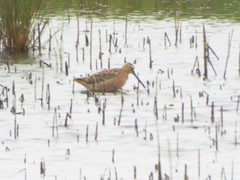
Short-billed Dowitcher

Short-billed Dowitcher

Limnodromus griseus

Silhouette: Sheatherius · PhyloPic

LCNTVUVulnerableENCR
Daily sighting probability ~20% · Possible
at Isla del Coco National Park

In 3 days ~60% in a week ~80%

60 Verified sightings at Isla del Coco National Park From 2019 to 2026
4,144 In all 32 parks
September Best month
☀️ Diurnal When it's spotted

About the Short-billed Dowitcher

The short-billed dowitcher (Limnodromus griseus), like its congener, the long-billed dowitcher, is a medium-sized, stocky, long-billed shorebird in the family Scolopacidae. It is an inhabitant of North America, Central America, the Caribbean, and northern South America. It is strongly migratory; it completely vacates its breeding areas during the snow-bound months. This species favors a variety of habitats, including tundra in the north to ponds and mudflats in the south. It feeds on invertebrates often by rapidly probing its bill into mud in a sewing machine fashion. It and the very similar long-billed dowitcher were considered one species until 1950. Field identification of the two American Limnodromus remains difficult today. Distinguishing wintering or juvenile short-billed dowitchers from the long-billed species is very difficult and, even given examination of their subtlety different body shapes, cannot always be isolated to a particular species. They differ most substantially in vocalizations. The names of American dowitchers are misleading, as there is much overlap in their bill lengths. Only a small percentage can be identified by this character alone.

The short... Wikipedia →

Sounds

Call0:04

United States · 2021

© Paul Driver · XC651127 · CC BY-NC-SA 4.0

Alarm call0:40

United States · 2015

© Garrett MacDonald · XC283633 · CC BY-NC-SA 4.0

Flight call0:07

United States · 2013

© Paul Marvin · XC143728 · CC BY-NC-SA 3.0

Global Distribution

Parks Where Found

# Park Country Daily sighting probability
1 El Vizcaíno Biosphere Reserve 🇲🇽 Mexico
~30%
2 Ría Lagartos Biosphere Reserve 🇲🇽 Mexico
~20%
3 Isla del Coco National Park 🇨🇷 Costa Rica
~20%
4 Ciénaga de Zapata 🇨🇺 Cuba
~20%
5 Katmai National Park 🇺🇸 United States
~10%
6 Merritt Island National Wildlife Refuge 🇺🇸 United States
~10%
7 Arrecifes de Cozumel National Park 🇲🇽 Mexico
~10%
8 Pacific Rim National Park Reserve 🇨🇦 Canada
~10%
9 Everglades National Park 🇺🇸 United States
~10%
10 Jaragua National Park 🇩🇴 Dominican Republic
~10%
11 Caroni Swamp 🇹🇹 Trinidad and Tobago
<5%
12 Celestún Biosphere Reserve 🇲🇽 Mexico
<5%
13 Bastimentos Island National Marine Park 🇵🇦 Panama
<5%
14 Carara National Park 🇨🇷 Costa Rica
<5%
15 Channel Islands National Park 🇺🇸 United States
<5%
16 Coiba National Park 🇵🇦 Panama
<5%
17 Palo Verde National Park 🇨🇷 Costa Rica
<5%
18 Point Pelee National Park 🇨🇦 Canada
<5%
19 Padre Island National Seashore 🇺🇸 United States
<5%
20 La Amistad International Park (Panama) 🇵🇦 Panama
<5%
21 Piedras Blancas National Park 🇨🇷 Costa Rica
<5%
22 Great Bear Rainforest 🇨🇦 Canada
<5%
23 Santa Rosa National Park 🇨🇷 Costa Rica
<5%
24 Gandoca-Manzanillo Wildlife Refuge 🇨🇷 Costa Rica
<5%
25 Big Cypress National Preserve 🇺🇸 United States
<5%
26 Bahía de Loreto National Park 🇲🇽 Mexico
<5%
27 Sian Ka'an Biosphere Reserve 🇲🇽 Mexico
<5%
28 Acadia National Park 🇺🇸 United States
<5%
29 Olympic National Park 🇺🇸 United States
<5%
30 Redwood National Park 🇺🇸 United States
<5%
31 Galápagos Islands 🇪🇨 Ecuador
<5%
32 Parque Natural Metropolitano 🇵🇦 Panama
<5%

Cities Where Found

# City Country Daily sighting probability
1 Panama City 🇵🇦 Panama
~20%
2 Havana 🇨🇺 Cuba
~10%
3 Anchorage 🇺🇸 United States
~10%
4 San Diego 🇺🇸 United States
~10%
5 San Francisco 🇺🇸 United States
<5%
6 Los Angeles 🇺🇸 United States
<5%
7 New York City 🇺🇸 United States
<5%
8 Boston 🇺🇸 United States
<5%
9 Miami 🇺🇸 United States
<5%
10 Chicago 🇺🇸 United States
<5%

Zoos & Centres Where Found

# Zoo / Centre Country
1 National Zoological Park 🇺🇸 United States In captivity

Before you go

What are the chances of seeing a Short-billed Dowitcher in Isla del Coco National Park?

Possible

About 20% of wildlife watchers report a Short-billed Dowitcher sighting in Isla del Coco National Park on a given day, based on 60 verified sightings from GBIF citizen-science data from 2019 to 2026. It is the 29th most-seen of the 69 birds we can rate there. Over three days the chance rises to about 60%, and over a week to about 80%, if each day is a fresh chance.

When is the best time to see a Short-billed Dowitcher in Isla del Coco National Park?

September

In that month about 70% of wildlife watchers report a Short-billed Dowitcher in Isla del Coco National Park on a given day, against under 5% in November, the lowest month. May and July–August have too few records to rate.

What time of day is best to see a Short-billed Dowitcher?

Between noon and 3 pm

Across all the parks we cover, that three-hour window holds the most Short-billed Dowitcher sightings with a recorded time, and nearly all of them come between 6 am and 6 pm: it is a daytime animal.

Is Isla del Coco National Park the best place to see a Short-billed Dowitcher?

3rd of 32

Of the 32 parks where we can rate Short-billed Dowitcher sightings, Isla del Coco National Park ranks 3rd at about 20%. The best odds are in El Vizcaíno Biosphere Reserve (Mexico, about 30%) and Ría Lagartos Biosphere Reserve (Mexico, about 20%).

Which relatives of the Short-billed Dowitcher live in Isla del Coco National Park?

Same family: Scolopacidae

The closest relatives of the Short-billed Dowitcher that you can see in Isla del Coco National Park (family Scolopacidae, Sandpipers and Allies) are Whimbrel (about 80%), Wandering Tattler (about 50%) and Spotted Sandpiper (about 40%), with each one's daily chance of a sighting.

Where does the Short-billed Dowitcher sighting chance come from?

GBIF citizen-science records

It is estimated from how often the Short-billed Dowitcher is recorded against all the birds logged in Isla del Coco National Park (60 verified sightings from 2019 to 2026), calibrated against known sighting rates. Figures are rounded to the nearest 10% because citizen-science data supports honest approximations, not decimals, and months with records from fewer than five people show "—". How it works.

← Back to Isla del Coco National Park