Brown Boobook

Brown Boobook

Ninox scutulata

Silhouette: Rachel T Mason · PhyloPic

LCLeast ConcernNTVUENCR
Daily sighting probability ~10% · With luck
at Kanha National Park

In 3 days ~20% in a week ~50%

732 Verified sightings at Kanha National Park From 2019 to 2026
3,246 In all 25 parks
February Best month
🌅 Crepuscular When it's spotted

About the Brown Boobook

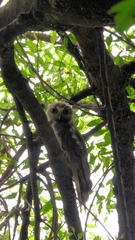
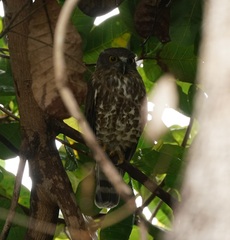
The brown boobook (Ninox scutulata), also known as the brown hawk-owl, is a typical owl species. It has dark brown upperparts, whitish underparts with reddish-brown streaking, and a barred tail. It is a resident breeder in India, Nepal, Bangladesh, Bhutan, Sri Lanka, southern China and western Indonesia.

The brown boobook was formally described in 1822 by Stamford Raffles from a specimen collected in Sumatra under the binomial name Strix scutulata. The specific epithet is from Latin scutulatus meaning "diamond-shaped". The brown boobook is now placed with the other boobooks in the genus Ninox that was introduced by Brian Houghton Hodgson in 1837.

Nine subspecies are recognised: N. s. burmanica Hume, 1876in northeast India to south China, Indochina and Thailand Wikipedia →

Sounds

Song1:04

Malaysia · 2026

© Ding Li Yong · XC1077757 · CC BY-NC-ND 4.0

Call0:20

China · 2024

© Dave GUO · XC973784 · CC BY-NC-SA 4.0

Duet0:43

Malaysia · 2024

© Lim Ying Hien · XC950688 · CC BY-NC-ND 4.0

Global Distribution

Parks Where Found

# Park Country Daily sighting probability
1 Way Kambas National Park 🇮🇩 Indonesia
~30%
2 Periyar National Park 🇮🇳 India
~20%
3 Cat Tien National Park 🇻🇳 Vietnam
~10%
4 Kaeng Krachan National Park 🇹🇭 Thailand
~10%
5 Kanha National Park 🇮🇳 India
~10%
6 Khao Yai National Park 🇹🇭 Thailand
~10%
7 Manas National Park 🇮🇳 India
~10%
8 Namdapha National Park 🇮🇳 India
~10%
9 Chitwan National Park 🇳🇵 Nepal
~10%
10 Taman Negara National Park 🇲🇾 Malaysia
<5%
11 Sepilok 🇲🇾 Malaysia
<5%
12 Cuc Phuong National Park 🇻🇳 Vietnam
<5%
13 Jim Corbett National Park 🇮🇳 India
<5%
14 Royal Manas National Park 🇧🇹 Bhutan
<5%
15 Sinharaja Forest Reserve 🇱🇰 Sri Lanka
<5%
16 Kinabatangan Wildlife Sanctuary 🇲🇾 Malaysia
<5%
17 Royal Bardia National Park 🇳🇵 Nepal
<5%
18 Doi Inthanon National Park 🇹🇭 Thailand
<5%
19 Kaziranga National Park 🇮🇳 India
<5%
20 Wilpattu National Park 🇱🇰 Sri Lanka
<5%
21 Danum Valley Conservation Area 🇲🇾 Malaysia
<5%
22 Nagarhole National Park 🇮🇳 India
<5%
23 Khao Luang National Park 🇹🇭 Thailand
<5%
24 Keoladeo National Park 🇮🇳 India
<5%
25 Bandipur National Park 🇮🇳 India
<5%

Cities Where Found

# City Country Daily sighting probability
1 Kollam 🇮🇳 India
~10%
2 Savar 🇧🇩 Bangladesh
~10%
3 Bangkok 🇹🇭 Thailand
<5%
4 Thiruvananthapuram 🇮🇳 India
<5%
5 Dehradun 🇮🇳 India
<5%
6 Dhaka 🇧🇩 Bangladesh
<5%
7 Jaipur 🇮🇳 India
<5%
8 Jabalpur 🇮🇳 India
<5%
9 Colombo [Sri Jayawardenepura Kotte] 🇱🇰 Sri Lanka
<5%
10 Thrissur 🇮🇳 India
<5%

Before you go

What are the chances of seeing a Brown Boobook in Kanha National Park?

With luck

About 10% of wildlife watchers report a Brown Boobook sighting in Kanha National Park on a given day, based on 732 verified sightings from GBIF citizen-science data from 2019 to 2026. It is the 107th most-seen of the 286 birds we can rate there. Over three days the chance rises to about 20%, and over a week to about 50%, if each day is a fresh chance.

When is the best time to see a Brown Boobook in Kanha National Park?

February

In that month about 20% of wildlife watchers report a Brown Boobook in Kanha National Park on a given day, against under 5% in July to December, the lowest months. That is one of Kanha National Park's driest months, with about 15 mm of rain against 430 mm in July.

What time of day is best to see a Brown Boobook?

Between 3 and 6 am

Across all the parks we cover, that three-hour window holds the most Brown Boobook sightings with a recorded time, and about 6 in 10 of them come between 6 am and 6 pm: it is most active around dawn and dusk.

Which relatives of the Brown Boobook live in Kanha National Park?

Same family: Strigidae

The closest relatives of the Brown Boobook that you can see in Kanha National Park (family Strigidae, Typical Owls) are Jungle Owlet (about 60%), Spotted Owlet (about 20%) and Indian Scops-Owl (about 10%), with each one's daily chance of a sighting.

Where does the Brown Boobook sighting chance come from?

GBIF citizen-science records

It is estimated from how often the Brown Boobook is recorded against all the birds logged in Kanha National Park (732 verified sightings from 2019 to 2026), calibrated against known sighting rates. Figures are rounded to the nearest 10% because citizen-science data supports honest approximations, not decimals, and months with records from fewer than five people show "—". How it works.

← Back to Kanha National Park