

Asian Woolly-necked Stork

Asian Woolly-necked Stork

Ciconia episcopus

Silhouette: L. Shyamal · PhyloPic

LCNTNear ThreatenedVUENCR
Daily sighting probability ~30% · Possible
at Keoladeo National Park

In 3 days ~70% in a week ~90%

718 Verified sightings at Keoladeo National Park From 2019 to 2026
6,843 In all 22 parks
May Best month
☀️ Diurnal When it's spotted

About the Asian Woolly-necked Stork

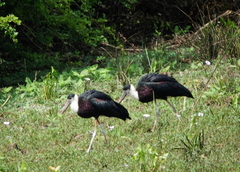
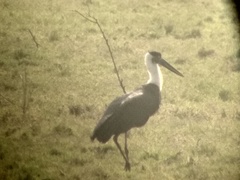
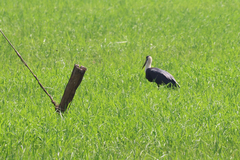
The Asian woolly-necked stork or Asian woollyneck (Ciconia episcopus) is a species of large wading bird in the stork family Ciconiidae. It breeds singly, or in small loose colonies. It is distributed in a wide variety of habitats including marshes in forests, agricultural areas, and freshwater wetlands across Asia.

The woolly-necked stork was described by the French polymath Georges-Louis Leclerc, Comte de Buffon in 1780 in his Histoire Naturelle des Oiseaux from a specimen collected from the Coromandel Coast of India. The bird was also illustrated in a hand-coloured plate engraved by François-Nicolas Martinet in the Planches Enluminées D'Histoire Naturelle which was produced under the supervision of Edme-Louis Daubenton to accompany Buffon's text. Neither the plate caption nor Buffon's description included a scientific name but in 1783 the Dutch naturalist Pieter Boddaert coined the binomial name Ardea episcopus in his catalogue of the Planches Enluminées. The woolly-necked stork is now placed in the genus Ciconia that was erected by the French zoologist Mathurin Jacques Brisson in 1760. The genus name Ciconia is the Latin word for a "stork"; the specific epithet episcopus... Wikipedia →

Sounds

Aberrant0:22

India · 2025

© Sreekumar Chirukandoth · XC1068686 · CC BY-NC-SA 4.0

Global Distribution

Parks Where Found

# Park Country Daily sighting probability
1 Kaziranga National Park 🇮🇳 India
~60%
2 Wilpattu National Park 🇱🇰 Sri Lanka
~60%
3 Royal Bardia National Park 🇳🇵 Nepal
~40%
4 Ranthambore National Park 🇮🇳 India
~40%
5 Keoladeo National Park 🇮🇳 India
~30%
6 Minneriya National Park 🇱🇰 Sri Lanka
~30%
7 Satpura National Park 🇮🇳 India
~30%
8 Udawalawe National Park 🇱🇰 Sri Lanka
~30%
9 Chitwan National Park 🇳🇵 Nepal
~30%
10 Yala National Park 🇱🇰 Sri Lanka
~30%
11 Mudumalai National Park 🇮🇳 India
~20%
12 Bandhavgarh National Park 🇮🇳 India
~20%
13 Nagarhole National Park 🇮🇳 India
~20%
14 Periyar National Park 🇮🇳 India
~20%
15 Gir National Park 🇮🇳 India
~20%
16 Bandipur National Park 🇮🇳 India
~10%
17 Cat Tien National Park 🇻🇳 Vietnam
~10%
18 Jim Corbett National Park 🇮🇳 India
~10%
19 Bali Barat National Park 🇮🇩 Indonesia
<5%
20 Sinharaja Forest Reserve 🇱🇰 Sri Lanka
<5%
21 Kanha National Park 🇮🇳 India
<5%
22 Manas National Park 🇮🇳 India
<5%

Cities Where Found

# City Country Daily sighting probability
1 Ponnani 🇮🇳 India
~30%
2 Agra 🇮🇳 India
~20%
3 Thrissur 🇮🇳 India
~20%
4 Bhopal 🇮🇳 India
~10%
5 Kota 🇮🇳 India
~10%
6 Chhatrapati Sambhajinagar 🇮🇳 India
~10%
7 Kalyan-Dombivli 🇮🇳 India
~10%
8 Vasai-Virar 🇮🇳 India
~10%
9 Solapur 🇮🇳 India
<5%
10 Kozhikode 🇮🇳 India
<5%

Zoos & Centres Where Found

# Zoo / Centre Country
1 Planckendael Zoo 🇧🇪 Belgium In captivity
2 Saigon Zoo and Botanical Gardens 🇻🇳 Vietnam In captivity
3 Bandung Zoo 🇮🇩 Indonesia In captivity
4 Tier- und Freizeitpark Thüle 🇩🇪 Germany In captivity
5 Thrissur Zoo 🇮🇳 India In captivity
6 Rákosův pavilon 🇨🇿 Czechia In captivity
7 Mořský svět 🇨🇿 Czechia In captivity
8 Wolfgang-Köhler-Primaten-Forschungszentrum 🇩🇪 Germany In captivity

Before you go

What are the chances of seeing an Asian Woolly-necked Stork in Keoladeo National Park?

Possible

About 30% of wildlife watchers report an Asian Woolly-necked Stork sighting in Keoladeo National Park on a given day, based on 718 verified sightings from GBIF citizen-science data from 2019 to 2026. It is the 84th most-seen of the 278 birds we can rate there. Over three days the chance rises to about 70%, and over a week to about 90%, if each day is a fresh chance.

When is the best time to see an Asian Woolly-necked Stork in Keoladeo National Park?

May

In that month about 60% of wildlife watchers report an Asian Woolly-necked Stork in Keoladeo National Park on a given day, against about 20% in January and March, the lowest months. That is one of Keoladeo National Park's driest months, with about 20 mm of rain against 240 mm in July.

What time of day is best to see an Asian Woolly-necked Stork?

Between 9 am and noon

Across all the parks we cover, that three-hour window holds the most Asian Woolly-necked Stork sightings with a recorded time, and about 9 in 10 of them come between 6 am and 6 pm: it is a daytime animal.

Where does the Asian Woolly-necked Stork sighting chance come from?

GBIF citizen-science records

It is estimated from how often the Asian Woolly-necked Stork is recorded against all the birds logged in Keoladeo National Park (718 verified sightings from 2019 to 2026), calibrated against known sighting rates. Figures are rounded to the nearest 10% because citizen-science data supports honest approximations, not decimals, and months with records from fewer than five people show "—". How it works.

← Back to Keoladeo National Park