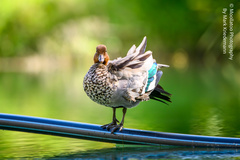
Australian Wood Duck

Australian Wood Duck

Chenonetta jubata

Silhouette: Michael Scroggie · PhyloPic

LCLeast ConcernNTVUENCR Endemic
Daily sighting probability <5% · Rare
at Lamington National Park

In 3 days ~10% in a week ~20%

109 Verified sightings at Lamington National Park From 2019 to 2026
5,369 In all 13 parks
July Best month
☀️ Diurnal When it's spotted

About the Australian Wood Duck

The Australian wood duck, maned duck, or maned goose (Chenonetta jubata) is a dabbling duck found throughout much of Australia. It is the only living species in the genus Chenonetta. The Australian wood duck was first described by English ornithologist John Latham in 1801 under the binomial name Anas jubata.

It had been associated with the ringed teal as possibly its closest living relative, but more detailed recent genetic evidence points to it belonging to an early clade of diving ducks, with its closest relatives being blue duck (Hymenolaimus malacorhynchos) in New Zealand and the pantropical comb ducks (Sarkidiornis), and with these next closest to a group including Hartlaub's duck (Pteronetta hartlaubii), blue-winged goose (Cyanochen cyanoptera), marbled duck (Marmaronetta angustirostris), white-winged duck (Asarcornis scutulata), and the widespread genera Netta and Aythya.

The extinct, flightless New Zealand species Chenonetta finschi (Finsch's duck) which was formerly believed to constitute a monotypic genus (Euryanas) has been determined to belong to Chenonetta. It became extinct before scientists could properly survey the New Zealand avifauna, but possibly as... Wikipedia →

Sounds

Call0:51

Australia · 2024

© Romuald Mikusek · XC1172787 · CC BY-NC-SA 4.0

Song0:32

Australia · 2022

© nick talbot · XC716431 · CC BY-NC-SA 4.0

Call0:20

Australia · 2026

© Nick Talbot · XC1137129 · CC BY-NC-SA 4.0

Global Distribution

Parks Where Found

# Park Country Daily sighting probability
1 Royal National Park 🇦🇺 Australia
~50%
2 Wilsons Promontory National Park 🇦🇺 Australia
~50%
3 Grampians National Park 🇦🇺 Australia
~40%
4 Kosciuszko National Park 🇦🇺 Australia
~40%
5 Great Otway National Park 🇦🇺 Australia
~30%
6 Hattah-Kulkyne National Park 🇦🇺 Australia
~30%
7 Booderee National Park 🇦🇺 Australia
~20%
8 Blue Mountains National Park 🇦🇺 Australia
~20%
9 Flinders Ranges National Park 🇦🇺 Australia
~10%
10 Springbrook National Park 🇦🇺 Australia
~10%
11 Lamington National Park 🇦🇺 Australia
<5%
12 Maria Island National Park 🇦🇺 Australia
<5%
13 Kakadu National Park 🇦🇺 Australia
<5%

Cities Where Found

# City Country Daily sighting probability
1 Perth 🇦🇺 Australia
~50%
2 Melbourne 🇦🇺 Australia
~40%
3 Brisbane 🇦🇺 Australia
~40%
4 Sydney 🇦🇺 Australia
~30%
5 Hobart 🇦🇺 Australia
~10%
6 Warsaw 🇵🇱 Poland
<5%

Zoos & Centres Where Found

# Zoo / Centre Country
1 Disney's Animal Kingdom 🇺🇸 United States In captivity
2 Tierpark Berlin 🇩🇪 Germany In captivity
3 Cincinnati Zoo and Botanical Garden 🇺🇸 United States In captivity
4 Australia Zoo 🇦🇺 Australia In captivity
5 San Diego Zoo Safari Park 🇺🇸 United States In captivity
6 Sedgwick County Zoo 🇺🇸 United States In captivity
7 Omaha’s Henry Doorly Zoo and Aquarium 🇺🇸 United States In captivity
8 Slimbridge Wetland Centre 🇬🇧 United Kingdom In captivity
9 Parc animalier de Gramat 🇫🇷 France In captivity
10 Hellabrunn Zoo 🇩🇪 Germany In captivity
11 Oasis Park 🇪🇸 Spain In captivity
12 Dierenpark Hoenderdaell 🇳🇱 Netherlands In captivity
13 Franklin Park Zoo 🇺🇸 United States In captivity
14 Singapore Zoo 🇸🇬 Singapore In captivity
15 Cleland Wildlife Park 🇦🇺 Australia In captivity
16 Blank Park Zoo 🇺🇸 United States In captivity
17 Lone Pine Koala Sanctuary 🇦🇺 Australia In captivity
18 Budapest Zoo & Botanical Garden 🇭🇺 Hungary In captivity
19 Bird Paradise 🇸🇬 Singapore In captivity
20 Cleres Zoological Park 🇫🇷 France In captivity
21 Rainforest Wild Asia 🇸🇬 Singapore In captivity
22 Vogelpark Avifauna 🇳🇱 Netherlands In captivity
23 Monkeyland 🇿🇦 South Africa In captivity
24 Van Blanckendaell Park 🇳🇱 Netherlands In captivity
25 Tamworth Marsupial Park & Adventure Playground 🇦🇺 Australia In captivity
26 Ellen Trout Zoo 🇺🇸 United States In captivity
27 Featherdale Sydney Wildlife Park 🇦🇺 Australia In captivity
28 Birds of Eden 🇿🇦 South Africa In captivity
29 Ipswich Nature Centre 🇦🇺 Australia In captivity
30 Caversham Wildlife Park 🇦🇺 Australia In captivity
31 Domaine des Oiseaux 🇫🇷 France In captivity
32 Margitszigeti Kisállatkert 🇭🇺 Hungary In captivity
33 Pantropica 🇳🇱 Netherlands In captivity
34 Zoo Schlichtweg 11 in München 🇩🇪 Germany In captivity
35 Zoo Siebenbrunner Straße 6 in München 🇩🇪 Germany In captivity

Before you go

What are the chances of seeing an Australian Wood Duck in Lamington National Park?

Rare

Under 5% of wildlife watchers report an Australian Wood Duck sighting in Lamington National Park on a given day, based on 109 verified sightings from GBIF citizen-science data from 2019 to 2026. It is the 91st most-seen of the 171 birds we can rate there. Over three days the chance rises to about 10%, and over a week to about 20%, if each day is a fresh chance.

When is the best time to see an Australian Wood Duck in Lamington National Park?

May to July

In those months about 10% of wildlife watchers report an Australian Wood Duck in Lamington National Park on a given day, against under 5% in August to April, the lowest months. Those are among Lamington National Park's driest months, with about 55 mm of rain a month against 160 mm in February.

What time of day is best to see an Australian Wood Duck?

Between 1 and 4 pm

Across all the parks we cover, that three-hour window holds the most Australian Wood Duck sightings with a recorded time, and nearly all of them come between 6 am and 6 pm: it is a daytime animal.

Where does the Australian Wood Duck sighting chance come from?

GBIF citizen-science records

It is estimated from how often the Australian Wood Duck is recorded against all the birds logged in Lamington National Park (109 verified sightings from 2019 to 2026), calibrated against known sighting rates. Figures are rounded to the nearest 10% because citizen-science data supports honest approximations, not decimals, and months with records from fewer than five people show "—". How it works.

← Back to Lamington National Park