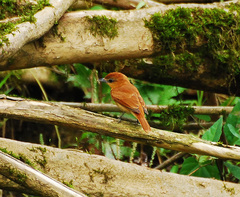

Cinnamon Becard

Cinnamon Becard

Pachyramphus cinnamomeus

Silhouette: Sheatherius · PhyloPic

LCLeast ConcernNTVUENCR
Daily sighting probability ~10% · With luck
at Gandoca-Manzanillo Wildlife Refuge

In 3 days ~40% in a week ~70%

221 Verified sightings at Gandoca-Manzanillo Wildlife Refuge From 2019 to 2026
7,577 In all 23 parks
July Best month
☀️ Diurnal When it's spotted

About the Cinnamon Becard

The cinnamon becard (Pachyramphus cinnamomeus) is a passerine bird in the family Tityridae, the tityras, becards, and allies. It is found in Mexico, in every Central American country except El Salvador, and in Colombia, Ecuador, and Venezuela.

The genus Pachyramphus has variously been assigned to the tyrant flycatcher family Tyrannidae and the cotinga family Cotingidae. Several early twenty-first century studies confirmed the placement of Pachyramphus in Tityridae and taxonomic systems made the reassignment. In 1998 the American Ornithological Society was unsure where to place the genus and listed its members as incertae sedis but in 2011 moved them to Tityridae. In 1998 the American Ornithological Society was unsure where to place the genus and listed its members as incertae sedis but in 2011 moved them to Tityridae.

The cinnamon becard and the chestnut-crowned becard (P. castaneus) are sister species and form a superspecies. The cinnamon becard has these four subspecies: Wikipedia →

Sounds

Call1:24

Ecuador · 2023

© Manuel Sanchez-Nivicela · XC993669 · CC BY-NC-ND 4.0

Song0:26

Ecuador · 1996

© Patricio Mena Valenzuela · XC275485 · CC BY-NC-SA 4.0

Call0:16

Panama · 2019

© Jerome Fischer · XC454263 · CC BY-NC-SA 4.0

Global Distribution

Parks Where Found

# Park Country Daily sighting probability
1 Braulio Carrillo National Park 🇨🇷 Costa Rica
~20%
2 Arenal Volcano National Park 🇨🇷 Costa Rica
~20%
3 Tenorio Volcano National Park 🇨🇷 Costa Rica
~10%
4 Gandoca-Manzanillo Wildlife Refuge 🇨🇷 Costa Rica
~10%
5 San Lorenzo Protected Forest 🇵🇦 Panama
~10%
6 Tortuguero National Park 🇨🇷 Costa Rica
~10%
7 Darién National Park 🇵🇦 Panama
~10%
8 Montes Azules Biosphere Reserve 🇲🇽 Mexico
~10%
9 Soberanía National Park 🇵🇦 Panama
~10%
10 Utría National Natural Park 🇨🇴 Colombia
~10%
11 La Amistad International Park (Panama) 🇵🇦 Panama
~10%
12 Cockscomb Basin Wildlife Sanctuary 🇧🇿 Belize
~10%
13 Farallones de Cali National Natural Park 🇨🇴 Colombia
~10%
14 Cahuita National Park 🇨🇷 Costa Rica
~10%
15 Tapantí-Macizo de la Muerte National Park 🇨🇷 Costa Rica
<5%
16 Carara National Park 🇨🇷 Costa Rica
<5%
17 Corcovado National Park 🇨🇷 Costa Rica
<5%
18 Bastimentos Island National Marine Park 🇵🇦 Panama
<5%
19 Marino Ballena National Park 🇨🇷 Costa Rica
<5%
20 Piedras Blancas National Park 🇨🇷 Costa Rica
<5%
21 Tayrona National Natural Park 🇨🇴 Colombia
<5%
22 Poás Volcano National Park 🇨🇷 Costa Rica
<5%
23 Monteverde Cloud Forest Reserve 🇨🇷 Costa Rica
<5%

Cities Where Found

# City Country Daily sighting probability
1 Cali 🇨🇴 Colombia
<5%

Before you go

What are the chances of seeing a Cinnamon Becard in Gandoca-Manzanillo Wildlife Refuge?

With luck

About 10% of wildlife watchers report a Cinnamon Becard sighting in Gandoca-Manzanillo Wildlife Refuge on a given day, based on 221 verified sightings from GBIF citizen-science data from 2019 to 2026. It is the 87th most-seen of the 329 birds we can rate there. Over three days the chance rises to about 40%, and over a week to about 70%, if each day is a fresh chance.

When is the best time to see a Cinnamon Becard in Gandoca-Manzanillo Wildlife Refuge?

June and July

In those months about 30% of wildlife watchers report a Cinnamon Becard in Gandoca-Manzanillo Wildlife Refuge on a given day, against under 5% in December, the lowest month. Those are among Gandoca-Manzanillo Wildlife Refuge's wettest months, with about 480 mm of rain a month against 140 mm in March.

What time of day is best to see a Cinnamon Becard?

Between 10 am and 1 pm

Across all the parks we cover, that three-hour window holds the most Cinnamon Becard sightings with a recorded time, and about 9 in 10 of them come between 6 am and 6 pm: it is a daytime animal.

Where does the Cinnamon Becard sighting chance come from?

GBIF citizen-science records

It is estimated from how often the Cinnamon Becard is recorded against all the birds logged in Gandoca-Manzanillo Wildlife Refuge (221 verified sightings from 2019 to 2026), calibrated against known sighting rates. Figures are rounded to the nearest 10% because citizen-science data supports honest approximations, not decimals, and months with records from fewer than five people show "—". How it works.

← Back to Gandoca-Manzanillo Wildlife Refuge