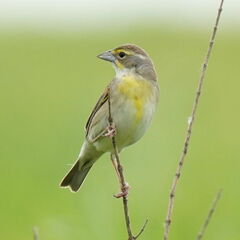
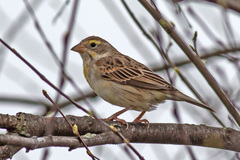
Dickcissel

Dickcissel

Spiza americana

Silhouette: Sheatherius · PhyloPic

LCLeast ConcernNTVUENCR
Daily sighting probability ~10% · With luck
at Gandoca-Manzanillo Wildlife Refuge

In 3 days ~20% in a week ~30%

100 Verified sightings at Gandoca-Manzanillo Wildlife Refuge From 2019 to 2026
1,602 In all 30 parks
October Best month
☀️ Diurnal When it's spotted

About the Dickcissel

The dickcissel (Spiza americana) is a small seed-eating migratory bird in the family Cardinalidae. It breeds on the prairie grasslands of the Midwestern United States and winters in Central America, northern Colombia, and northern Venezuela. It is the only member of the genus Spiza, though some sources list another supposedly extinct species.

The dickcissel was formally described in 1789 by German naturalist Johann Friedrich Gmelin under the binomial name Emberiza americana. Gmelin based his account on the "black-throated bunting" that the Welsh naturalist Thomas Pennant had described and illustrated in 1785 in his Arctic Zoology. The dickcissel is now the only species placed in the genus Spiza that was introduced in 1824 by French naturalist Charles Lucien Bonaparte. The genus name Spiza is the Ancient Greek word for a common type of finch, now assumed to be a chaffinch. The species is monotypic; no subspecies are recognised.

The dickcissel is part of a group of the Cardinalidae that also includes Amaurospiza, Cyanocompsa, Cyanoloxia, and Passerina. Spiza is the only one among these that lacks blue structural colors in its plumage. Though the color pattern and habits... Wikipedia →

Sounds

Song0:15

United States · 2026

© Valerie Heemstra · XC1153953 · CC BY-NC-SA 4.0

Call0:27

United States · 2024

© Richard E. Webster · XC936318 · CC BY-NC-SA 4.0

Alarm call0:10

United States · 2019

© Paul Driver · XC503200 · CC BY-NC-SA 4.0

Global Distribution

Parks Where Found

# Park Country Daily sighting probability
1 Badlands National Park 🇺🇸 United States
~10%
2 Gandoca-Manzanillo Wildlife Refuge 🇨🇷 Costa Rica
~10%
3 Manuel Antonio National Park 🇨🇷 Costa Rica
~10%
4 Biotopo Cerro Cahuí 🇬🇹 Guatemala
~10%
5 Isla del Coco National Park 🇨🇷 Costa Rica
~10%
6 Bastimentos Island National Marine Park 🇵🇦 Panama
<5%
7 Celestún Biosphere Reserve 🇲🇽 Mexico
<5%
8 Palo Verde National Park 🇨🇷 Costa Rica
<5%
9 Santa Rosa National Park 🇨🇷 Costa Rica
<5%
10 La Amistad International Park (Panama) 🇵🇦 Panama
<5%
11 Darién National Park 🇵🇦 Panama
<5%
12 Caroni Swamp 🇹🇹 Trinidad and Tobago
<5%
13 Point Pelee National Park 🇨🇦 Canada
<5%
14 Soberanía National Park 🇵🇦 Panama
<5%
15 Big Bend National Park 🇺🇸 United States
<5%
16 Padre Island National Seashore 🇺🇸 United States
<5%
17 Cahuita National Park 🇨🇷 Costa Rica
<5%
18 Tikal National Park 🇬🇹 Guatemala
<5%
19 Great Bear Rainforest 🇨🇦 Canada
<5%
20 Sian Ka'an Biosphere Reserve 🇲🇽 Mexico
<5%
21 Tortuguero National Park 🇨🇷 Costa Rica
<5%
22 Saguaro National Park 🇺🇸 United States
<5%
23 Cumbres de Monterrey National Park 🇲🇽 Mexico
<5%
24 Parque Natural Metropolitano 🇵🇦 Panama
<5%
25 Marino Ballena National Park 🇨🇷 Costa Rica
<5%
26 Everglades National Park 🇺🇸 United States
<5%
27 Braulio Carrillo National Park 🇨🇷 Costa Rica
<5%
28 Tenorio Volcano National Park 🇨🇷 Costa Rica
<5%
29 Acadia National Park 🇺🇸 United States
<5%
30 Carara National Park 🇨🇷 Costa Rica
<5%

Cities Where Found

# City Country Daily sighting probability
1 Toluca 🇲🇽 México
~10%
2 Austin 🇺🇸 United States
<5%
3 Dallas 🇺🇸 United States
<5%
4 San Antonio 🇺🇸 United States
<5%
5 Maracaibo 🇻🇪 Venezuela
<5%
6 Houston 🇺🇸 United States
<5%
7 Chicago 🇺🇸 United States
<5%
8 Panama City 🇵🇦 Panama
<5%
9 San José 🇨🇷 Costa Rica
<5%
10 Montreal 🇨🇦 Canada
<5%

Zoos & Centres Where Found

# Zoo / Centre Country
1 Yumka' 🇲🇽 Mexico In captivity
2 Xcaret 🇲🇽 Mexico In captivity

Before you go

What are the chances of seeing a Dickcissel in Gandoca-Manzanillo Wildlife Refuge?

With luck

About 10% of wildlife watchers report a Dickcissel sighting in Gandoca-Manzanillo Wildlife Refuge on a given day, based on 100 verified sightings from GBIF citizen-science data from 2019 to 2026. It is the 155th most-seen of the 329 birds we can rate there. Over three days the chance rises to about 20%, and over a week to about 30%, if each day is a fresh chance.

When is the best time to see a Dickcissel in Gandoca-Manzanillo Wildlife Refuge?

September and October

In those months about 20% of wildlife watchers report a Dickcissel in Gandoca-Manzanillo Wildlife Refuge on a given day, against under 5% in November to August, the lowest months.

What time of day is best to see a Dickcissel?

Between 7 and 10 am

Across all the parks we cover, that three-hour window holds the most Dickcissel sightings with a recorded time, and about 9 in 10 of them come between 6 am and 6 pm: it is a daytime animal.

Is Gandoca-Manzanillo Wildlife Refuge the best place to see a Dickcissel?

Among the best

Of the 30 parks where we can rate Dickcissel sightings, Gandoca-Manzanillo Wildlife Refuge ranks 2nd at about 10%, level with the leaders once rounded. The best odds are in Badlands National Park (United States, about 10%).

Which relatives of the Dickcissel live in Gandoca-Manzanillo Wildlife Refuge?

Same family: Cardinalidae

The closest relatives of the Dickcissel that you can see in Gandoca-Manzanillo Wildlife Refuge (family Cardinalidae, Cardinals and Allies) are Summer Tanager (about 20%), Blue-black Grosbeak (about 10%) and Scarlet Tanager (about 10%), with each one's daily chance of a sighting.

Where does the Dickcissel sighting chance come from?

GBIF citizen-science records

It is estimated from how often the Dickcissel is recorded against all the birds logged in Gandoca-Manzanillo Wildlife Refuge (100 verified sightings from 2019 to 2026), calibrated against known sighting rates. Figures are rounded to the nearest 10% because citizen-science data supports honest approximations, not decimals, and months with records from fewer than five people show "—". How it works.
← Back to Gandoca-Manzanillo Wildlife Refuge