
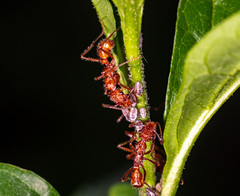
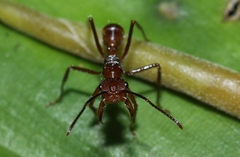

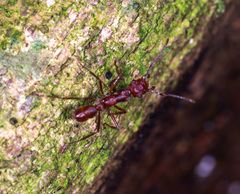
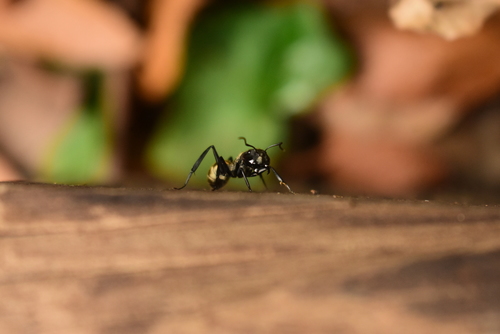
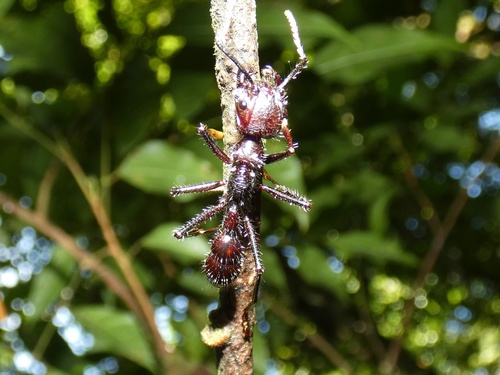

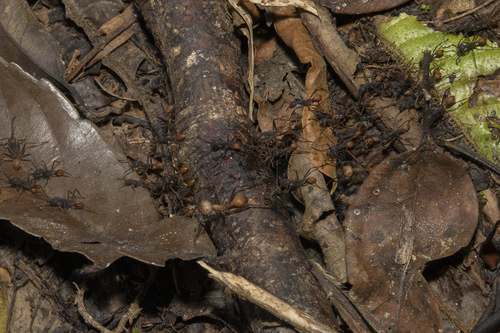
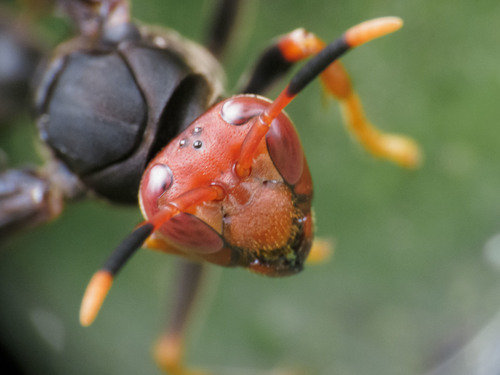
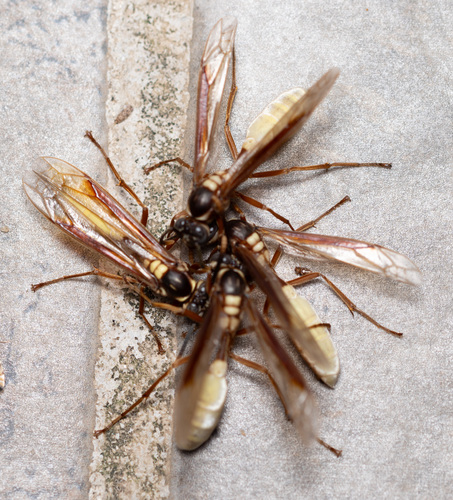

Ectatomma tuberculatum

Ectatomma tuberculatum

Ectatomma tuberculatum

Daily sighting probability ~10% · With luck
at Gandoca-Manzanillo Wildlife Refuge

In 3 days ~30% in a week ~60%

7 Verified sightings at Gandoca-Manzanillo Wildlife Refuge From 2019 to 2026
339 In all 19 parks
February Best month
☀️ Diurnal When it's spotted

About the Ectatomma tuberculatum

Ectatomma tuberculatum, known in Qʼeqchiʼ as the kelep, is a Neotropical species of ant in the subfamily Ectatomminae. Common in the Neotropics, the species is found from Mexico to Argentina. It is a host to the related social parasite Ectatomma parasiticum, the only known parasitic species in the subfamily Ectatomminae.

Ectatomin Media related to Ectatomma tuberculatum at Wikimedia Commons Wikipedia →

Global Distribution

Parks Where Found

# Park Country Daily sighting probability
1 Brownsberg Nature Park 🇸🇷 Suriname
~30%
2 Manu National Park 🇵🇪 Peru
~30%
3 Cuyabeno Wildlife Reserve 🇪🇨 Ecuador
~20%
4 Main Ridge Forest Reserve 🇹🇹 Trinidad and Tobago
~20%
5 Biotopo Cerro Cahuí 🇬🇹 Guatemala
~20%
6 Ría Lagartos Biosphere Reserve 🇲🇽 Mexico
~20%
7 Tayrona National Natural Park 🇨🇴 Colombia
~20%
8 Tambopata National Reserve 🇵🇪 Peru
~20%
9 Yasuní National Park 🇪🇨 Ecuador
~20%
10 Tenorio Volcano National Park 🇨🇷 Costa Rica
~10%
11 Bastimentos Island National Marine Park 🇵🇦 Panama
~10%
12 Gandoca-Manzanillo Wildlife Refuge 🇨🇷 Costa Rica
~10%
13 Tortuguero National Park 🇨🇷 Costa Rica
~10%
14 Arenal Volcano National Park 🇨🇷 Costa Rica
~10%
15 Corcovado National Park 🇨🇷 Costa Rica
~10%
16 Soberanía National Park 🇵🇦 Panama
~10%
17 Parque Natural Metropolitano 🇵🇦 Panama
~10%
18 Manuel Antonio National Park 🇨🇷 Costa Rica
~10%
19 La Amistad International Park (Panama) 🇵🇦 Panama
~10%

Cities Where Found

# City Country Daily sighting probability
1 Salvador 🇧🇷 Brazil
~20%
2 Belém 🇧🇷 Brazil
~20%
3 San Pedro Sula 🇭🇳 Honduras
~20%
4 Recife 🇧🇷 Brazil
~20%
5 Manaus 🇧🇷 Brazil
~10%
6 Maceió 🇧🇷 Brazil
~10%
7 São Luís 🇧🇷 Brazil
~10%
8 Niterói 🇧🇷 Brazil
~10%
9 Vitória 🇧🇷 Brazil
~10%
10 Panama City 🇵🇦 Panama
~10%

Before you go

What are the chances of seeing an Ectatomma tuberculatum in Gandoca-Manzanillo Wildlife Refuge?

With luck

About 10% of wildlife watchers report an Ectatomma tuberculatum sighting in Gandoca-Manzanillo Wildlife Refuge on a given day, based on 7 verified sightings from GBIF citizen-science data from 2019 to 2026. It is the 43rd most-seen of the 72 insects we can rate there. Over three days the chance rises to about 30%, and over a week to about 60%, if each day is a fresh chance.

When is the best time to see an Ectatomma tuberculatum in Gandoca-Manzanillo Wildlife Refuge?

February

In that month about 30% of wildlife watchers report an Ectatomma tuberculatum in Gandoca-Manzanillo Wildlife Refuge on a given day, against under 5% in March–October and December, the lowest months. That is one of Gandoca-Manzanillo Wildlife Refuge's driest months, with about 160 mm of rain against 560 mm in July.

What time of day is best to see an Ectatomma tuberculatum?

Between 9 am and noon

Across all the parks we cover, that three-hour window holds the most Ectatomma tuberculatum sightings with a recorded time, and about 8 in 10 of them come between 6 am and 6 pm: it is a daytime animal.

Is Gandoca-Manzanillo Wildlife Refuge the best place to see an Ectatomma tuberculatum?

12th of 19

Of the 19 parks where we can rate Ectatomma tuberculatum sightings, Gandoca-Manzanillo Wildlife Refuge ranks 12th at about 10%. The best odds are in Brownsberg Nature Park (Suriname, about 30%), Manu National Park (Peru, about 30%) and Cuyabeno Wildlife Reserve (Ecuador, about 20%).

Which relatives of the Ectatomma tuberculatum live in Gandoca-Manzanillo Wildlife Refuge?

Same family: Formicidae

The closest relatives of the Ectatomma tuberculatum that you can see in Gandoca-Manzanillo Wildlife Refuge (family Formicidae, Ants) are Shimmering Golden Sugar Ant (about 30%), Bullet Ant (about 30%) and Hairy-Headed Leafcutter Ant (about 20%), with each one's daily chance of a sighting.

Where does the Ectatomma tuberculatum sighting chance come from?

GBIF citizen-science records

It is estimated from how often the Ectatomma tuberculatum is recorded against all the insects logged in Gandoca-Manzanillo Wildlife Refuge (7 verified sightings from 2019 to 2026), calibrated against known sighting rates. Figures are rounded to the nearest 10% because citizen-science data supports honest approximations, not decimals, and months with records from fewer than five people show "—". How it works.

← Back to Gandoca-Manzanillo Wildlife Refuge