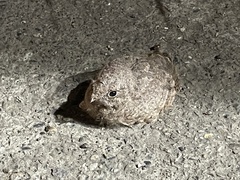
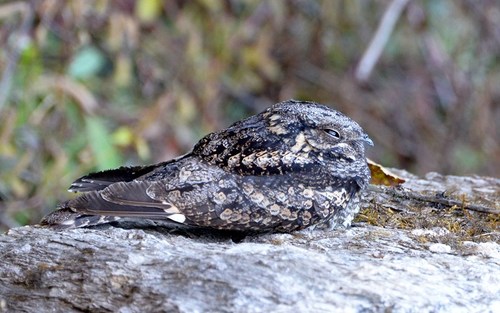
Savanna Nightjar

Savanna Nightjar

Caprimulgus affinis

Silhouette: Ferran Sayol · PhyloPic

LCLeast ConcernNTVUENCR
Daily sighting probability <5% · Rare
at Mudumalai National Park

In 3 days ~10% in a week ~20%

29 Verified sightings at Mudumalai National Park From 2019 to 2026
1,239 In all 16 parks
April Best month
☀️ Diurnal When it's spotted

About the Savanna Nightjar

The savanna nightjar (Caprimulgus affinis), also known as allied nightjar or Franklin's nightjar, is a species of nightjar found in South and Southeast Asia. The IUCN Red List has assessed the species to be of least concern because it has a large range and its population trend is stable. As other nightjars, this nocturnal bird is characterised by its large eyes, gaping mouth and excellent camouflage. It can be distinguished from similar south Asian nightjar species, like the chirruping nightjar, by its unique vocalisations.

The savanna nightjar belongs to the diverse family Caprimulgidae along with 89 other species, 39 of which share the genus Caprimulgus. Wikipedia →

Sounds

Call0:22

Malaysia · 2020

© Lim Ying Hien 林勇贤 · XC1162372 · CC BY-NC-ND 4.0

Uncertain0:10

India · 2026

© SACHIN PRABHU · XC1092305 · CC BY-NC-SA 4.0

Song0:48

Laos · 2026

© Bram Piot · XC1074028 · CC BY-NC-SA 4.0

Global Distribution

Parks Where Found

# Park Country Daily sighting probability
1 Bali Barat National Park 🇮🇩 Indonesia
~40%
2 Way Kambas National Park 🇮🇩 Indonesia
~30%
3 Satpura National Park 🇮🇳 India
~10%
4 Bandhavgarh National Park 🇮🇳 India
~10%
5 Royal Bardia National Park 🇳🇵 Nepal
~10%
6 Gir National Park 🇮🇳 India
~10%
7 Ranthambore National Park 🇮🇳 India
~10%
8 Manas National Park 🇮🇳 India
<5%
9 Kanha National Park 🇮🇳 India
<5%
10 Mudumalai National Park 🇮🇳 India
<5%
11 Doi Inthanon National Park 🇹🇭 Thailand
<5%
12 Jim Corbett National Park 🇮🇳 India
<5%
13 Chitwan National Park 🇳🇵 Nepal
<5%
14 Periyar National Park 🇮🇳 India
<5%
15 Bandipur National Park 🇮🇳 India
<5%
16 Keoladeo National Park 🇮🇳 India
<5%

Cities Where Found

# City Country Daily sighting probability
1 Makassar 🇮🇩 Indonesia
~20%
2 Padang 🇮🇩 Indonesia
~10%
3 Denpasar 🇮🇩 Indonesia
~10%
4 Yogyakarta 🇮🇩 Indonesia
~10%
5 Tainan 🇹🇼 Taiwan
~10%
6 Taichung 🇹🇼 Taiwan
~10%
7 Jakarta 🇮🇩 Indonesia
~10%
8 Thrissur 🇮🇳 India
~10%
9 Surabaya 🇮🇩 Indonesia
~10%
10 Bhopal 🇮🇳 India
<5%

Before you go

What are the chances of seeing a Savanna Nightjar in Mudumalai National Park?

Rare

Under 5% of wildlife watchers report a Savanna Nightjar sighting in Mudumalai National Park on a given day, based on 29 verified sightings from GBIF citizen-science data from 2019 to 2026. It is the 181st most-seen of the 233 birds we can rate there. Over three days the chance rises to about 10%, and over a week to about 20%, if each day is a fresh chance.

When is the best time to see a Savanna Nightjar in Mudumalai National Park?

April and November–December

In those months about 10% of wildlife watchers report a Savanna Nightjar in Mudumalai National Park on a given day, against under 5% in January–March and May–October, the lowest months.

What time of day is best to see a Savanna Nightjar?

Between noon and 3 pm

Across all the parks we cover, that three-hour window holds the most Savanna Nightjar sightings with a recorded time, and about 7 in 10 of them come between 6 am and 6 pm: it is a daytime animal.

Is Mudumalai National Park the best place to see a Savanna Nightjar?

10th of 16

Of the 16 parks where we can rate Savanna Nightjar sightings, Mudumalai National Park ranks 10th at under 5%. The best odds are in Bali Barat National Park (Indonesia, about 40%), Way Kambas National Park (Indonesia, about 30%) and Satpura National Park (India, about 10%).

Which relatives of the Savanna Nightjar live in Mudumalai National Park?

Same genus: Caprimulgus

The closest relatives of the Savanna Nightjar that you can see in Mudumalai National Park (genus Caprimulgus, Old World Nightjars) are Jungle Nightjar (about 20%) and Jerdon's Nightjar (about 10%), with each one's daily chance of a sighting.

Where does the Savanna Nightjar sighting chance come from?

GBIF citizen-science records

It is estimated from how often the Savanna Nightjar is recorded against all the birds logged in Mudumalai National Park (29 verified sightings from 2019 to 2026), calibrated against known sighting rates. Figures are rounded to the nearest 10% because citizen-science data supports honest approximations, not decimals, and months with records from fewer than five people show "—". How it works.

← Back to Mudumalai National Park