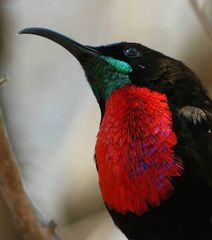
Scarlet-chested Sunbird

Scarlet-chested Sunbird

Chalcomitra senegalensis

Silhouette: Sheatherius · PhyloPic

LCLeast ConcernNTVUENCR
Daily sighting probability ~30% · Possible
at Niokolo-Koba National Park

In 3 days ~60% in a week ~90%

109 Verified sightings at Niokolo-Koba National Park From 2019 to 2026
7,415 In all 46 parks
September Best month
☀️ Diurnal When it's spotted

About the Scarlet-chested Sunbird

The scarlet-chested sunbird (Chalcomitra senegalensis) is a species of bird in the family Nectariniidae. It is found in many areas of Sub-Saharan Africa, and from South Sudan to South Africa. It is found in Angola, Benin, Botswana, Burkina Faso, Burundi, Cameroon, Central African Republic, Chad, Democratic Republic of the Congo, Eswatini, Ivory Coast, Eritrea, Ethiopia, Gambia, Ghana, Guinea, Guinea-Bissau, Kenya, Malawi, Mali, Mauritania, Mozambique, Namibia, Niger, Nigeria, Rwanda, Senegal, Sierra Leone, South Africa, Sudan, Tanzania, Togo, Uganda, Zambia, and Zimbabwe.

The scarlet-chested sunbird is similar to Hunter's sunbird in appearance, with adult males having a characteristic red–scarlet coloured breast and an iridescent green patch on top of its head. The female is dark brown with no supercilium. It inhabits woodland and gardens, at elevations of up to 2,400 metres (7,900 ft). The bird is around 13–15 centimetres (5.1–5.9 in) in length, with males having a weight of 7.5–17.2 grams (0.26–0.61 oz) and females weighing 6.8–15.3 grams (0.24–0.54 oz).

In 1760, the French zoologist Mathurin Jacques Brisson included a description of the... Wikipedia →

Sounds

Duet0:11

South Africa · 2026

© Marna Buys · XC1155529 · CC BY-NC-SA 4.0

Call0:51

Senegal · 2026

© Peter Boesman · XC1081119 · CC BY-NC-ND 4.0

Song0:28

Kenya · 2017

© Rory Nefdt · XC398563 · CC BY-NC-SA 4.0

Global Distribution

Parks Where Found

# Park Country Daily sighting probability
1 Nairobi National Park 🇰🇪 Kenya
~40%
2 Selous Game Reserve 🇹🇿 Tanzania
~40%
3 Gonarezhou National Park 🇿🇼 Zimbabwe
~40%
4 Mikumi National Park 🇹🇿 Tanzania
~40%
5 Kafue National Park 🇿🇲 Zambia
~30%
6 Mana Pools National Park 🇿🇼 Zimbabwe
~30%
7 Kibale National Park 🇺🇬 Uganda
~30%
8 Niokolo-Koba National Park 🇸🇳 Senegal
~30%
9 Lower Zambezi National Park 🇿🇲 Zambia
~30%
10 uMkhuze Game Reserve 🇿🇦 South Africa
~30%
11 Lake Nakuru National Park 🇰🇪 Kenya
~30%
12 Liwonde National Park 🇲🇼 Malawi
~30%
13 Waterberg Plateau Park 🇳🇦 Namibia
~30%
14 Kidepo Valley National Park 🇺🇬 Uganda
~20%
15 Lake Mburo National Park 🇺🇬 Uganda
~20%
16 Meru National Park 🇰🇪 Kenya
~20%
17 Arusha National Park 🇹🇿 Tanzania
~20%
18 Ruaha National Park 🇹🇿 Tanzania
~20%
19 Hluhluwe-Imfolozi Park 🇿🇦 South Africa
~20%
20 Akagera National Park 🇷🇼 Rwanda
~20%
21 iSimangaliso Wetland Park 🇿🇦 South Africa
~20%
22 Kruger National Park 🇿🇦 South Africa
~20%
23 Queen Elizabeth National Park 🇺🇬 Uganda
~10%
24 Volcanoes National Park 🇷🇼 Rwanda
~10%
25 Nyungwe National Park 🇷🇼 Rwanda
~10%
26 Ngorongoro Conservation Area 🇹🇿 Tanzania
~10%
27 Serengeti National Park 🇹🇿 Tanzania
~10%
28 Amboseli National Park 🇰🇪 Kenya
~10%
29 Tarangire National Park 🇹🇿 Tanzania
~10%
30 Masai Mara National Reserve 🇰🇪 Kenya
~10%
31 Murchison Falls National Park 🇺🇬 Uganda
~10%
32 Hwange National Park 🇿🇼 Zimbabwe
~10%
33 Gorongosa National Park 🇲🇿 Mozambique
~10%
34 South Luangwa National Park 🇿🇲 Zambia
~10%
35 Namib-Naukluft National Park 🇳🇦 Namibia
~10%
36 Mkomazi National Park 🇹🇿 Tanzania
~10%
37 Virunga National Park 🇨🇩 Democratic Republic of the Congo
~10%
38 Bwindi Impenetrable National Park 🇺🇬 Uganda
~10%
39 Chobe National Park 🇧🇼 Botswana
~10%
40 Awash National Park 🇪🇹 Ethiopia
~10%
41 Lake Manyara National Park 🇹🇿 Tanzania
<5%
42 Moremi Game Reserve 🇧🇼 Botswana
<5%
43 Etosha National Park 🇳🇦 Namibia
<5%
44 Semuliki National Park 🇺🇬 Uganda
<5%
45 Aberdare National Park 🇰🇪 Kenya
<5%
46 Tsavo West National Park 🇰🇪 Kenya
<5%

Cities Where Found

# City Country Daily sighting probability
1 Zanzibar City 🇹🇿 Tanzania
~80%
2 Dar es-Salaam 🇹🇿 Tanzania
~50%
3 Kigali 🇷🇼 Rwanda
~50%
4 Kampala 🇺🇬 Uganda
~50%
5 Mombasa 🇰🇪 Kenya
~40%
6 Abuja 🇳🇬 Nigeria
~20%
7 Ouagadougou 🇧🇫 Burkina Faso
~20%
8 Lilongwe 🇲🇼 Malawi
~20%
9 Harare 🇿🇼 Zimbabwe
~10%
10 Nairobi 🇰🇪 Kenya
~10%

Zoos & Centres Where Found

# Zoo / Centre Country
1 London Zoo 🇬🇧 United Kingdom In captivity

Before you go

What are the chances of seeing a Scarlet-chested Sunbird in Niokolo-Koba National Park?

Possible

About 30% of wildlife watchers report a Scarlet-chested Sunbird sighting in Niokolo-Koba National Park on a given day, based on 109 verified sightings from GBIF citizen-science data from 2019 to 2026. It is the 68th most-seen of the 215 birds we can rate there. Over three days the chance rises to about 60%, and over a week to about 90%, if each day is a fresh chance.

When is the best time to see a Scarlet-chested Sunbird in Niokolo-Koba National Park?

January and August–September

In those months about 40% of wildlife watchers report a Scarlet-chested Sunbird in Niokolo-Koba National Park on a given day, against about 20% in March and December, the lowest months. May–July and October have too few records to rate.

What time of day is best to see a Scarlet-chested Sunbird?

Between 7 and 10 am

Across all the parks we cover, that three-hour window holds the most Scarlet-chested Sunbird sightings with a recorded time, and about 9 in 10 of them come between 6 am and 6 pm: it is a daytime animal.

Which relatives of the Scarlet-chested Sunbird live in Niokolo-Koba National Park?

Same family: Nectariniidae

The closest relatives of the Scarlet-chested Sunbird that you can see in Niokolo-Koba National Park (family Nectariniidae, Sunbirds and Spiderhunters) are Beautiful Sunbird (about 60%), Pygmy Sunbird (about 10%) and Western Violet-backed Sunbird (about 10%), with each one's daily chance of a sighting.

Where does the Scarlet-chested Sunbird sighting chance come from?

GBIF citizen-science records

It is estimated from how often the Scarlet-chested Sunbird is recorded against all the birds logged in Niokolo-Koba National Park (109 verified sightings from 2019 to 2026), calibrated against known sighting rates. Figures are rounded to the nearest 10% because citizen-science data supports honest approximations, not decimals, and months with records from fewer than five people show "—". How it works.

← Back to Niokolo-Koba National Park