Striated Pardalote

Striated Pardalote

Pardalotus striatus

Silhouette: Sheatherius · PhyloPic

LCLeast ConcernNTVUENCR Endemic
Daily sighting probability ~10% · With luck
at Noosa National Park

In 3 days ~20% in a week ~50%

46 Verified sightings at Noosa National Park From 2019 to 2026
3,092 In all 18 parks
May Best month
☀️ Diurnal When it's spotted

About the Striated Pardalote

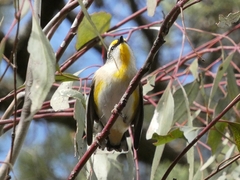
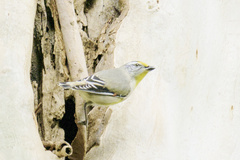
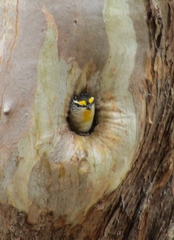
The striated pardalote (Pardalotus striatus) is the least colourful and most common of the four pardalote species. Other common names include pickwick, wittachew and chip-chip. It is a very small, short-tailed bird that is more often heard than seen, foraging noisily for lerps and other small creatures in the treetops.

The striated pardalote was formally described in 1789 by the German naturalist Johann Friedrich Gmelin in his revised and expanded edition of Carl Linnaeus's Systema Naturae. He placed it with the manakins in the genus Pipra and coined the binomial name Pipra striata. Gmelin based his description on the "striped-headed manakin" that had been described and illustrated in 1783 by the English ornithologist John Latham in his book A General Synopsis of Birds. Latham had examined a specimen in the collection of the naturalist Joseph Banks. The type locality is Tasmania. The striated pardalote is now placed with the three other pardalotes in the genus Pardalotus that was introduced in 1816 by the French ornithologist Louis Pierre Vieillot.

Six subspecies are recognised: Wikipedia →

Sounds

Song0:16

Australia · 2025

© Étienne Leroy · XC1069919 · CC BY-NC-SA 4.0

Call0:19

Australia · 2024

© Drew Davison · XC940102 · CC BY-NC-ND 4.0

Song0:35

Australia · 2023

© Romuald Mikusek · XC935839 · CC BY-NC-SA 4.0

Global Distribution

Parks Where Found

# Park Country Daily sighting probability
1 Hattah-Kulkyne National Park 🇦🇺 Australia
~60%
2 Flinders Chase 🇦🇺 Australia
~50%
3 Flinders Ranges National Park 🇦🇺 Australia
~50%
4 Kosciuszko National Park 🇦🇺 Australia
~40%
5 Maria Island National Park 🇦🇺 Australia
~30%
6 Nitmiluk National Park 🇦🇺 Australia
~30%
7 Grampians National Park 🇦🇺 Australia
~30%
8 Cradle Mountain-Lake St Clair National Park 🇦🇺 Australia
~20%
9 Springbrook National Park 🇦🇺 Australia
~20%
10 Great Otway National Park 🇦🇺 Australia
~20%
11 Litchfield National Park 🇦🇺 Australia
~20%
12 Kakadu National Park 🇦🇺 Australia
~10%
13 Noosa National Park 🇦🇺 Australia
~10%
14 Freycinet National Park 🇦🇺 Australia
<5%
15 Lamington National Park 🇦🇺 Australia
<5%
16 Booderee National Park 🇦🇺 Australia
<5%
17 Blue Mountains National Park 🇦🇺 Australia
<5%
18 Royal National Park 🇦🇺 Australia
<5%

Cities Where Found

# City Country Daily sighting probability
1 Brisbane 🇦🇺 Australia
~40%
2 Perth 🇦🇺 Australia
~30%
3 Hobart 🇦🇺 Australia
~10%
4 Melbourne 🇦🇺 Australia
~10%
5 Sydney 🇦🇺 Australia
<5%

Before you go

What are the chances of seeing a Striated Pardalote in Noosa National Park?

With luck

About 10% of wildlife watchers report a Striated Pardalote sighting in Noosa National Park on a given day, based on 46 verified sightings from GBIF citizen-science data from 2019 to 2026. It is the 70th most-seen of the 128 birds we can rate there. Over three days the chance rises to about 20%, and over a week to about 50%, if each day is a fresh chance.

When is the best time to see a Striated Pardalote in Noosa National Park?

January–June and August–November

In those months about 10% of wildlife watchers report a Striated Pardalote in Noosa National Park on a given day, against under 5% in July and December, the lowest months.

What time of day is best to see a Striated Pardalote?

Between 10 am and 1 pm

Across all the parks we cover, that three-hour window holds the most Striated Pardalote sightings with a recorded time, and nearly all of them come between 6 am and 6 pm: it is a daytime animal.

Where does the Striated Pardalote sighting chance come from?

GBIF citizen-science records

It is estimated from how often the Striated Pardalote is recorded against all the birds logged in Noosa National Park (46 verified sightings from 2019 to 2026), calibrated against known sighting rates. Figures are rounded to the nearest 10% because citizen-science data supports honest approximations, not decimals, and months with records from fewer than five people show "—". How it works.

← Back to Noosa National Park