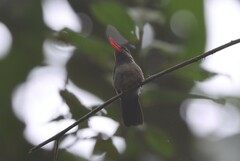
Blue-throated Sapphire

Blue-throated Sapphire

Chlorestes eliciae

Silhouette: Ferran Sayol · PhyloPic

LCLeast ConcernNTVUENCR
Daily sighting probability ~10% · With luck
at Ostional Wildlife Refuge

In 3 days ~20% in a week ~30%

36 Verified sightings at Ostional Wildlife Refuge From 2019 to 2026
6,173 In all 23 parks
November Best month
☀️ Diurnal When it's spotted

About the Blue-throated Sapphire

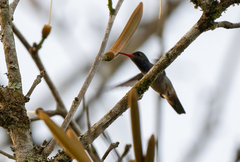
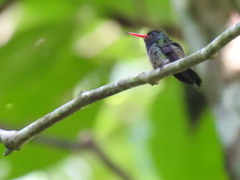
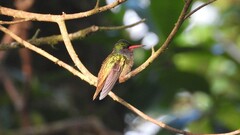
The blue-throated goldentail (Chlorestes eliciae), also known as the blue-throated sapphire, is a species of hummingbird in the family Trochilidae. It is found in Belize, Colombia, Costa Rica, El Salvador, Guatemala, Honduras, Mexico, Nicaragua, and Panama. Its natural habitats are subtropical or tropical moist lowland forest and heavily degraded former forest.

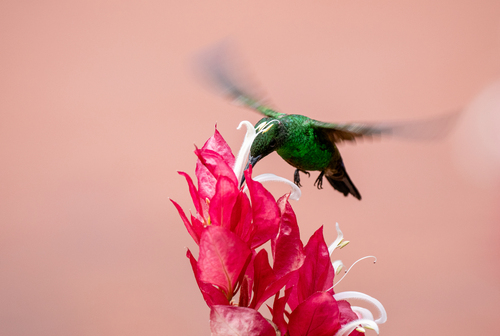
The male blue-throated goldentail is a little bit larger than the female and display similar patterns but brighter colors on its plumage. This species can be distinguished by its straight, bright red bill with a black tip. The crown and upperparts of the male blue-throated goldentail are green, and more coppery or golden on the rectrices. The throat is glittering blue-violet to violet, the belly is cream-brown buff, and the sides of the breast and the flanks are streaked with green. The female's throat is rather violet blue, mixed with gray buff, and the belly is paler than the male's. The immature looks like the female adult as it has duller colors. This characteristic more pronounced in the female juvenile.

As most hummingbird species, the blue-throated goldentail is primarily nectarivorous. It feeds on flowers of shrubs (Stachytarpheta, Hamelia) and large herbs (Heliconia, Renealmia, Thalea), on epiphytes, and sometimes on small arthropods. Wikipedia →

Sounds

Song0:17

Costa Rica · 2023

© Johan Chaves · XC828082 · CC BY-NC-SA 4.0

Call0:10

Costa Rica · 2017

© Albert Lastukhin · XC378390 · CC BY-NC-SA 4.0

Song?0:37

Panama · 2016

© Hans Matheve · XC359203 · CC BY-NC-ND 4.0

Global Distribution

Parks Where Found

# Park Country Daily sighting probability
1 Coiba National Park 🇵🇦 Panama
~40%
2 Tenorio Volcano National Park 🇨🇷 Costa Rica
~30%
3 Cabo Blanco Absolute Nature Reserve 🇨🇷 Costa Rica
~20%
4 Corcovado National Park 🇨🇷 Costa Rica
~20%
5 Carara National Park 🇨🇷 Costa Rica
~20%
6 Rincón de la Vieja National Park 🇨🇷 Costa Rica
~10%
7 Piedras Blancas National Park 🇨🇷 Costa Rica
~10%
8 Marino Ballena National Park 🇨🇷 Costa Rica
~10%
9 Arenal Volcano National Park 🇨🇷 Costa Rica
~10%
10 Manuel Antonio National Park 🇨🇷 Costa Rica
~10%
11 Ostional Wildlife Refuge 🇨🇷 Costa Rica
~10%
12 Darién National Park 🇵🇦 Panama
~10%
13 Santa Rosa National Park 🇨🇷 Costa Rica
~10%
14 Bastimentos Island National Marine Park 🇵🇦 Panama
<5%
15 Pico Bonito National Park 🇭🇳 Honduras
<5%
16 La Amistad International Park (Panama) 🇵🇦 Panama
<5%
17 Palo Verde National Park 🇨🇷 Costa Rica
<5%
18 Poás Volcano National Park 🇨🇷 Costa Rica
<5%
19 Tortuguero National Park 🇨🇷 Costa Rica
<5%
20 Chirripó National Park 🇨🇷 Costa Rica
<5%
21 Gandoca-Manzanillo Wildlife Refuge 🇨🇷 Costa Rica
<5%
22 Monteverde Cloud Forest Reserve 🇨🇷 Costa Rica
<5%
23 Braulio Carrillo National Park 🇨🇷 Costa Rica
<5%

Cities Where Found

# City Country Daily sighting probability
1 San José 🇨🇷 Costa Rica
<5%

Before you go

What are the chances of seeing a Blue-throated Sapphire in Ostional Wildlife Refuge?

With luck

About 10% of wildlife watchers report a Blue-throated Sapphire sighting in Ostional Wildlife Refuge on a given day, based on 36 verified sightings from GBIF citizen-science data from 2019 to 2026. It is the 106th most-seen of the 182 birds we can rate there. Over three days the chance rises to about 20%, and over a week to about 30%, if each day is a fresh chance.

When is the best time to see a Blue-throated Sapphire in Ostional Wildlife Refuge?

March and October–December

In those months about 10% of wildlife watchers report a Blue-throated Sapphire in Ostional Wildlife Refuge on a given day, against under 5% in January–February and April–September, the lowest months.

What time of day is best to see a Blue-throated Sapphire?

Between 9 am and noon

Across all the parks we cover, that three-hour window holds the most Blue-throated Sapphire sightings with a recorded time, and about 9 in 10 of them come between 6 am and 6 pm: it is a daytime animal.

Which relatives of the Blue-throated Sapphire live in Ostional Wildlife Refuge?

Same family: Trochilidae

The closest relatives of the Blue-throated Sapphire that you can see in Ostional Wildlife Refuge (family Trochilidae, Hummingbirds) are Cinnamon Hummingbird (about 20%), Rufous-tailed Hummingbird (about 20%) and Canivet's Emerald (about 10%), with each one's daily chance of a sighting.

Where does the Blue-throated Sapphire sighting chance come from?

GBIF citizen-science records

It is estimated from how often the Blue-throated Sapphire is recorded against all the birds logged in Ostional Wildlife Refuge (36 verified sightings from 2019 to 2026), calibrated against known sighting rates. Figures are rounded to the nearest 10% because citizen-science data supports honest approximations, not decimals, and months with records from fewer than five people show "—". How it works.

← Back to Ostional Wildlife Refuge