Short-tailed Swift

Short-tailed Swift

Chaetura brachyura

Silhouette: Aviceda (vectorized by T. Michael Keesey) · PhyloPic

LCLeast ConcernNTVUENCR
Daily sighting probability <5% · Rare
at Podocarpus National Park

In 3 days <5%

5 Verified sightings at Podocarpus National Park From 2019 to 2026
5,322 In all 19 parks
May Best month
☀️ Diurnal When it's spotted

About the Short-tailed Swift

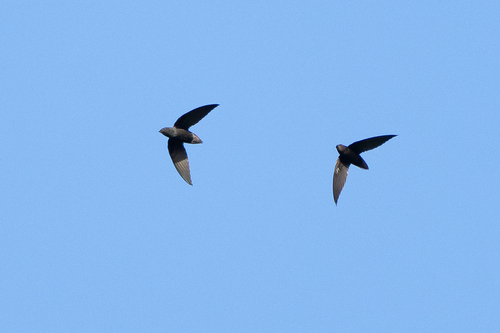
The short-tailed swift (Chaetura brachyura) is a bird in the Apodidae, or swift family. The species was first formally described as Acanthylis brachyura in 1846 by the Scottish naturalist Sir William Jardine, based on the observations of Mr. Kirk, a resident of Tobago.

The genus name Chaetura is derived from the Greek khaite (hair) and oura (tail). The specific epithet brachyura is Greek for brakhus (short) and ouros (tailed). Four subspecies are recognized: C. b. praevelox, found in Grenada, Saint Vincent, and Tobago

C. b. brachyura, the nominate subspecies, found from Panama to Trinidad and the Guianas, south to west-central Brazil and northern Bolivia C. b. ocypetes, found in southwest Ecuador and northwest Peru The swift is a common resident of Trinidad, Tobago, Grenada and Saint Vincent, and in tropical South America from Panama, Colombia and the Guianas south to Ecuador, Peru and Brazil; in Brazil, the entire Amazon Basin, excluding much of the southeastern Basin.... Wikipedia →
Sounds

Flight call0:14

Brazil · 2024

© JAYRSON ARAUJO DE OLIVEIRA · XC944032 · CC BY-NC-SA 4.0

Song0:20

Ecuador · 2024

© Manuel Sanchez-Nivicela · XC930334 · CC BY-NC-ND 4.0

Call0:46

Colombia · 2021

© Peter Boesman · XC693395 · CC BY-NC-ND 4.0

Global Distribution

Parks Where Found

# Park Country Daily sighting probability
1 Main Ridge Forest Reserve 🇹🇹 Trinidad and Tobago
~30%
2 Yasuní National Park 🇪🇨 Ecuador
~30%
3 Soberanía National Park 🇵🇦 Panama
~20%
4 Cuyabeno Wildlife Reserve 🇪🇨 Ecuador
~20%
5 San Lorenzo Protected Forest 🇵🇦 Panama
~20%
6 Anavilhanas National Park 🇧🇷 Brazil
~10%
7 Caroni Swamp 🇹🇹 Trinidad and Tobago
~10%
8 Amacayacu National Natural Park 🇨🇴 Colombia
~10%
9 Parque Natural Metropolitano 🇵🇦 Panama
~10%
10 Manu National Park 🇵🇪 Peru
~10%
11 Brownsberg Nature Park 🇸🇷 Suriname
~10%
12 Sierra de la Macarena National Park 🇨🇴 Colombia
~10%
13 Henri Pittier National Park 🇻🇪 Venezuela
<5%
14 Chagres National Park 🇵🇦 Panama
<5%
15 Tambopata National Reserve 🇵🇪 Peru
<5%
16 Darién National Park 🇵🇦 Panama
<5%
17 Tayrona National Natural Park 🇨🇴 Colombia
<5%
18 Podocarpus National Park 🇪🇨 Ecuador
<5%
19 Los Nevados National Natural Park 🇨🇴 Colombia
<5%

Cities Where Found

# City Country Daily sighting probability
1 Belém 🇧🇷 Brazil
~40%
2 São Luís 🇧🇷 Brazil
~20%
3 Santa Cruz de la Sierra 🇧🇴 Bolivia
~10%
4 Panama City 🇵🇦 Panama
~10%
5 Manaus 🇧🇷 Brazil
~10%
6 Guayaquil 🇪🇨 Ecuador
<5%

Before you go

What are the chances of seeing a Short-tailed Swift in Podocarpus National Park?

Rare

Under 5% of wildlife watchers report a Short-tailed Swift sighting in Podocarpus National Park on a given day, based on 5 verified sightings from GBIF citizen-science data from 2019 to 2026. It is the 435th most-seen of the 446 birds we can rate there. Over three days the chance rises to under 5%, if each day is a fresh chance.

When is the best time to see a Short-tailed Swift in Podocarpus National Park?

Any time of year

In every month with enough records, under 5% of wildlife watchers report a Short-tailed Swift in Podocarpus National Park on a given day, so our monthly data shows no clear season.

What time of day is best to see a Short-tailed Swift?

Between 7 and 10 am

Across all the parks we cover, that three-hour window holds the most Short-tailed Swift sightings with a recorded time, and about 9 in 10 of them come between 6 am and 6 pm: it is a daytime animal.

Is Podocarpus National Park the best place to see a Short-tailed Swift?

18th of 19

Of the 19 parks where we can rate Short-tailed Swift sightings, Podocarpus National Park ranks 18th at under 5%. The best odds are in Main Ridge Forest Reserve (Trinidad and Tobago, about 30%), Yasuní National Park (Ecuador, about 30%) and Soberanía National Park (Panama, about 20%).

Where does the Short-tailed Swift sighting chance come from?

GBIF citizen-science records

It is estimated from how often the Short-tailed Swift is recorded against all the birds logged in Podocarpus National Park (5 verified sightings from 2019 to 2026), calibrated against known sighting rates. Figures are rounded to the nearest 10% because citizen-science data supports honest approximations, not decimals, and months with records from fewer than five people show "—". How it works.

← Back to Podocarpus National Park