Palm Warbler

Palm Warbler

Setophaga palmarum

Silhouette: Dylan GE Gomes · PhyloPic

LCLeast ConcernNTVUENCR
Daily sighting probability ~10% · With luck
at Riding Mountain National Park

In 3 days ~30% in a week ~50%

71 Verified sightings at Riding Mountain National Park From 2019 to 2026
25,730 In all 34 parks
May Best month
☀️ Diurnal When it's spotted

About the Palm Warbler

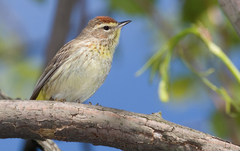
The palm warbler (Setophaga palmarum) is a small songbird in the New World warbler family. Measurements: Length: 12–14 cm (4.7–5.5 in) Wingspan: 20–21 cm (7.9–8.3 in) Weight: 8.5–14.2 g (0.30–0.50 oz) The species comprises two subspecies, with fairly extensive intergradation and mixing where they meet.

S. p. palmarum ("brown palm warbler" or "western palm warbler") inhabits the western two-thirds of the breeding range, and migrates southeast to winter on the Atlantic coast from Delaware to Florida (with a few on the Gulf coast west to Louisiana). It has much less yellow below, with less colorful streaking, and cold grayish-brown upper parts.

S. p. hypochrysea ("yellow palm warbler" or "eastern palm warbler") of the eastern third of the breeding range, and migrates southwest to winter on the Gulf coast from western Florida to Texas; it migrates later in the fall than its western counterpart. It has brownish-olive upper parts and thoroughly yellow underparts with bold rufous breast and flank streaking.

Palm warblers breed in open coniferous bogs and edge east of the Continental Divide, across Canada and the northeastern United States... Wikipedia →

Sounds

Song0:18

United States · 2025

© David A. Brinkman · XC1009101 · CC BY-NC-SA 4.0

Call0:54

United States · 2024

© Valerie Heemstra · XC941412 · CC BY-NC-SA 4.0

Nocturnal flight call0:06

Canada · 2023

© David Tattersley · XC811990 · CC BY-NC-SA 4.0

Global Distribution

Parks Where Found

# Park Country Daily sighting probability
1 Ciénaga de Zapata 🇨🇺 Cuba
~60%
2 Everglades National Park 🇺🇸 United States
~60%
3 Big Cypress National Preserve 🇺🇸 United States
~50%
4 Arrecifes de Cozumel National Park 🇲🇽 Mexico
~50%
5 Merritt Island National Wildlife Refuge 🇺🇸 United States
~40%
6 Point Pelee National Park 🇨🇦 Canada
~40%
7 Jaragua National Park 🇩🇴 Dominican Republic
~20%
8 Sian Ka'an Biosphere Reserve 🇲🇽 Mexico
~20%
9 Celestún Biosphere Reserve 🇲🇽 Mexico
~10%
10 Blue and John Crow Mountains National Park 🇯🇲 Jamaica
~10%
11 Ría Lagartos Biosphere Reserve 🇲🇽 Mexico
~10%
12 Riding Mountain National Park 🇨🇦 Canada
~10%
13 Isla del Coco National Park 🇨🇷 Costa Rica
~10%
14 Los Haitises National Park 🇩🇴 Dominican Republic
~10%
15 Isle Royale National Park 🇺🇸 United States
~10%
16 Voyageurs National Park 🇺🇸 United States
<5%
17 Acadia National Park 🇺🇸 United States
<5%
18 Celaque National Park 🇭🇳 Honduras
<5%
19 Great Smoky Mountains National Park 🇺🇸 United States
<5%
20 Cape Breton Highlands National Park 🇨🇦 Canada
<5%
21 Congaree National Park 🇺🇸 United States
<5%
22 Shenandoah National Park 🇺🇸 United States
<5%
23 Calakmul Biosphere Reserve 🇲🇽 Mexico
<5%
24 El Vizcaíno Biosphere Reserve 🇲🇽 Mexico
<5%
25 Gros Morne National Park 🇨🇦 Canada
<5%
26 Manuel Antonio National Park 🇨🇷 Costa Rica
<5%
27 Olympic National Park 🇺🇸 United States
<5%
28 Pacific Rim National Park Reserve 🇨🇦 Canada
<5%
29 Joshua Tree National Park 🇺🇸 United States
<5%
30 Channel Islands National Park 🇺🇸 United States
<5%
31 Soberanía National Park 🇵🇦 Panama
<5%
32 La Amistad International Park (Panama) 🇵🇦 Panama
<5%
33 Rocky Mountain National Park 🇺🇸 United States
<5%
34 Arenal Volcano National Park 🇨🇷 Costa Rica
<5%

Cities Where Found

# City Country Daily sighting probability
1 Havana 🇨🇺 Cuba
~50%
2 Miami 🇺🇸 United States
~50%
3 Orlando 🇺🇸 United States
~50%
4 Chicago 🇺🇸 United States
~20%
5 New York City 🇺🇸 United States
~10%
6 Minneapolis [Saint Paul] 🇺🇸 United States
~10%
7 Philadelphia 🇺🇸 United States
~10%
8 Toronto 🇨🇦 Canada
~10%
9 Baltimore 🇺🇸 United States
~10%
10 Detroit 🇺🇸 United States
~10%

Zoos & Centres Where Found

# Zoo / Centre Country
1 National Zoological Park 🇺🇸 United States In captivity
2 Butterfly World 🇺🇸 United States In captivity

Before you go

What are the chances of seeing a Palm Warbler in Riding Mountain National Park?

With luck

About 10% of wildlife watchers report a Palm Warbler sighting in Riding Mountain National Park on a given day, based on 71 verified sightings from GBIF citizen-science data from 2019 to 2026. It is the 95th most-seen of the 181 birds we can rate there. Over three days the chance rises to about 30%, and over a week to about 50%, if each day is a fresh chance.

When is the best time to see a Palm Warbler in Riding Mountain National Park?

May

In that month about 30% of wildlife watchers report a Palm Warbler in Riding Mountain National Park on a given day, against under 5% in April, June–July and December–February, the lowest months.

What time of day is best to see a Palm Warbler?

Between 9 am and noon

Across all the parks we cover, that three-hour window holds the most Palm Warbler sightings with a recorded time, and about 9 in 10 of them come between 6 am and 6 pm: it is a daytime animal.

Which relatives of the Palm Warbler live in Riding Mountain National Park?

Same genus: Setophaga

The closest relatives of the Palm Warbler that you can see in Riding Mountain National Park (genus Setophaga, Setophaga Warblers) are Yellow-rumped Warbler (about 50%), Chestnut-sided Warbler (about 40%) and American Redstart (about 40%), with each one's daily chance of a sighting.

Where does the Palm Warbler sighting chance come from?

GBIF citizen-science records

It is estimated from how often the Palm Warbler is recorded against all the birds logged in Riding Mountain National Park (71 verified sightings from 2019 to 2026), calibrated against known sighting rates. Figures are rounded to the nearest 10% because citizen-science data supports honest approximations, not decimals, and months with records from fewer than five people show "—". How it works.

← Back to Riding Mountain National Park