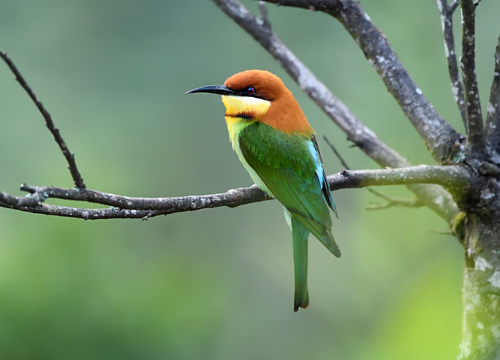
Asian Green Bee-eater

Asian Green Bee-eater

Merops orientalis

Silhouette: Sheatherius · PhyloPic

LCLeast ConcernNTVUENCR
Daily sighting probability <5% · Rare
at Sinharaja Forest Reserve

In 3 days <5%

11 Verified sightings at Sinharaja Forest Reserve From 2019 to 2026
16,509 In all 27 parks
December Best month
☀️ Diurnal When it's spotted

About the Asian Green Bee-eater

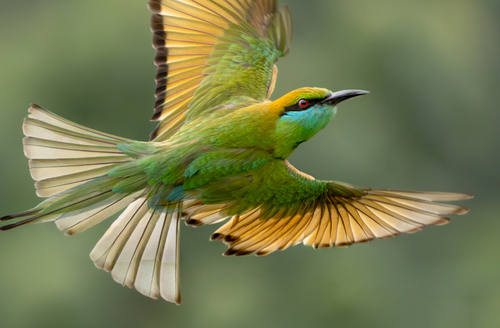
The Asian green bee-eater (Merops orientalis), also known as the little green bee-eater, and just green bee-eater, is a bird species in the bee-eater family. It is resident or with short-distance seasonal movements, and is found widely distributed across Asia from coastal southern Iran east through the Indian subcontinent to Vietnam. Populations in Africa and the Arabian Peninsula that were formerly assigned to this species (under the name green bee-eater) are now considered to be distinct species, the African green bee-eater and the Arabian green bee-eater. They are mainly insect eaters and they are found in grassland, thin scrub and forest often quite far from water. Several regional plumage variations are known and several subspecies have been named.

The Asian green bee-eater was first described by the English ornithologist John Latham in 1801 using its current binomial name. Wikipedia →

Sounds

Song0:55

India · 2025

© Jairam Vijayan · XC1043295 · CC BY-SA 4.0

Call0:29

India · 2025

© Peter Boesman · XC1030637 · CC BY-NC-ND 4.0

Flight call0:27

Laos · 2020

© Bram Piot · XC584168 · CC BY-NC-SA 4.0

Global Distribution

Parks Where Found

# Park Country Daily sighting probability
1 Udawalawe National Park 🇱🇰 Sri Lanka
~90%
2 Yala National Park 🇱🇰 Sri Lanka
~80%
3 Wilpattu National Park 🇱🇰 Sri Lanka
~80%
4 Gir National Park 🇮🇳 India
~60%
5 Minneriya National Park 🇱🇰 Sri Lanka
~60%
6 Sundarbans National Park 🇮🇳 India
~60%
7 Bandhavgarh National Park 🇮🇳 India
~50%
8 Bandipur National Park 🇮🇳 India
~50%
9 Royal Bardia National Park 🇳🇵 Nepal
~50%
10 Mudumalai National Park 🇮🇳 India
~40%
11 Chitwan National Park 🇳🇵 Nepal
~40%
12 Kaziranga National Park 🇮🇳 India
~40%
13 Satpura National Park 🇮🇳 India
~40%
14 Kanha National Park 🇮🇳 India
~40%
15 Nagarhole National Park 🇮🇳 India
~40%
16 Keoladeo National Park 🇮🇳 India
~30%
17 Ranthambore National Park 🇮🇳 India
~30%
18 Manas National Park 🇮🇳 India
~30%
19 Jim Corbett National Park 🇮🇳 India
~20%
20 Doi Inthanon National Park 🇹🇭 Thailand
~10%
21 Kaeng Krachan National Park 🇹🇭 Thailand
~10%
22 Periyar National Park 🇮🇳 India
<5%
23 Royal Manas National Park 🇧🇹 Bhutan
<5%
24 Eravikulam National Park 🇮🇳 India
<5%
25 Khao Yai National Park 🇹🇭 Thailand
<5%
26 Cat Tien National Park 🇻🇳 Vietnam
<5%
27 Sinharaja Forest Reserve 🇱🇰 Sri Lanka
<5%

Cities Where Found

# City Country Daily sighting probability
1 Asansol 🇮🇳 India
~70%
2 Chhatrapati Sambhajinagar 🇮🇳 India
~60%
3 Indore 🇮🇳 India
~60%
4 Solapur 🇮🇳 India
~60%
5 Surat 🇮🇳 India
~60%
6 Bhopal 🇮🇳 India
~50%
7 Hyderabad 🇮🇳 India
~50%
8 Raipur 🇮🇳 India
~50%
9 Pune 🇮🇳 India
~50%
10 Vadodara 🇮🇳 India
~50%

Zoos & Centres Where Found

# Zoo / Centre Country
1 National Zoological Park Delhi 🇮🇳 India In captivity

Before you go

What are the chances of seeing an Asian Green Bee-eater in Sinharaja Forest Reserve?

Rare

Under 5% of wildlife watchers report an Asian Green Bee-eater sighting in Sinharaja Forest Reserve on a given day, based on 11 verified sightings from GBIF citizen-science data from 2019 to 2026. It is the 140th most-seen of the 156 birds we can rate there. Over three days the chance rises to under 5%, if each day is a fresh chance.

When is the best time to see an Asian Green Bee-eater in Sinharaja Forest Reserve?

Any time of year

In every month with enough records, under 5% of wildlife watchers report an Asian Green Bee-eater in Sinharaja Forest Reserve on a given day, so our monthly data shows no clear season.

What time of day is best to see an Asian Green Bee-eater?

Between 7 and 10 am

Across all the parks we cover, that three-hour window holds the most Asian Green Bee-eater sightings with a recorded time, and nearly all of them come between 6 am and 6 pm: it is a daytime animal.

Where does the Asian Green Bee-eater sighting chance come from?

GBIF citizen-science records

It is estimated from how often the Asian Green Bee-eater is recorded against all the birds logged in Sinharaja Forest Reserve (11 verified sightings from 2019 to 2026), calibrated against known sighting rates. Figures are rounded to the nearest 10% because citizen-science data supports honest approximations, not decimals, and months with records from fewer than five people show "—". How it works.
← Back to Sinharaja Forest Reserve