
Rufous Mourner

Rufous Mourner

Rhytipterna holerythra

Silhouette: Emily Willoughby · PhyloPic

LCLeast ConcernNTVUENCR
Daily sighting probability ~10% · With luck
at Soberanía National Park

In 3 days ~20% in a week ~30%

554 Verified sightings at Soberanía National Park From 2019 to 2026
4,280 In all 22 parks
February Best month
☀️ Diurnal When it's spotted

About the Rufous Mourner

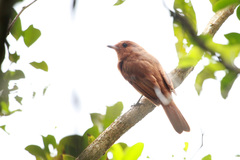
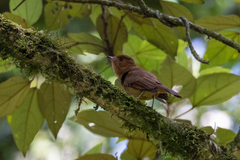
The rufous mourner (Rhytipterna holerythra) is a passerine bird in the family Tyrannidae, the tyrant flycatchers. It is found in Mexico, every Central American country except El Salvador, Colombia, and Ecuador. The rufous mourner was originally described as Lipaugus holerythrus, mistakenly grouping it with the cotingas. It was later transferred to genus Rhytipterna that had been erected in 1850. Rhytipterna was also treated as a cotinga genus but a series of studies published beginning in the 1960s resulted in its movement to the tyrant flycatcher family. The rufous mourner shares the genus with the pale-bellied mourner (R. immunda) and grayish mourner (R. simplex). The rufous and greyish mourners apparently form a superspecies.

The rufous mourner is 19.5 to 21 cm (7.7 to 8.3 in) long and weighs about 32 to 39 g (1.1 to 1.4 oz). The sexes have the same plumage. Males of the nominate subspecies have a mostly cinnamon brown to russet head and upperparts with a darker rufous crown. Their wings are... Wikipedia →

Sounds

Alarm call1:16

Ecuador · 2020

© Manuel Sánchez-Nivicela · XC1176061 · CC BY-NC-ND 4.0

Call0:10

Costa Rica · 2016

© Frank Lambert · XC411349 · CC BY-NC-ND 4.0

Song0:16

Mexico · 2003

© Peter Boesman · XC229099 · CC BY-NC-ND 4.0

Global Distribution

Parks Where Found

# Park Country Daily sighting probability
1 Darién National Park 🇵🇦 Panama
~10%
2 Montes Azules Biosphere Reserve 🇲🇽 Mexico
~10%
3 Braulio Carrillo National Park 🇨🇷 Costa Rica
~10%
4 Tenorio Volcano National Park 🇨🇷 Costa Rica
~10%
5 Corcovado National Park 🇨🇷 Costa Rica
~10%
6 Cockscomb Basin Wildlife Sanctuary 🇧🇿 Belize
~10%
7 Tikal National Park 🇬🇹 Guatemala
~10%
8 Pico Bonito National Park 🇭🇳 Honduras
~10%
9 Arenal Volcano National Park 🇨🇷 Costa Rica
~10%
10 Piedras Blancas National Park 🇨🇷 Costa Rica
~10%
11 Soberanía National Park 🇵🇦 Panama
~10%
12 Chagres National Park 🇵🇦 Panama
<5%
13 Tapantí-Macizo de la Muerte National Park 🇨🇷 Costa Rica
<5%
14 Tortuguero National Park 🇨🇷 Costa Rica
<5%
15 Carara National Park 🇨🇷 Costa Rica
<5%
16 Monteverde Cloud Forest Reserve 🇨🇷 Costa Rica
<5%
17 Rincón de la Vieja National Park 🇨🇷 Costa Rica
<5%
18 Gandoca-Manzanillo Wildlife Refuge 🇨🇷 Costa Rica
<5%
19 La Amistad International Park (Panama) 🇵🇦 Panama
<5%
20 Farallones de Cali National Natural Park 🇨🇴 Colombia
<5%
21 Poás Volcano National Park 🇨🇷 Costa Rica
<5%
22 Volcán Barú National Park 🇵🇦 Panama
<5%

Before you go

What are the chances of seeing a Rufous Mourner in Soberanía National Park?

With luck

About 10% of wildlife watchers report a Rufous Mourner sighting in Soberanía National Park on a given day, based on 554 verified sightings from GBIF citizen-science data from 2019 to 2026. It is the 220th most-seen of the 449 birds we can rate there. Over three days the chance rises to about 20%, and over a week to about 30%, if each day is a fresh chance.

When is the best time to see a Rufous Mourner in Soberanía National Park?

January–May and September

In those months about 10% of wildlife watchers report a Rufous Mourner in Soberanía National Park on a given day, against under 5% in June–August and October–December, the lowest months.

What time of day is best to see a Rufous Mourner?

Between 9 am and noon

Across all the parks we cover, that three-hour window holds the most Rufous Mourner sightings with a recorded time, and about 9 in 10 of them come between 6 am and 6 pm: it is a daytime animal.

Which relatives of the Rufous Mourner live in Soberanía National Park?

Same family: Tyrannidae

The closest relatives of the Rufous Mourner that you can see in Soberanía National Park (family Tyrannidae, Tyrant Flycatchers) are Tropical Kingbird (about 60%), Social Flycatcher (about 50%) and Great Kiskadee (about 40%), with each one's daily chance of a sighting.

Where does the Rufous Mourner sighting chance come from?

GBIF citizen-science records

It is estimated from how often the Rufous Mourner is recorded against all the birds logged in Soberanía National Park (554 verified sightings from 2019 to 2026), calibrated against known sighting rates. Figures are rounded to the nearest 10% because citizen-science data supports honest approximations, not decimals, and months with records from fewer than five people show "—". How it works.

← Back to Soberanía National Park