American Crocodile

American Crocodile

Crocodylus acutus

Silhouette: Beth Reinke · PhyloPic

LCNTVUVulnerableENCR
Daily sighting probability ~20% · Possible
at Tayrona National Natural Park

In 3 days ~50% in a week ~80%

38 Verified sightings at Tayrona National Natural Park From 2019 to 2026
4,444 In all 28 parks
January Best month
☀️ Diurnal When it's spotted

About the American Crocodile

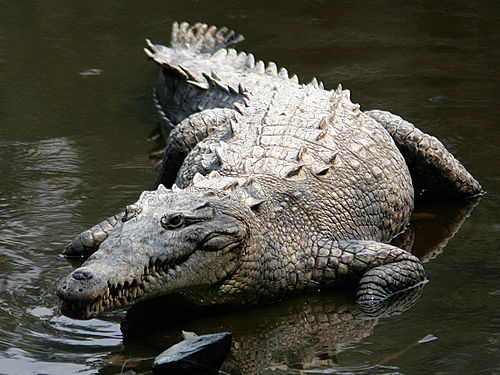
The American crocodile (Crocodylus acutus) is a species of crocodilian found in the Neotropics. It is the most widespread of the four extant species of crocodiles from the Americas, with populations present from South Florida, the Caribbean islands of Cuba, Jamaica, and Hispaniola, and the coasts of Mexico to as far south as Peru, Ecuador, Colombia, and Venezuela.

The habitat of the American crocodile consists largely of coastal areas. It is also found in river systems, but tends to prefer salinity, resulting in the species congregating in brackish lakes, mangrove swamps, lagoons, cays, and small islands. Other crocodiles also have tolerance to saltwater due to salt glands underneath the tongue, but the American crocodile is the only species other than the saltwater crocodile to commonly live and thrive in saltwater. They can be found on beaches and small island formations without any freshwater source, such as many cays and islets across the Caribbean. They are also found in hypersaline lakes; one of the largest known populations inhabits Lago Enriquillo in the Dominican Republic.

The American crocodile is one of the largest crocodile species. Males can reach lengths of more than 7 m (23 ft 0 in), weighing over 1,000 kilograms (2,200 lb). On average, mature males are more in the range of 2.9 to 4.1 m (9 ft 6 in to 13 ft 5 in) in length weighing up to about 400 kg (880 lb). As with other crocodile species, females are smaller, rarely exceeding 3.8 m (12 ft 6 in) in length even in the largest-bodied population.

Like any other large crocodilian, the American crocodile is potentially dangerous to humans, but it tends not to be as aggressive as some other species. American crocodiles coexist with the American alligator in Florida, and with the smaller spectacled caiman within Central America and South America. The IUCN lists the American crocodile as vulnerable, and is a federally threatened, flagship species and ecological indicator within the Florida Everglades World Heritage Site. Wikipedia →
Sounds

Recording0:17

United States · 2026

© Isaac Lord · iNaturalist · CC BY-NC 4.0

Global Distribution

Parks Where Found

# Park Country Daily sighting probability
1 Coiba National Park 🇵🇦 Panama
~80%
2 Palo Verde National Park 🇨🇷 Costa Rica
~70%
3 Everglades National Park 🇺🇸 United States
~70%
4 Cañón del Sumidero National Park 🇲🇽 Mexico
~60%
5 Tortuguero National Park 🇨🇷 Costa Rica
~50%
6 Arrecifes de Cozumel National Park 🇲🇽 Mexico
~50%
7 Las Baulas Marine National Park 🇨🇷 Costa Rica
~50%
8 Corcovado National Park 🇨🇷 Costa Rica
~40%
9 Ría Lagartos Biosphere Reserve 🇲🇽 Mexico
~40%
10 Sian Ka'an Biosphere Reserve 🇲🇽 Mexico
~40%
11 Ostional Wildlife Refuge 🇨🇷 Costa Rica
~30%
12 Soberanía National Park 🇵🇦 Panama
~30%
13 Carara National Park 🇨🇷 Costa Rica
~30%
14 Piedras Blancas National Park 🇨🇷 Costa Rica
~30%
15 Santa Rosa National Park 🇨🇷 Costa Rica
~30%
16 San Lorenzo Protected Forest 🇵🇦 Panama
~20%
17 Pico Bonito National Park 🇭🇳 Honduras
~20%
18 Tayrona National Natural Park 🇨🇴 Colombia
~20%
19 Manuel Antonio National Park 🇨🇷 Costa Rica
~20%
20 Cabo Blanco Absolute Nature Reserve 🇨🇷 Costa Rica
~10%
21 Tapantí-Macizo de la Muerte National Park 🇨🇷 Costa Rica
~10%
22 Big Cypress National Preserve 🇺🇸 United States
~10%
23 Parque Natural Metropolitano 🇵🇦 Panama
~10%
24 Chagres National Park 🇵🇦 Panama
~10%
25 Cahuita National Park 🇨🇷 Costa Rica
~10%
26 Arenal Volcano National Park 🇨🇷 Costa Rica
~10%
27 La Amistad International Park (Panama) 🇵🇦 Panama
~10%
28 Chirripó National Park 🇨🇷 Costa Rica
<5%

Zoos & Centres Where Found

# Zoo / Centre Country
1 Disney's Animal Kingdom 🇺🇸 United States In captivity
2 Belize Zoo 🇧🇿 Belize In captivity
3 Parque Temático Hacienda Nápoles 🇨🇴 Colombia In captivity
4 Nandankanan Zoological Park 🇮🇳 India In captivity
5 Arignar Anna Zoological Park 🇮🇳 India In captivity
6 Zoo Miami 🇺🇸 United States In captivity
7 Ponderosa Adventure Park 🇨🇷 Costa Rica In captivity
8 Yumka' 🇲🇽 Mexico In captivity
9 Kadoorie Farm and Botanic Garden 🇭🇰 Hong Kong SAR China In captivity
10 Everglades Safari Park 🇺🇸 United States In captivity
11 Omaha’s Henry Doorly Zoo and Aquarium 🇺🇸 United States In captivity
12 Shenzhen Safari Park 🇨🇳 China In captivity
13 Parque y Zoológico Nacional Arquitecto Manuel Valverde Podestá 🇩🇴 Dominican Republic In captivity
14 Parque Zoológico de León - Zooleón 🇲🇽 Mexico In captivity
15 Parque Municipal Summit 🇵🇦 Panama In captivity
16 Central Florida Zoo and Botanical Gardens 🇺🇸 United States In captivity
17 Guadalajara Zoo 🇲🇽 Mexico In captivity
18 Ukumarí Biopark 🇨🇴 Colombia In captivity
19 Brevard Zoo 🇺🇸 United States In captivity
20 Fort Worth Zoo 🇺🇸 United States In captivity
21 Gatorland 🇺🇸 United States In captivity
22 Indianapolis Zoo 🇺🇸 United States In captivity
23 Zoológico Benito Juárez 🇲🇽 Mexico In captivity
24 bioparco 🇮🇹 Italy In captivity
25 Amaru 🇪🇨 Ecuador In captivity
26 Parque de las Leyendas 🇵🇪 Peru In captivity
27 Zoo Sibiu 🇷🇴 Romania In captivity
28 Bioparque Los Ocarros 🇨🇴 Colombia In captivity
29 Bioparque Wakatá 🇨🇴 Colombia In captivity
30 Safari Masai Mara 🇲🇽 Mexico In captivity
31 UMA "El Palapo" 🇲🇽 Mexico In captivity
32 Yaguar Xoo 🇲🇽 Mexico In captivity
33 Zoo. La Isla del Tapir 🇪🇨 Ecuador In captivity
34 Jungle Island 🇺🇸 United States In captivity
35 Parque de la Conservación 🇨🇴 Colombia In captivity
36 Parque Zoológico Miguel Ángel de Quevedo 🇲🇽 Mexico In captivity
37 Bhiwani Zoo 🇮🇳 India In captivity
38 Hope Zoo 🇯🇲 Jamaica In captivity
39 Parque Zoológico El Pinar 🇻🇪 Venezuela In captivity
40 Everglades Alligator Farm 🇺🇸 United States In captivity
41 Parque Zoológico Nacional Simón Bolívar 🇨🇷 Costa Rica In captivity
42 Croco Cun Zoo 🇲🇽 Mexico In captivity
43 Ecozoológico San Martín 🇪🇨 Ecuador In captivity
44 El Nispero Zoo 🇵🇦 Panama In captivity
45 St. Augustine Alligator Farm Zoological Park 🇺🇸 United States In captivity
46 Zoo El Pantanal 🇪🇨 Ecuador In captivity
47 Zoológico de Culiacán 🇲🇽 Mexico In captivity
48 Dubai Crocodile Park 🇦🇪 United Arab Emirates In captivity
49 Gulfarium Marine Adventure Park 🇺🇸 United States In captivity
50 Marino Valdivia Park 🇪🇨 Ecuador In captivity

Closest Relatives at Tayrona National Natural Park

No species of the same family or order lives in Tayrona National Natural Park, so these are its closest relatives here: other reptiles.

Before you go

What are the chances of seeing an American Crocodile in Tayrona National Natural Park?

Possible

About 20% of wildlife watchers report an American Crocodile sighting in Tayrona National Natural Park on a given day, based on 38 verified sightings from GBIF citizen-science data from 2019 to 2026. It is the 21st most-seen of the 26 reptiles we can rate there. Over three days the chance rises to about 50%, and over a week to about 80%, if each day is a fresh chance.

When is the best time to see an American Crocodile in Tayrona National Natural Park?

January

In that month about 40% of wildlife watchers report an American Crocodile in Tayrona National Natural Park on a given day, against under 5% in March, May and August, the lowest months. That is one of Tayrona National Natural Park's driest months, with about 5 mm of rain against 180 mm in October.

What time of day is best to see an American Crocodile?

Between 9 am and noon

Across all the parks we cover, that three-hour window holds the most American Crocodile sightings with a recorded time, and about 8 in 10 of them come between 6 am and 6 pm: it is a daytime animal.

Where does the American Crocodile sighting chance come from?

GBIF citizen-science records

It is estimated from how often the American Crocodile is recorded against all the reptiles logged in Tayrona National Natural Park (38 verified sightings from 2019 to 2026), calibrated against known sighting rates. Figures are rounded to the nearest 10% because citizen-science data supports honest approximations, not decimals, and months with records from fewer than five people show "—". How it works.

← Back to Tayrona National Natural Park