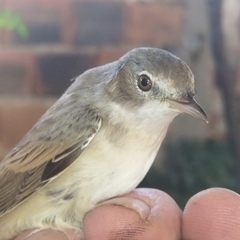
Whitethroat

Whitethroat

Sylvia communis

Silhouette: Alexis Lours · PhyloPic

Daily sighting probability ~10% · With luck
at Wadden Sea National Park

In 3 days ~20% in a week ~50%

727 Verified sightings at Wadden Sea National Park From 2019 to 2026
3,499 In all 36 parks
May Best month
☀️ Diurnal When it's spotted

About the Whitethroat

The greater whitethroat or common whitethroat (Curruca communis) is a common and widespread Old World warbler which breeds throughout Europe and across much of temperate western Asia. This small passerine bird is strongly migratory, and winters in tropical Africa, Arabia, and Pakistan.

The English ornithologist John Latham described the Greater whitethroat in 1783 in his A General Synopsis of Birds but introduced the binomial name Sylvia communis in the supplement to this work which was published in 1787. The specific communis is Latin for "common". The common whitethroat is now placed in the genus Curruca that was introduced by the German naturalist Johann Matthäus Bechstein in 1802.

This species may appear to be closely related to the lesser whitethroat, the species having evolved only during the end of the last ice age similar to the willow warbler and chiffchaffs. However, researchers found the presence of a white throat is an unreliable morphological marker for relationships in Curruca, and the greater and lesser whitethroats are not closely related. A molecular phylogenetic study of the Sylviidae published in 2011 found that within the genus Curruca the common whitethroat... Wikipedia →

Sounds

Recording0:12

Germany · 2026

© nicandra711ph · iNaturalist · CC BY-NC 4.0

Recording0:08

United Kingdom · 2026

© hstone26 · iNaturalist · CC BY-NC 4.0

Recording0:16

United Kingdom · 2026

© Geoff Stockle · iNaturalist · CC BY-NC 4.0

Global Distribution

Parks Where Found

# Park Country Daily sighting probability
1 Biebrza National Park 🇵🇱 Poland
~30%
2 Gobi Gurvansaikhan National Park 🇲🇳 Mongolia
~30%
3 Białowieża National Park 🇵🇱 Poland
~20%
4 Fertő-Hanság National Park 🇭🇺 Hungary
~20%
5 Gauja National Park 🇱🇻 Latvia
~20%
6 Tsavo West National Park 🇰🇪 Kenya
~20%
7 Kiskunság National Park 🇭🇺 Hungary
~10%
8 Mkomazi National Park 🇹🇿 Tanzania
~10%
9 Cévennes National Park 🇫🇷 France
~10%
10 Tatra National Park 🇸🇰 Slovakia
~10%
11 Wadden Sea National Park 🇩🇪 Germany
~10%
12 Snowdonia National Park 🇬🇧 United Kingdom
~10%
13 Hortobágy National Park 🇭🇺 Hungary
~10%
14 Sierra de Guadarrama National Park 🇪🇸 Spain
~10%
15 Meru National Park 🇰🇪 Kenya
~10%
16 Bavarian Forest National Park 🇩🇪 Germany
~10%
17 Picos de Europa National Park 🇪🇸 Spain
<5%
18 Sierra Nevada National Park 🇪🇸 Spain
<5%
19 Pyrénées National Park 🇫🇷 France
<5%
20 Ngorongoro Conservation Area 🇹🇿 Tanzania
<5%
21 Samburu National Reserve 🇰🇪 Kenya
<5%
22 Tsavo East National Park 🇰🇪 Kenya
<5%
23 Arusha National Park 🇹🇿 Tanzania
<5%
24 Lake Manyara National Park 🇹🇿 Tanzania
<5%
25 Tarangire National Park 🇹🇿 Tanzania
<5%
26 Nairobi National Park 🇰🇪 Kenya
<5%
27 Camargue 🇫🇷 France
<5%
28 Ordesa y Monte Perdido National Park 🇪🇸 Spain
<5%
29 Aigüestortes National Park 🇪🇸 Spain
<5%
30 Serengeti National Park 🇹🇿 Tanzania
<5%
31 Cairngorms National Park 🇬🇧 United Kingdom
<5%
32 Doñana National Park 🇪🇸 Spain
<5%
33 Monfragüe National Park 🇪🇸 Spain
<5%
34 Amboseli National Park 🇰🇪 Kenya
<5%
35 Lake Nakuru National Park 🇰🇪 Kenya
<5%
36 Kruger National Park 🇿🇦 South Africa
<5%

Cities Where Found

# City Country Daily sighting probability
1 Jerusalem 🇮🇱 Israel
~20%
2 Abu Dhabi 🇦🇪 United Arab Emirates
~20%
3 Doha 🇶🇦 Qatar
~20%
4 N'Djamena 🇹🇩 Chad
~20%
5 Novosibirsk 🇷🇺 Russia
~20%
6 Kuwait City 🇰🇼 Kuwait
~10%
7 Helsinki 🇫🇮 Finland
~10%
8 Manchester 🇬🇧 United Kingdom
~10%
9 Ramallah 🇵🇸 Palestine
~10%
10 Liverpool 🇬🇧 United Kingdom
~10%

Before you go

What are the chances of seeing a Whitethroat in Wadden Sea National Park?

With luck

About 10% of wildlife watchers report a Whitethroat sighting in Wadden Sea National Park on a given day, based on 727 verified sightings from GBIF citizen-science data from 2019 to 2026. It is the 102nd most-seen of the 285 birds we can rate there. Over three days the chance rises to about 20%, and over a week to about 50%, if each day is a fresh chance.

When is the best time to see a Whitethroat in Wadden Sea National Park?

May

In that month about 40% of wildlife watchers report a Whitethroat in Wadden Sea National Park on a given day, against under 5% in September to April, the lowest months. That is one of Wadden Sea National Park's driest months, with about 45 mm of rain against 140 mm in November.

What time of day is best to see a Whitethroat?

Between 7 and 10 am

Across all the parks we cover, that three-hour window holds the most Whitethroat sightings with a recorded time, and about 9 in 10 of them come between 6 am and 6 pm: it is a daytime animal.

Which relatives of the Whitethroat live in Wadden Sea National Park?

Same genus: Sylvia

The closest relatives of the Whitethroat that you can see in Wadden Sea National Park (genus Sylvia, Sylvia Warblers) are Blackcap (about 10%) and Lesser Whitethroat (about 10%), with each one's daily chance of a sighting.

Where does the Whitethroat sighting chance come from?

GBIF citizen-science records

It is estimated from how often the Whitethroat is recorded against all the birds logged in Wadden Sea National Park (727 verified sightings from 2019 to 2026), calibrated against known sighting rates. Figures are rounded to the nearest 10% because citizen-science data supports honest approximations, not decimals, and months with records from fewer than five people show "—". How it works.

← Back to Wadden Sea National Park