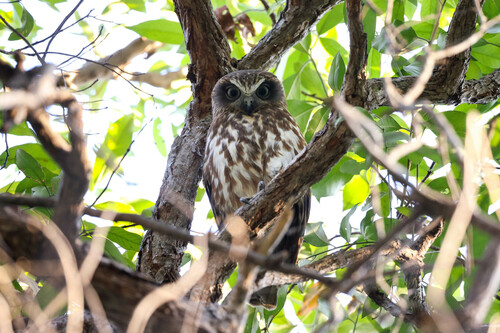
Southern Boobook

Southern Boobook

Ninox boobook

Silhouette: Rachel T Mason · PhyloPic

LCLeast ConcernNTVUENCR
Daily sighting probability ~10% · With luck
at Wilsons Promontory National Park

In 3 days ~20% in a week ~30%

40 Verified sightings at Wilsons Promontory National Park From 2019 to 2026
1,391 In all 15 parks
December Best month
☀️🌙 Day & Night When it's spotted

About the Southern Boobook

The Australian boobook (Ninox boobook), is a species of owl native to mainland Australia, southern New Guinea, the island of Timor, and the Sunda Islands. Described by John Latham in 1801, it was generally considered to be the same species as the morepork of New Zealand until 1999. Its name is derived from its two-tone boo-book call. Eight subspecies of the Australian boobook are recognized, with three further subspecies being reclassified as separate species in 2019 due to their distinctive calls and genetics.

The smallest owl on the Australian mainland, the Australian boobook is 27 to 36 cm (10.5 to 14 in) long, with predominantly dark-brown plumage with prominent pale spots. It has grey-green or yellow-green eyes. It is generally nocturnal, though sometimes it is active at dawn and dusk, retiring to roost in secluded spots in the foliage of trees. The Australian boobook feeds on insects and small vertebrates, hunting by pouncing on them from tree perches. Breeding takes place from late winter to early summer, using tree hollows as nesting sites. The International Union for Conservation of Nature has assessed the Australian boobook as being of least concern on account of its large range and apparently stable population. Wikipedia →

Sounds

Call0:34

Australia · 2026

© Colin Reid · XC1173887 · CC BY-NC-SA 4.0

Uncertain0:24

Australia · 2024

© Meaghan Adam-Cross · XC936351 · CC BY-NC-SA 4.0

Song1:16

Australia · 2023

© Peter Boesman · XC859978 · CC BY-NC-ND 4.0

Global Distribution

Parks Where Found

# Park Country Daily sighting probability
1 Flinders Chase 🇦🇺 Australia
~10%
2 Flinders Ranges National Park 🇦🇺 Australia
~10%
3 Lamington National Park 🇦🇺 Australia
~10%
4 Hattah-Kulkyne National Park 🇦🇺 Australia
~10%
5 Wilsons Promontory National Park 🇦🇺 Australia
~10%
6 Kosciuszko National Park 🇦🇺 Australia
~10%
7 Booderee National Park 🇦🇺 Australia
~10%
8 Grampians National Park 🇦🇺 Australia
<5%
9 Kakadu National Park 🇦🇺 Australia
<5%
10 Great Otway National Park 🇦🇺 Australia
<5%
11 Springbrook National Park 🇦🇺 Australia
<5%
12 Blue Mountains National Park 🇦🇺 Australia
<5%
13 Litchfield National Park 🇦🇺 Australia
<5%
14 Nitmiluk National Park 🇦🇺 Australia
<5%
15 Royal National Park 🇦🇺 Australia
<5%

Cities Where Found

# City Country Daily sighting probability
1 Perth 🇦🇺 Australia
<5%
2 Brisbane 🇦🇺 Australia
<5%
3 Sydney 🇦🇺 Australia
<5%
4 Melbourne 🇦🇺 Australia
<5%

Zoos & Centres Where Found

# Zoo / Centre Country
1 ZooParc de Beauval 🇫🇷 France In captivity
2 Tierpark Berlin 🇩🇪 Germany In captivity
3 Zoo Pilsen 🇨🇿 Czechia In captivity
4 Walsrode World Bird Park 🇩🇪 Germany In captivity
5 Espace Rambouillet 🇫🇷 France In captivity
6 Kyabram Fauna Park 🇦🇺 Australia In captivity
7 Alice Springs Desert Park 🇦🇺 Australia In captivity
8 Hartley’s Crocodile Adventures 🇦🇺 Australia In captivity
9 Ballarat Wildlife Park 🇦🇺 Australia In captivity
10 Gorge Wildlife Park 🇦🇺 Australia In captivity
11 Small Breeds Farm Park 🇬🇧 United Kingdom In captivity
12 Featherdale Sydney Wildlife Park 🇦🇺 Australia In captivity
13 Kangaroo Island Wildlife Park 🇦🇺 Australia In captivity
14 Le centre de soins des rapaces Espace Rambouillet 🇫🇷 France In captivity
15 Ranger Red’s Zoo & Conservation Park 🇦🇺 Australia In captivity
16 Warrawong Wildlife Sanctuary 🇦🇺 Australia In captivity

Closest Relatives at Wilsons Promontory National Park

No species of the same family or order lives in Wilsons Promontory National Park, so these are its closest relatives here: other birds.

Before you go

What are the chances of seeing a Southern Boobook in Wilsons Promontory National Park?

With luck

About 10% of wildlife watchers report a Southern Boobook sighting in Wilsons Promontory National Park on a given day, based on 40 verified sightings from GBIF citizen-science data from 2019 to 2026. It is the 79th most-seen of the 138 birds we can rate there. Over three days the chance rises to about 20%, and over a week to about 30%, if each day is a fresh chance.

When is the best time to see a Southern Boobook in Wilsons Promontory National Park?

March, May–June, September–October and December

In those months about 10% of wildlife watchers report a Southern Boobook in Wilsons Promontory National Park on a given day, against under 5% in January–February, April, July–August and November, the lowest months.

What time of day is best to see a Southern Boobook?

Between 7 and 10 pm

Across all the parks we cover, that three-hour window holds the most Southern Boobook sightings with a recorded time, and about 6 in 10 of them come between 6 pm and 6 am: it is seen both by day and at night.

Is Wilsons Promontory National Park the best place to see a Southern Boobook?

Among the best

Of the 15 parks where we can rate Southern Boobook sightings, Wilsons Promontory National Park ranks 5th at about 10%, level with the leaders once rounded. The best odds are in Flinders Chase (Australia, about 10%), Flinders Ranges National Park (Australia, about 10%) and Lamington National Park (Australia, about 10%).

Where does the Southern Boobook sighting chance come from?

GBIF citizen-science records

It is estimated from how often the Southern Boobook is recorded against all the birds logged in Wilsons Promontory National Park (40 verified sightings from 2019 to 2026), calibrated against known sighting rates. Figures are rounded to the nearest 10% because citizen-science data supports honest approximations, not decimals, and months with records from fewer than five people show "—". How it works.

← Back to Wilsons Promontory National Park