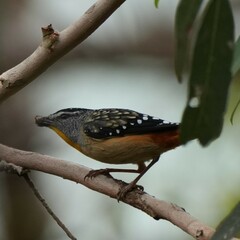
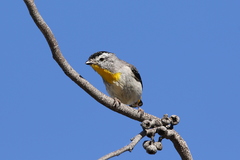

Spotted Pardalote

Spotted Pardalote

Pardalotus punctatus

Silhouette: Sheatherius · PhyloPic

LCLeast ConcernNTVUENCR Endemic
Daily sighting probability ~10% · With luck
at Wilsons Promontory National Park

In 3 days ~20% in a week ~50%

51 Verified sightings at Wilsons Promontory National Park From 2019 to 2026
6,264 In all 17 parks
November Best month
☀️ Diurnal When it's spotted

About the Spotted Pardalote

The spotted pardalote (Pardalotus punctatus) is a small passerine bird native to eastern and southern Australia, at elevations of up to 2,000 metres (6,600 ft). It is part of the pardalote family, Pardalotidae. One of the smallest of all Australian birds at 8 to 10 centimetres (3.1 to 3.9 in) in length, and one of the most colourful; it is sometimes known as the diamondbird. Although moderately common in all of the reasonably fertile parts of Australia (the east coast, the south-east, and the south-west corner) it is seldom seen closely enough to enable identification.

Three subspecies are recognised. The wet tropics spotted pardalote (subspecies militaris) is found in northeastern Queensland, while the distinctive subspecies, the yellow-rumped pardalote (subspecies xanthopyge), is mostly found in drier inland regions of southern Australia, particularly in semi-arid Mallee woodlands. Also occasionally found nesting in burrows in semi-rainforest areas inland from the coast in Mid North Coast NSW.

The spotted pardalote was described by English naturalist George Shaw and drawn by Frederick Polydore Nodder in the 1792 work The Naturalist's Miscellany: Or, Coloured Figures... Wikipedia →

Sounds

Song0:12

Australia · 2025

© Étienne Leroy · XC1069925 · CC BY-NC-SA 4.0

Call0:44

Australia · 2024

© Khristos Nizamis · XC913067 · CC BY-NC-ND 4.0

Song0:54

Australia · 2025

© Marc Anderson · XC1031601 · CC BY-NC-ND 4.0

Global Distribution

Parks Where Found

# Park Country Daily sighting probability
1 Kosciuszko National Park 🇦🇺 Australia
~50%
2 Flinders Chase 🇦🇺 Australia
~40%
3 Grampians National Park 🇦🇺 Australia
~40%
4 Maria Island National Park 🇦🇺 Australia
~40%
5 Hattah-Kulkyne National Park 🇦🇺 Australia
~40%
6 Blue Mountains National Park 🇦🇺 Australia
~30%
7 Great Otway National Park 🇦🇺 Australia
~30%
8 Booderee National Park 🇦🇺 Australia
~30%
9 Royal National Park 🇦🇺 Australia
~30%
10 Springbrook National Park 🇦🇺 Australia
~20%
11 Freycinet National Park 🇦🇺 Australia
~20%
12 Lamington National Park 🇦🇺 Australia
~20%
13 Wilsons Promontory National Park 🇦🇺 Australia
~10%
14 Cradle Mountain-Lake St Clair National Park 🇦🇺 Australia
~10%
15 Flinders Ranges National Park 🇦🇺 Australia
<5%
16 Noosa National Park 🇦🇺 Australia
<5%
17 Daintree National Park 🇦🇺 Australia
<5%

Cities Where Found

# City Country Daily sighting probability
1 Melbourne 🇦🇺 Australia
~30%
2 Hobart 🇦🇺 Australia
~30%
3 Sydney 🇦🇺 Australia
~20%
4 Perth 🇦🇺 Australia
<5%
5 Brisbane 🇦🇺 Australia
<5%

Before you go

What are the chances of seeing a Spotted Pardalote in Wilsons Promontory National Park?

With luck

About 10% of wildlife watchers report a Spotted Pardalote sighting in Wilsons Promontory National Park on a given day, based on 51 verified sightings from GBIF citizen-science data from 2019 to 2026. It is the 58th most-seen of the 138 birds we can rate there. Over three days the chance rises to about 20%, and over a week to about 50%, if each day is a fresh chance.

When is the best time to see a Spotted Pardalote in Wilsons Promontory National Park?

November and December

In those months about 20% of wildlife watchers report a Spotted Pardalote in Wilsons Promontory National Park on a given day, against under 5% in January, April and July–August, the lowest months.

What time of day is best to see a Spotted Pardalote?

Between 10 am and 1 pm

Across all the parks we cover, that three-hour window holds the most Spotted Pardalote sightings with a recorded time, and nearly all of them come between 6 am and 6 pm: it is a daytime animal.

Is Wilsons Promontory National Park the best place to see a Spotted Pardalote?

13th of 17

Of the 17 parks where we can rate Spotted Pardalote sightings, Wilsons Promontory National Park ranks 13th at about 10%. The best odds are in Kosciuszko National Park (Australia, about 50%), Flinders Chase (Australia, about 40%) and Grampians National Park (Australia, about 40%). All parks ranked.

Which relatives of the Spotted Pardalote live in Wilsons Promontory National Park?

Same order: Passeriformes

The closest relatives of the Spotted Pardalote that you can see in Wilsons Promontory National Park (order Passeriformes, Perching Birds) are Superb Fairywren (about 80%), Australian Magpie (about 70%) and Red Wattlebird (about 70%), with each one's daily chance of a sighting.

Where does the Spotted Pardalote sighting chance come from?

GBIF citizen-science records

It is estimated from how often the Spotted Pardalote is recorded against all the birds logged in Wilsons Promontory National Park (51 verified sightings from 2019 to 2026), calibrated against known sighting rates. Figures are rounded to the nearest 10% because citizen-science data supports honest approximations, not decimals, and months with records from fewer than five people show "—". How it works.

← Back to Wilsons Promontory National Park