Australian White Ibis

Australian White Ibis

Threskiornis molucca

Silhouette: PhyloPic

Daily sighting probability <5% · Rare
at Booderee National Park

In 3 days ~10% in a week ~20%

13 Verified sightings at Booderee National Park From 2019 to 2026
2,587 In all 15 parks
August Best month
☀️ Diurnal When it's spotted

About the Australian White Ibis

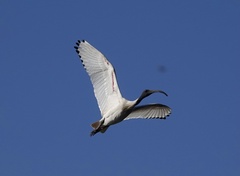
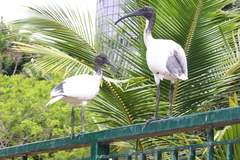
The Australian white ibis (Threskiornis molucca), commonly known as the bin chicken, is a wading bird of the family Threskiornithidae. It is widespread across much of Australia. It has a predominantly white plumage with a bare, black head, long downcurved bill, and black legs. While it is closely related to the African sacred ibis, the Australian white ibis is a native Australian bird. Contrary to urban myth, it is not a feral species introduced to Australia by people, and it does not come from Egypt.

Historically rare in urban areas, the Australian white ibis has established in urban areas of the east coast in increasing numbers since the late 1970s; it is now commonly seen in Wollongong, Sydney, Melbourne, Adelaide, Darwin, the Gold Coast, Brisbane and Townsville. In recent years, the bird has also become increasingly common in Perth, Western Australia, and surrounding towns in south-western Australia. Populations have disappeared from natural breeding areas such as the Macquarie Marshes in northern New South Wales. Management plans have been introduced to control problematic urban populations in Sydney.

Due to their commonality in urban areas, and their habit of rummaging in outside garbage, the species has acquired a variety of names, including "tip turkey" and "bin chicken". Wikipedia →

Sounds

Call0:39

Australia · 2023

© Romuald Mikusek · XC1062938 · CC BY-NC-SA 4.0

Begging call1:25

Australia · 2022

© James Lambert · XC722464 · CC BY-NC-ND 4.0

Call0:04

Australia · 2022

© Marc Anderson · XC816337 · CC BY-NC-ND 4.0

Global Distribution

Parks Where Found

# Park Country Daily sighting probability
1 Kakadu National Park 🇦🇺 Australia
~40%
2 Daintree National Park 🇦🇺 Australia
~40%
3 Hattah-Kulkyne National Park 🇦🇺 Australia
~20%
4 Royal National Park 🇦🇺 Australia
~20%
5 Wilsons Promontory National Park 🇦🇺 Australia
~20%
6 Litchfield National Park 🇦🇺 Australia
~10%
7 Noosa National Park 🇦🇺 Australia
~10%
8 Flinders Chase 🇦🇺 Australia
~10%
9 Springbrook National Park 🇦🇺 Australia
~10%
10 Grampians National Park 🇦🇺 Australia
<5%
11 Booderee National Park 🇦🇺 Australia
<5%
12 Blue Mountains National Park 🇦🇺 Australia
<5%
13 Great Otway National Park 🇦🇺 Australia
<5%
14 Lamington National Park 🇦🇺 Australia
<5%
15 Raja Ampat 🇮🇩 Indonesia
<5%

Cities Where Found

# City Country Daily sighting probability
1 Brisbane 🇦🇺 Australia
~70%
2 Sydney 🇦🇺 Australia
~70%
3 Perth 🇦🇺 Australia
~70%
4 Melbourne 🇦🇺 Australia
~40%

Zoos & Centres Where Found

# Zoo / Centre Country
1 Australia Zoo 🇦🇺 Australia In captivity
2 Zoo Pilsen 🇨🇿 Czechia In captivity
3 San Diego Zoo Safari Park 🇺🇸 United States In captivity
4 Toronto Zoo 🇨🇦 Canada In captivity
5 Ree Park – Ebeltoft Safari 🇩🇰 Denmark In captivity
6 Cape May County Park & Zoo 🇺🇸 United States In captivity
7 Healesville Sanctuary 🇦🇺 Australia In captivity
8 Terra Natura Benidorm 🇪🇸 Spain In captivity
9 San Francisco Zoo 🇺🇸 United States In captivity
10 Temaikén 🇦🇷 Argentina In captivity
11 African Safari Wildlife Park 🇺🇸 United States In captivity
12 Taronga Zoo 🇦🇺 Australia In captivity
13 Naturwildpark Freisen 🇩🇪 Germany In captivity
14 Melbourne Zoo 🇦🇺 Australia In captivity
15 Tashkent Zoo 🇺🇿 Uzbekistan In captivity
16 Parndana Wildlife Park 🇦🇺 Australia In captivity
17 Surabaya Zoo 🇮🇩 Indonesia In captivity
18 Zoo das Aves 🇧🇷 Brazil In captivity
19 Seville Zoo 🇪🇸 Spain In captivity
20 Rivne Zoo 🇺🇦 Ukraine In captivity
21 Kuala Lumpur Bird Park 🇲🇾 Malaysia In captivity
22 Jardin zoologique de la ville de Lyon 🇫🇷 France In captivity
23 Blåvand Zoo 🇩🇰 Denmark In captivity
24 Děčín Zoo 🇨🇿 Czechia In captivity
25 World of Birds Wildlife Sanctuary and Monkey Park 🇿🇦 South Africa In captivity
26 Featherdale Sydney Wildlife Park 🇦🇺 Australia In captivity
27 Langkawi Nature Park 🇲🇾 Malaysia In captivity
28 Haifa Zoo and Botanical Gardens 🇮🇱 Israel In captivity
29 Ipswich Nature Centre 🇦🇺 Australia In captivity
30 Langkawi Wildlife Park 🇲🇾 Malaysia In captivity
31 Olching Bird Park 🇩🇪 Germany In captivity
32 Debrecen Amusement Park 🇭🇺 Hungary In captivity

Before you go

What are the chances of seeing an Australian White Ibis in Booderee National Park?

Rare

Under 5% of wildlife watchers report an Australian White Ibis sighting in Booderee National Park on a given day, based on 13 verified sightings from GBIF citizen-science data from 2019 to 2026. It is the 98th most-seen of the 128 birds we can rate there. Over three days the chance rises to about 10%, and over a week to about 20%, if each day is a fresh chance.

When is the best time to see an Australian White Ibis in Booderee National Park?

August and September

In those months about 10% of wildlife watchers report an Australian White Ibis in Booderee National Park on a given day, against under 5% in October to July, the lowest months.

What time of day is best to see an Australian White Ibis?

Between 10 am and 1 pm

Across all the parks we cover, that three-hour window holds the most Australian White Ibis sightings with a recorded time, and nearly all of them come between 6 am and 6 pm: it is a daytime animal.

Where does the Australian White Ibis sighting chance come from?

GBIF citizen-science records

It is estimated from how often the Australian White Ibis is recorded against all the birds logged in Booderee National Park (13 verified sightings from 2019 to 2026), calibrated against known sighting rates. Figures are rounded to the nearest 10% because citizen-science data supports honest approximations, not decimals, and months with records from fewer than five people show "—". How it works.

← Back to Booderee National Park