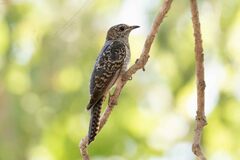
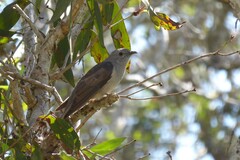
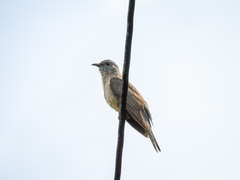
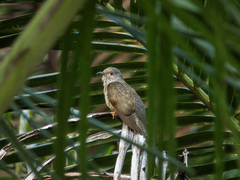

Rusty-breasted Cuckoo

Rusty-breasted Cuckoo

Cacomantis variolosus

Silhouette: Nicolas Huet le Jeune and Jean-Gabriel Prêtre (vectorized by T. Michael Keesey) · PhyloPic

LCLeast ConcernNTVUENCR
Daily sighting probability <5% · Rare
at Booderee National Park

In 3 days <5% in a week ~10%

5 Verified sightings at Booderee National Park From 2019 to 2026
1,232 In all 21 parks
September Best month
☀️ Diurnal When it's spotted

About the Rusty-breasted Cuckoo

The Sahul brush cuckoo (Cacomantis variolosus), formerly known as the brush cuckoo, is a member of the cuckoo family. It is native to Malesia, New Guinea, the Solomon Islands and northern and eastern Australia. It is a grey-brown bird with a buff breast. Its call is a familiar sound of the Australian and Indonesian bush.

The Manus brush cuckoo (Cacomantis blandus) and the Solomons brush cuckoo... Wikipedia →

Sounds

Call0:09

Australia · 2024

© Tom Cooney · XC1104906 · CC BY-NC-SA 4.0

Song0:26

Australia · 2025

© Étienne Leroy · XC1070884 · CC BY-NC-SA 4.0

Song and call1:29

Australia · 2025

© Peter Boesman · XC1066410 · CC BY-NC-ND 4.0

Global Distribution

Parks Where Found

# Park Country Daily sighting probability
1 Kakadu National Park 🇦🇺 Australia
~20%
2 Raja Ampat 🇮🇩 Indonesia
~20%
3 Daintree National Park 🇦🇺 Australia
~10%
4 Litchfield National Park 🇦🇺 Australia
~10%
5 Kosciuszko National Park 🇦🇺 Australia
~10%
6 Springbrook National Park 🇦🇺 Australia
~10%
7 Tangkoko Nature Reserve 🇮🇩 Indonesia
~10%
8 Bali Barat National Park 🇮🇩 Indonesia
~10%
9 Khao Luang National Park 🇹🇭 Thailand
~10%
10 Kerinci Seblat National Park 🇮🇩 Indonesia
~10%
11 Way Kambas National Park 🇮🇩 Indonesia
<5%
12 Nitmiluk National Park 🇦🇺 Australia
<5%
13 Taman Negara National Park 🇲🇾 Malaysia
<5%
14 Lamington National Park 🇦🇺 Australia
<5%
15 Noosa National Park 🇦🇺 Australia
<5%
16 Booderee National Park 🇦🇺 Australia
<5%
17 Sepilok 🇲🇾 Malaysia
<5%
18 Great Otway National Park 🇦🇺 Australia
<5%
19 Danum Valley Conservation Area 🇲🇾 Malaysia
<5%
20 Blue Mountains National Park 🇦🇺 Australia
<5%
21 Kinabalu Park 🇲🇾 Malaysia
<5%

Cities Where Found

# City Country Daily sighting probability
1 Brisbane 🇦🇺 Australia
<5%
2 Denpasar 🇮🇩 Indonesia
<5%
3 Cebu City 🇵🇭 Philippines
<5%
4 Manila 🇵🇭 Philippines
<5%
5 Kuala Lumpur 🇲🇾 Malaysia
<5%
6 Jakarta 🇮🇩 Indonesia
<5%
7 Singapore 🇸🇬 Singapore
<5%

Before you go

What are the chances of seeing a Rusty-breasted Cuckoo in Booderee National Park?

Rare

Under 5% of wildlife watchers report a Rusty-breasted Cuckoo sighting in Booderee National Park on a given day, based on 5 verified sightings from GBIF citizen-science data from 2019 to 2026. It is the 122nd most-seen of the 128 birds we can rate there. Over three days the chance rises to under 5%, and over a week to about 10%, if each day is a fresh chance.

When is the best time to see a Rusty-breasted Cuckoo in Booderee National Park?

September

In that month about 10% of wildlife watchers report a Rusty-breasted Cuckoo in Booderee National Park on a given day, against under 5% in October to August, the lowest months. That is one of Booderee National Park's driest months, with about 60 mm of rain against 150 mm in March.

What time of day is best to see a Rusty-breasted Cuckoo?

Between 7 and 10 am

Across all the parks we cover, that three-hour window holds the most Rusty-breasted Cuckoo sightings with a recorded time, and about 9 in 10 of them come between 6 am and 6 pm: it is a daytime animal.

Is Booderee National Park the best place to see a Rusty-breasted Cuckoo?

16th of 21

Of the 21 parks where we can rate Rusty-breasted Cuckoo sightings, Booderee National Park ranks 16th at under 5%. The best odds are in Kakadu National Park (Australia, about 20%), Raja Ampat (Indonesia, about 20%) and Daintree National Park (Australia, about 10%).

Where does the Rusty-breasted Cuckoo sighting chance come from?

GBIF citizen-science records

It is estimated from how often the Rusty-breasted Cuckoo is recorded against all the birds logged in Booderee National Park (5 verified sightings from 2019 to 2026), calibrated against known sighting rates. Figures are rounded to the nearest 10% because citizen-science data supports honest approximations, not decimals, and months with records from fewer than five people show "—". How it works.

← Back to Booderee National Park