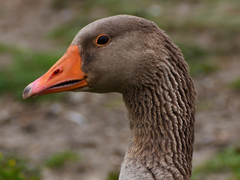
Greylag Goose

Greylag Goose

Anser anser

Silhouette: Wouter Koch · PhyloPic

LCLeast ConcernNTVUENCR
Daily sighting probability ~40% · Likely
at Cairngorms National Park

In 3 days ~80% in a week >90%

1,243 Verified sightings at Cairngorms National Park From 2019 to 2026
17,846 In all 22 parks
April Best month
☀️ Diurnal When it's spotted

About the Greylag Goose

The greylag goose (Anser anser) is a species of large goose in the waterfowl family Anatidae and the type species of the genus Anser. It has mottled and barred grey and white plumage and an orange beak and pink legs. A large bird, it measures between 74 and 91 centimetres (29 and 36 in) in length, with an average weight of 3.3 kilograms (7 lb 4 oz). Its distribution is widespread, with birds from the north of its range in Europe and Asia often migrating southwards to spend the winter in warmer places, although many populations are resident, even in the north. It is the ancestor of most breeds of domestic goose, having been domesticated at least as early as 1360 BCE. The genus name and specific epithet are from anser, the Latin for "goose". In the USA, its name has been spelled "graylag".

Greylag geese travel to their northerly breeding grounds in spring, nesting on moorlands, in marshes, around lakes and on coastal islands. They normally mate for life and nest on the ground among vegetation. A clutch of three to five eggs is laid; the female incubates the eggs and both parents defend and rear the young. The birds stay together as a family group, migrating southwards in autumn as part of a flock, and separating the following year. During the winter they occupy semi-aquatic habitats, estuaries, marshes and flooded fields, feeding on grass and often consuming agricultural crops. Some populations, such as those in southern England and in urban areas across the species' range, are primarily resident and occupy the same area year-round. Wikipedia →

Sounds

Call0:25

Netherlands · 2026

© Joost van Bruggen · XC1182370 · CC BY-NC-ND 4.0

Flight call0:46

Sweden · 2026

© Lars Edenius · XC1163267 · CC BY-NC-SA 4.0

Alarm call0:46

Sweden · 2024

© Lennart Jeppsson · XC914627 · CC BY-NC-SA 4.0

Global Distribution

Parks Where Found

# Park Country Daily sighting probability
1 Hortobágy National Park 🇭🇺 Hungary
~80%
2 Kiskunság National Park 🇭🇺 Hungary
~80%
3 Fertő-Hanság National Park 🇭🇺 Hungary
~70%
4 Wadden Sea National Park 🇩🇪 Germany
~60%
5 Biebrza National Park 🇵🇱 Poland
~60%
6 Doñana National Park 🇪🇸 Spain
~50%
7 Keoladeo National Park 🇮🇳 India
~50%
8 Cairngorms National Park 🇬🇧 United Kingdom
~40%
9 Bavarian Forest National Park 🇩🇪 Germany
~40%
10 Vatnajokull National Park 🇮🇸 Iceland
~20%
11 Kaziranga National Park 🇮🇳 India
~20%
12 Snowdonia National Park 🇬🇧 United Kingdom
~20%
13 Białowieża National Park 🇵🇱 Poland
~20%
14 Camargue 🇫🇷 France
~10%
15 Sierra de Guadarrama National Park 🇪🇸 Spain
~10%
16 Ranthambore National Park 🇮🇳 India
<5%
17 Monfragüe National Park 🇪🇸 Spain
<5%
18 Pyrénées National Park 🇫🇷 France
<5%
19 Satpura National Park 🇮🇳 India
<5%
20 Chitwan National Park 🇳🇵 Nepal
<5%
21 Jim Corbett National Park 🇮🇳 India
<5%
22 Kanha National Park 🇮🇳 India
<5%

Cities Where Found

# City Country Daily sighting probability
1 Copenhagen 🇩🇰 Denmark
~60%
2 Munich 🇩🇪 Germany
~50%
3 Hamburg 🇩🇪 Germany
~50%
4 Sincan 🇹🇷 Turkey
~40%
5 Rotterdam [The Hague] 🇳🇱 Netherlands
~40%
6 London 🇬🇧 United Kingdom
~30%
7 Amsterdam 🇳🇱 Netherlands
~30%
8 Lyon 🇫🇷 France
~30%
9 Berlin 🇩🇪 Germany
~20%
10 Birmingham 🇬🇧 United Kingdom
~20%

Zoos & Centres Where Found

# Zoo / Centre Country
1 Moscow Zoo 🇷🇺 Russia In captivity
2 Pairi Daiza 🇧🇪 Belgium In captivity
3 SeaWorld Abu Dhabi 🇦🇪 United Arab Emirates In captivity
4 Skansen 🇸🇪 Sweden In captivity
5 Lisbon Oceanarium 🇵🇹 Portugal In captivity
6 Barcelona Zoo 🇪🇸 Spain In captivity
7 Ostrava Zoo 🇨🇿 Czechia In captivity
8 Réserve africaine de Sigean 🇫🇷 France In captivity
9 Jihlava Zoo 🇨🇿 Czechia In captivity
10 Walsrode World Bird Park 🇩🇪 Germany In captivity
11 Kaliningrad Zoo 🇷🇺 Russia In captivity
12 Aquarium du palais de la Porte Dorée 🇫🇷 France In captivity
13 Zoopark Vyškov 🇨🇿 Czechia In captivity
14 La Tanière 🇫🇷 France In captivity
15 Nordens Ark 🇸🇪 Sweden In captivity
16 Parc animalier de Merlet 🇫🇷 France In captivity
17 Wildwald Voßwinkel 🇩🇪 Germany In captivity
18 Cheetah Experience 🇿🇦 South Africa In captivity
19 Lusen National Park Centre 🇩🇪 Germany In captivity
20 Taipei Zoo 🇹🇼 Taiwan In captivity
21 Nehru Zoological Park 🇮🇳 India In captivity
22 Tierpark Sababurg 🇩🇪 Germany In captivity
23 Ningbo Wildlife Park 🇨🇳 China In captivity
24 Parc du Belvédère 🇹🇳 Tunisia In captivity
25 Badoca Safari Park 🇵🇹 Portugal In captivity
26 Parc animalier de Sainte-Croix 🇫🇷 France In captivity
27 Ramat Gan Safari 🇮🇱 Israel In captivity
28 Wisentgehege Springe 🇩🇪 Germany In captivity
29 Karachi Safari Park 🇵🇰 Pakistan In captivity
30 Love Lake 🇦🇪 United Arab Emirates In captivity
31 Parc ornithologique de Pont-de-Gau 🇫🇷 France In captivity
32 西宁野生动物园 🇨🇳 China In captivity
33 Südliche Weinstraße Wildlife Park 🇩🇪 Germany In captivity
34 Silesian Zoological Garden 🇵🇱 Poland In captivity
35 Wildpark Poing 🇩🇪 Germany In captivity
36 Selwo Aventura 🇪🇸 Spain In captivity
37 南昌新动物园 🇨🇳 China In captivity
38 Kano Zoo 🇳🇬 Nigeria In captivity
39 Antalya Zoo 🇹🇷 Türkiye In captivity
40 Hellabrunn Zoo 🇩🇪 Germany In captivity
41 Kyiv Zoo 🇺🇦 Ukraine In captivity
42 Friguia Park 🇹🇳 Tunisia In captivity
43 Zoodyssée 🇫🇷 France In captivity
44 Jimmy’s Farm & Wildlife Park 🇬🇧 United Kingdom In captivity
45 Körösvölgyi Állatpark 🇭🇺 Hungary In captivity
46 无锡动物园 🇨🇳 China In captivity
47 Lisbon Zoo 🇵🇹 Portugal In captivity
48 Belgorod Zoo 🇷🇺 Russia In captivity
49 Parc de l'Auxois 🇫🇷 France In captivity
50 Miskolc Zoo 🇭🇺 Hungary In captivity

Before you go

What are the chances of seeing a Greylag Goose in Cairngorms National Park?

Likely

About 40% of wildlife watchers report a Greylag Goose sighting in Cairngorms National Park on a given day, based on 1,243 verified sightings from GBIF citizen-science data from 2019 to 2026. It is the 18th most-seen of the 140 birds we can rate there. Over three days the chance rises to about 80%, and over a week to over 90%, if each day is a fresh chance.

When is the best time to see a Greylag Goose in Cairngorms National Park?

April and May

In those months about 60% of wildlife watchers report a Greylag Goose in Cairngorms National Park on a given day, against about 20% in August and September, the lowest months.

What time of day is best to see a Greylag Goose?

Between 11 am and 2 pm

Across all the parks we cover, that three-hour window holds the most Greylag Goose sightings with a recorded time, and about 9 in 10 of them come between 6 am and 6 pm: it is a daytime animal.

Where does the Greylag Goose sighting chance come from?

GBIF citizen-science records

It is estimated from how often the Greylag Goose is recorded against all the birds logged in Cairngorms National Park (1,243 verified sightings from 2019 to 2026), calibrated against known sighting rates. Figures are rounded to the nearest 10% because citizen-science data supports honest approximations, not decimals, and months with records from fewer than five people show "—". How it works.

← Back to Cairngorms National Park