Brown Falcon

Brown Falcon

Falco berigora

Silhouette: Shyamal · PhyloPic

LCLeast ConcernNTVUENCR
Daily sighting probability ~10% · With luck
at Cape Range

In 3 days ~10% in a week ~30%

21 Verified sightings at Cape Range From 2019 to 2026
723 In all 18 parks
July Best month
☀️ Diurnal When it's spotted

About the Brown Falcon

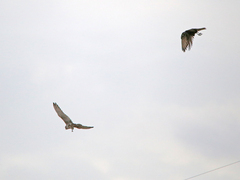
The brown falcon (Falco berigora) is a relatively large falcon native to Australia and New Guinea. A number of plumage morphs occur, with the primary distinction being between the pale morph and the dark morph. Both morphs usually have dark brown upper parts and wing coverts. Dark morph birds have predominantly dark under parts, although some light streaking is common. Pale morph birds have white underparts that are varyingly streaked with brown, sometimes heavily so. Pale individuals may also have prominently white under tail coverts and these may be diagnostic. A distinctive aspect of their behaviour is shown in the breeding season when brown falcons make a loud, high pitched, cackle call (like a laying hen) and screeching while in flight.

The species name berigora has Aboriginal origins. Adults are usually 40 to 50 cm (16 to 20 in) long. They are found in light and dark forms and a variety of intermediates. Animals typically have red-brown heads with narrow black streaks with a light crown and off-white chin. Wings are a spotted red-brown with dark brown quills. Beaks are light blue/grey; eyes are brown. The falcons make a loud cackle call uttered frequently.... Wikipedia →

Sounds

Call1:00

Australia · 2021

© Marc Anderson · XC1001930 · CC BY-NC-ND 4.0

Flight call0:17

Australia · 2021

© nick talbot · XC659789 · CC BY-NC-SA 4.0

Call0:33

Australia · 2023

© Peter Boesman · XC859875 · CC BY-NC-ND 4.0

Global Distribution

Parks Where Found

# Park Country Daily sighting probability
1 Uluru-Kata Tjuta National Park 🇦🇺 Australia
~30%
2 Flinders Ranges National Park 🇦🇺 Australia
~20%
3 Kakadu National Park 🇦🇺 Australia
~10%
4 Kosciuszko National Park 🇦🇺 Australia
~10%
5 Litchfield National Park 🇦🇺 Australia
~10%
6 Flinders Chase 🇦🇺 Australia
~10%
7 Hattah-Kulkyne National Park 🇦🇺 Australia
~10%
8 Cape Range 🇦🇺 Australia
~10%
9 Ningaloo Marine Park 🇦🇺 Australia
<5%
10 Freycinet National Park 🇦🇺 Australia
<5%
11 Cradle Mountain-Lake St Clair National Park 🇦🇺 Australia
<5%
12 Nitmiluk National Park 🇦🇺 Australia
<5%
13 Maria Island National Park 🇦🇺 Australia
<5%
14 Great Otway National Park 🇦🇺 Australia
<5%
15 Wilsons Promontory National Park 🇦🇺 Australia
<5%
16 Grampians National Park 🇦🇺 Australia
<5%
17 Lamington National Park 🇦🇺 Australia
<5%
18 Blue Mountains National Park 🇦🇺 Australia
<5%

Cities Where Found

# City Country Daily sighting probability
1 Brisbane 🇦🇺 Australia
<5%
2 Hobart 🇦🇺 Australia
<5%
3 Melbourne 🇦🇺 Australia
<5%
4 Perth 🇦🇺 Australia
<5%
5 Sydney 🇦🇺 Australia
<5%

Zoos & Centres Where Found

# Zoo / Centre Country
1 Alice Springs Desert Park 🇦🇺 Australia In captivity
2 Healesville Sanctuary 🇦🇺 Australia In captivity
3 Kangaroo Island Wildlife Park 🇦🇺 Australia In captivity

Before you go

What are the chances of seeing a Brown Falcon in Cape Range?

With luck

About 10% of wildlife watchers report a Brown Falcon sighting in Cape Range on a given day, based on 21 verified sightings from GBIF citizen-science data from 2019 to 2026. It is the 70th most-seen of the 84 birds we can rate there. Over three days the chance rises to about 10%, and over a week to about 30%, if each day is a fresh chance.

When is the best time to see a Brown Falcon in Cape Range?

June to August

In those months about 10% of wildlife watchers report a Brown Falcon in Cape Range on a given day, against under 5% in March–May and September–January, the lowest months. Those are among Cape Range's wettest months, with about 25 mm of rain a month against almost none in October. February has too few records to rate.

What time of day is best to see a Brown Falcon?

Between noon and 3 pm

Across all the parks we cover, that three-hour window holds the most Brown Falcon sightings with a recorded time, and nearly all of them come between 6 am and 6 pm: it is a daytime animal.

Where does the Brown Falcon sighting chance come from?

GBIF citizen-science records

It is estimated from how often the Brown Falcon is recorded against all the birds logged in Cape Range (21 verified sightings from 2019 to 2026), calibrated against known sighting rates. Figures are rounded to the nearest 10% because citizen-science data supports honest approximations, not decimals, and months with records from fewer than five people show "—". How it works.

← Back to Cape Range