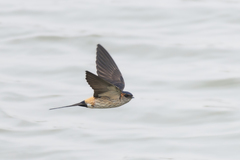
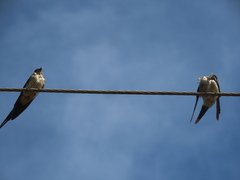


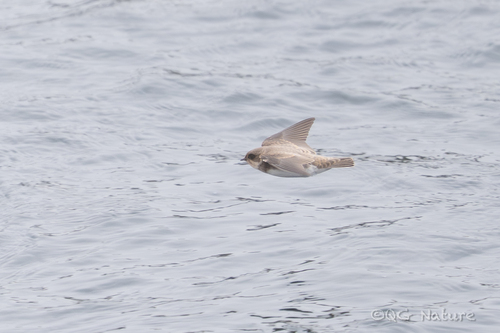

Eastern Red-rumped Swallow

Eastern Red-rumped Swallow

Cecropis daurica

Silhouette: Andy Wilson · PhyloPic

LCLeast ConcernNTVUENCR
Daily sighting probability <5% · Rare
at Chitwan National Park

In 3 days ~10% in a week ~30%

69 Verified sightings at Chitwan National Park From 2019 to 2026
6,451 In all 32 parks
January Best month
🌅 Crepuscular When it's spotted

About the Eastern Red-rumped Swallow

The eastern red-rumped swallow (Cecropis daurica) is a small passerine bird in the swallow family Hirundinidae. It is found in open, often hilly, areas with clearings and cultivation across eastern and southeastern Asia to north-eastern India and Taiwan.

The European red-rumped swallow and the African red-rumped swallow were formerly considered as subspecies of the eastern red-rumped swallow. The eastern red-rumped swallow was formally described in 1769 by the Finnish-Swedish clergyman, explorer and natural scientist Erik Laxmann as Hirundo daurica, using a specimen from Mount Schlangen, near Zmeinogorsk, Russia. It is now placed in the genus Cecropis created by German scientist Friedrich Boie in 1826. Boie's genus name Cecropis is from the Ancient Greek for an Athenian woman. The specific daurica is derived from Dauria, a mountainous region to the east of Lake Baikal in Russia. The alternative genus Hirundo is the Latin word for "swallow". Some authorities consider the West African swallow to be a subspecies of the red-rumped swallow.

Eight subspecies are recognised: Wikipedia →

Sounds

Song0:39

Turkey · 2026

© Kasper Wieck · XC1096381 · CC BY-NC-SA 4.0

Call0:14

France · 2025

© Thierry THOMAS · XC995073 · CC BY-NC-SA 4.0

Flight call0:31

Portugal · 2023

© Jorge Leitão · XC830658 · CC BY-NC-SA 4.0

Global Distribution

Parks Where Found

# Park Country Daily sighting probability
1 Komodo National Park 🇮🇩 Indonesia
~50%
2 Mudumalai National Park 🇮🇳 India
~40%
3 Bandipur National Park 🇮🇳 India
~30%
4 Doi Inthanon National Park 🇹🇭 Thailand
~20%
5 Gir National Park 🇮🇳 India
~20%
6 Kanha National Park 🇮🇳 India
~20%
7 Khao Yai National Park 🇹🇭 Thailand
~20%
8 Ranthambore National Park 🇮🇳 India
~20%
9 Nagarhole National Park 🇮🇳 India
~20%
10 Jim Corbett National Park 🇮🇳 India
~20%
11 Bandhavgarh National Park 🇮🇳 India
~10%
12 Kaeng Krachan National Park 🇹🇭 Thailand
~10%
13 Satpura National Park 🇮🇳 India
~10%
14 Periyar National Park 🇮🇳 India
~10%
15 Keoladeo National Park 🇮🇳 India
~10%
16 Kaziranga National Park 🇮🇳 India
~10%
17 Bali Barat National Park 🇮🇩 Indonesia
~10%
18 Eravikulam National Park 🇮🇳 India
~10%
19 Chitwan National Park 🇳🇵 Nepal
<5%
20 Royal Manas National Park 🇧🇹 Bhutan
<5%
21 Royal Bardia National Park 🇳🇵 Nepal
<5%
22 Khao Sok National Park 🇹🇭 Thailand
<5%
23 Cat Tien National Park 🇻🇳 Vietnam
<5%
24 Cuc Phuong National Park 🇻🇳 Vietnam
<5%
25 Yala National Park 🇱🇰 Sri Lanka
<5%
26 Langtang National Park 🇳🇵 Nepal
<5%
27 Sundarbans National Park 🇮🇳 India
<5%
28 Udawalawe National Park 🇱🇰 Sri Lanka
<5%
29 Sinharaja Forest Reserve 🇱🇰 Sri Lanka
<5%
30 Taman Negara National Park 🇲🇾 Malaysia
<5%
31 Namdapha National Park 🇮🇳 India
<5%
32 Manas National Park 🇮🇳 India
<5%

Cities Where Found

# City Country Daily sighting probability
1 Tainan 🇹🇼 Taiwan
~60%
2 Harbin 🇨🇳 China
~30%
3 Thrissur 🇮🇳 India
~30%
4 Dehradun 🇮🇳 India
~30%
5 Mysuru 🇮🇳 India
~30%
6 Taichung 🇹🇼 Taiwan
~30%
7 Chongqing 🇨🇳 China
~20%
8 Bengaluru 🇮🇳 India
~20%
9 Kaohsiung 🇹🇼 Taiwan
~20%
10 Jinan 🇨🇳 China
~20%

Before you go

What are the chances of seeing an Eastern Red-rumped Swallow in Chitwan National Park?

Rare

Under 5% of wildlife watchers report an Eastern Red-rumped Swallow sighting in Chitwan National Park on a given day, based on 69 verified sightings from GBIF citizen-science data from 2019 to 2026. It is the 185th most-seen of the 367 birds we can rate there. Over three days the chance rises to about 10%, and over a week to about 30%, if each day is a fresh chance.

When is the best time to see an Eastern Red-rumped Swallow in Chitwan National Park?

January–February and September–October

In those months about 10% of wildlife watchers report an Eastern Red-rumped Swallow in Chitwan National Park on a given day, against under 5% in March–August and November–December, the lowest months. Those are among Chitwan National Park's driest months, with about 120 mm of rain a month against 660 mm in July.

What time of day is best to see an Eastern Red-rumped Swallow?

Between 2 and 5 am

Across all the parks we cover, that three-hour window holds the most Eastern Red-rumped Swallow sightings with a recorded time, and about half of them come between 6 am and 6 pm: it is most active around dawn and dusk.

Which relatives of the Eastern Red-rumped Swallow live in Chitwan National Park?

Same family: Hirundinidae

The closest relatives of the Eastern Red-rumped Swallow that you can see in Chitwan National Park (family Hirundinidae, Swallows and Martins) are Gray-throated Martin (about 50%) and Barn Swallow (about 20%), with each one's daily chance of a sighting.

Where does the Eastern Red-rumped Swallow sighting chance come from?

GBIF citizen-science records

It is estimated from how often the Eastern Red-rumped Swallow is recorded against all the birds logged in Chitwan National Park (69 verified sightings from 2019 to 2026), calibrated against known sighting rates. Figures are rounded to the nearest 10% because citizen-science data supports honest approximations, not decimals, and months with records from fewer than five people show "—". How it works.

← Back to Chitwan National Park