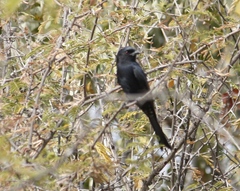
Fork-tailed Drongo

Fork-tailed Drongo

Dicrurus adsimilis

Silhouette: Ferran Sayol · PhyloPic

LCLeast ConcernNTVUENCR
Daily sighting probability ~60% · Likely
at Chobe National Park

In 3 days ~90% in a week >90%

1,060 Verified sightings at Chobe National Park From 2019 to 2026
30,133 In all 55 parks
July Best month
☀️ Diurnal When it's spotted

About the Fork-tailed Drongo

The fork-tailed drongo (Dicrurus adsimilis), also called the common drongo or African drongo, is a small bird found from the Sahel to South Africa that lives in wooded habitats, particularly woodlands and savannas. Like other drongos, the fork-tailed is mostly insectivorous; its diet mainly consists of butterflies, termites, and grasshoppers.

Physically, this species is characterized with a narrow fork-shaped tail, red-brownish eyes, and black plumage throughout all of its body. These birds nest close to wetlands, forests, and farms and the breeding season varies depending the region. The female usually lays one to four eggs, which hatch in 15 to 18 days.

The fork-tailed drongo is known for its ability to deceptively mimic other bird alarm calls in order for a certain animal to flee the scene so it can steal their food (kleptoparasitism). They are also known for their aggressive and fearless behavior, often attacking and driving away much larger animals, including birds of prey, when their nest is in danger. Due to its extensive range and stable population, the fork-tailed drongo is classified by the IUCN Red List as a least-concern species. Wikipedia →

Sounds

Call0:10

Botswana · 2026

© Ehren Eksteen · XC1187097 · CC BY-NC-SA 4.0

Song0:47

Gambia · 2025

© Romuald Mikusek · XC1018268 · CC BY-NC-SA 4.0

Recording0:35

Kenya · 2024

© Nathan Mixon · XC950625 · CC BY-NC-SA 4.0

Global Distribution

Parks Where Found

# Park Country Daily sighting probability
1 Etosha National Park 🇳🇦 Namibia
~80%
2 Kgalagadi Transfrontier Park 🇿🇦 South Africa
~80%
3 Meru National Park 🇰🇪 Kenya
~80%
4 Gonarezhou National Park 🇿🇼 Zimbabwe
~70%
5 Hluhluwe-Imfolozi Park 🇿🇦 South Africa
~70%
6 uMkhuze Game Reserve 🇿🇦 South Africa
~70%
7 Kruger National Park 🇿🇦 South Africa
~70%
8 Lower Zambezi National Park 🇿🇲 Zambia
~70%
9 Samburu National Reserve 🇰🇪 Kenya
~70%
10 Garden Route National Park 🇿🇦 South Africa
~60%
11 Ruaha National Park 🇹🇿 Tanzania
~60%
12 Waterberg Plateau Park 🇳🇦 Namibia
~60%
13 Tarangire National Park 🇹🇿 Tanzania
~60%
14 Akagera National Park 🇷🇼 Rwanda
~60%
15 Hwange National Park 🇿🇼 Zimbabwe
~60%
16 Pilanesberg National Park 🇿🇦 South Africa
~60%
17 Mana Pools National Park 🇿🇼 Zimbabwe
~60%
18 Moremi Game Reserve 🇧🇼 Botswana
~60%
19 Liwonde National Park 🇲🇼 Malawi
~60%
20 Tsavo West National Park 🇰🇪 Kenya
~60%
21 Lake Nakuru National Park 🇰🇪 Kenya
~60%
22 Tsavo East National Park 🇰🇪 Kenya
~60%
23 Gorongosa National Park 🇲🇿 Mozambique
~60%
24 Chobe National Park 🇧🇼 Botswana
~60%
25 Awash National Park 🇪🇹 Ethiopia
~50%
26 South Luangwa National Park 🇿🇲 Zambia
~50%
27 Kidepo Valley National Park 🇺🇬 Uganda
~50%
28 Addo Elephant National Park 🇿🇦 South Africa
~50%
29 Mikumi National Park 🇹🇿 Tanzania
~50%
30 Mkomazi National Park 🇹🇿 Tanzania
~50%
31 Kafue National Park 🇿🇲 Zambia
~50%
32 Serengeti National Park 🇹🇿 Tanzania
~50%
33 Lake Manyara National Park 🇹🇿 Tanzania
~50%
34 Lake Mburo National Park 🇺🇬 Uganda
~40%
35 De Hoop Nature Reserve 🇿🇦 South Africa
~40%
36 Nairobi National Park 🇰🇪 Kenya
~30%
37 Masai Mara National Reserve 🇰🇪 Kenya
~30%
38 Selous Game Reserve 🇹🇿 Tanzania
~30%
39 Amboseli National Park 🇰🇪 Kenya
~30%
40 Niokolo-Koba National Park 🇸🇳 Senegal
~30%
41 Queen Elizabeth National Park 🇺🇬 Uganda
~30%
42 iSimangaliso Wetland Park 🇿🇦 South Africa
~20%
43 Ngorongoro Conservation Area 🇹🇿 Tanzania
~20%
44 Golden Gate Highlands National Park 🇿🇦 South Africa
~20%
45 Murchison Falls National Park 🇺🇬 Uganda
~20%
46 Table Mountain National Park 🇿🇦 South Africa
~10%
47 Virunga National Park 🇨🇩 Democratic Republic of the Congo
~10%
48 Arusha National Park 🇹🇿 Tanzania
~10%
49 Aberdare National Park 🇰🇪 Kenya
<5%
50 Namib-Naukluft National Park 🇳🇦 Namibia
<5%
51 Semuliki National Park 🇺🇬 Uganda
<5%
52 Bwindi Impenetrable National Park 🇺🇬 Uganda
<5%
53 Kibale National Park 🇺🇬 Uganda
<5%
54 Nyungwe National Park 🇷🇼 Rwanda
<5%
55 West Coast National Park 🇿🇦 South Africa
<5%

Cities Where Found

# City Country Daily sighting probability
1 Mombasa 🇰🇪 Kenya
~70%
2 Abuja 🇳🇬 Nigeria
~60%
3 Harare 🇿🇼 Zimbabwe
~50%
4 Lusaka 🇿🇲 Zambia
~40%
5 Kigali 🇷🇼 Rwanda
~30%
6 Durban 🇿🇦 South Africa
~30%
7 Serrekunda 🇬🇲 Gambia
~20%
8 Maputo 🇲🇿 Mozambique
~10%
9 Lilongwe 🇲🇼 Malawi
~10%
10 Kampala 🇺🇬 Uganda
~10%

Before you go

What are the chances of seeing a Fork-tailed Drongo in Chobe National Park?

Likely

About 60% of wildlife watchers report a Fork-tailed Drongo sighting in Chobe National Park on a given day, based on 1,060 verified sightings from GBIF citizen-science data from 2019 to 2026. It is the 10th most-seen of the 373 birds we can rate there. Over three days the chance rises to about 90%, and over a week to over 90%, if each day is a fresh chance.

When is the best time to see a Fork-tailed Drongo in Chobe National Park?

March–September and December

In those months about 60% of wildlife watchers report a Fork-tailed Drongo in Chobe National Park on a given day, against about 40% in January–February and November, the lowest months.

What time of day is best to see a Fork-tailed Drongo?

Between 2 and 5 pm

Across all the parks we cover, that three-hour window holds the most Fork-tailed Drongo sightings with a recorded time, and about 9 in 10 of them come between 6 am and 6 pm: it is a daytime animal.

Which relatives of the Fork-tailed Drongo live in Chobe National Park?

Same order: Passeriformes

The closest relatives of the Fork-tailed Drongo that you can see in Chobe National Park (order Passeriformes, Perching Birds) are Red-billed Oxpecker (about 40%), Common Bulbul (about 30%) and Magpie Shrike (about 30%), with each one's daily chance of a sighting.

Where does the Fork-tailed Drongo sighting chance come from?

GBIF citizen-science records

It is estimated from how often the Fork-tailed Drongo is recorded against all the birds logged in Chobe National Park (1,060 verified sightings from 2019 to 2026), calibrated against known sighting rates. Figures are rounded to the nearest 10% because citizen-science data supports honest approximations, not decimals, and months with records from fewer than five people show "—". How it works.

← Back to Chobe National Park