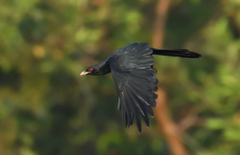
Asian Koel

Asian Koel

Eudynamys scolopaceus

Silhouette: Nicolas Huet le Jeune and Jean-Gabriel Prêtre (vectorized by T. Michael Keesey) · PhyloPic

LCLeast ConcernNTVUENCR
Daily sighting probability ~50% · Likely
at Aligarh

In 3 days ~90% in a week >90%

162 Verified sightings at Aligarh
8,277 In all 32 parks From 2019 to 2026
April Best month
☀️ Diurnal When it's spotted

About the Asian Koel

The Asian koel (Eudynamys scolopaceus) is a member of the cuckoo family of birds, the Cuculidae. It is found in the Indian subcontinent, China, and Southeast Asia. It forms a superspecies with the closely related black-billed koels, and Pacific koels which are sometimes treated as subspecies. The Asian koel, like many of its related cuckoo kin, is a brood parasite that lays its eggs in the nests of crows and other hosts, who raise its young. They are unusual among the cuckoos in being largely frugivorous as adults. The name koel is echoic in origin with several language variants. The bird is a widely used symbol in Indian, Pakistani and Nepali poetry.

In 1747, the English naturalist George Edwards included an illustration and a description of an Asian koel in the second volume of his A Natural History of Uncommon Birds book. He used the English name "The Brown and Spotted Indian Cuckow". Edwards based his hand-coloured etching on a specimen from Bengal that belonged to the London silk-pattern designer and naturalist Joseph Dandridge. When in 1758 the Swedish naturalist Carl Linnaeus updated his Systema Naturae for the tenth edition, he placed the Asian koel with the... Wikipedia →

Sounds

Song0:32

Philippines · 2026

© Kelle Moreau · XC1163242 · CC BY-NC-SA 4.0

Alarm call0:10

Sri Lanka · 2026

© Uku Paal · XC1096405 · CC BY-NC-SA 4.0

Call0:35

Myanmar · 2026

© Thet Zaw Naing · XC1078430 · CC BY-NC-SA 4.0

Global Distribution

Parks Where Found

# Park Country Daily sighting probability
1 Gir National Park 🇮🇳 India
~40%
2 Udawalawe National Park 🇱🇰 Sri Lanka
~40%
3 Yala National Park 🇱🇰 Sri Lanka
~30%
4 Mudumalai National Park 🇮🇳 India
~30%
5 Tangkoko Nature Reserve 🇮🇩 Indonesia
~30%
6 Sundarbans National Park 🇮🇳 India
~30%
7 Kaeng Krachan National Park 🇹🇭 Thailand
~30%
8 Nagarhole National Park 🇮🇳 India
~20%
9 Bandipur National Park 🇮🇳 India
~20%
10 Wilpattu National Park 🇱🇰 Sri Lanka
~20%
11 Khao Yai National Park 🇹🇭 Thailand
~20%
12 Keoladeo National Park 🇮🇳 India
~20%
13 Doi Inthanon National Park 🇹🇭 Thailand
~20%
14 Ranthambore National Park 🇮🇳 India
~20%
15 Manas National Park 🇮🇳 India
~20%
16 Chitwan National Park 🇳🇵 Nepal
~20%
17 Khao Luang National Park 🇹🇭 Thailand
~20%
18 Bandhavgarh National Park 🇮🇳 India
~10%
19 Komodo National Park 🇮🇩 Indonesia
~10%
20 Kanha National Park 🇮🇳 India
~10%
21 Kaziranga National Park 🇮🇳 India
~10%
22 Minneriya National Park 🇱🇰 Sri Lanka
~10%
23 Royal Bardia National Park 🇳🇵 Nepal
~10%
24 Cat Tien National Park 🇻🇳 Vietnam
~10%
25 Khao Sok National Park 🇹🇭 Thailand
~10%
26 Periyar National Park 🇮🇳 India
~10%
27 Satpura National Park 🇮🇳 India
~10%
28 Jim Corbett National Park 🇮🇳 India
~10%
29 Taman Negara National Park 🇲🇾 Malaysia
<5%
30 Sinharaja Forest Reserve 🇱🇰 Sri Lanka
<5%
31 Royal Manas National Park 🇧🇹 Bhutan
<5%
32 Danum Valley Conservation Area 🇲🇾 Malaysia
<5%

Cities Where Found

# City Country Daily sighting probability
1 Hajipur 🇮🇳 India
~90%
2 Vijayawada 🇮🇳 India
~90%
3 Yangon 🇲🇲 Myanmar
~90%
4 Tiruppur 🇮🇳 India
~90%
5 Visakhapatnam 🇮🇳 India
~90%
6 Madurai 🇮🇳 India
~80%
7 Puducherry 🇮🇳 India
~80%
8 Coimbatore 🇮🇳 India
~80%
9 Bangkok 🇹🇭 Thailand
~80%
10 Bhubaneshwar 🇮🇳 India
~80%

Zoos & Centres Where Found

# Zoo / Centre Country
1 Jijamata Udyaan 🇮🇳 India In captivity
2 Chai Nat Bird Park 🇹🇭 Thailand In captivity
3 Penang Bird Park 🇲🇾 Malaysia In captivity

Before you go

What are the chances of seeing an Asian Koel in Aligarh?

Likely

About 50% of wildlife watchers report an Asian Koel sighting in Aligarh on a given day, based on 162 verified sightings from GBIF citizen-science data. It is the 14th most-seen of the 94 birds we can rate there. Over three days the chance rises to about 90%, and over a week to over 90%, if each day is a fresh chance.

When is the best time to see an Asian Koel in Aligarh?

April and May

In those months about 70% of wildlife watchers report an Asian Koel in Aligarh on a given day, against about 20% in October, the lowest month. Those are among Aligarh's driest months, with about 20 mm of rain a month against 220 mm in July. July has too few records to rate.

What time of day is best to see an Asian Koel?

Between 7 and 10 am

Across all the parks we cover, that three-hour window holds the most Asian Koel sightings with a recorded time, and about 9 in 10 of them come between 6 am and 6 pm: it is a daytime animal.

Is Aligarh the best place to see an Asian Koel?

50th of 111

Of the 111 cities where we can rate Asian Koel sightings, Aligarh ranks 50th at about 50%. The best odds are in Hajipur (India, about 90%), Vijayawada (India, about 90%) and Yangon (Myanmar, about 90%).

Which relatives of the Asian Koel live in Aligarh?

Same family: Cuculidae

The closest relatives of the Asian Koel that you can see in Aligarh (family Cuculidae, Cuckoos) are Greater Coucal (about 40%) and Common Hawk-Cuckoo (about 10%), with each one's daily chance of a sighting.

Where does the Asian Koel sighting chance come from?

GBIF citizen-science records

It is estimated from how often the Asian Koel is recorded against all the birds logged in Aligarh (162 verified sightings), calibrated against known sighting rates. Figures are rounded to the nearest 10% because citizen-science data supports honest approximations, not decimals, and months with records from fewer than five people show "—". How it works.

← Back to Aligarh




