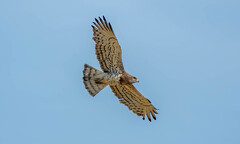
Short-toed Eagle

Short-toed Eagle

Circaetus gallicus

Silhouette: Sheatherius · PhyloPic

LCLeast ConcernNTVUENCR
Daily sighting probability <5% · Rare
at Dushanbe

In 3 days ~10%

9 Verified sightings at Dushanbe
3,924 In all 30 parks From 2019 to 2026
April Best month
☀️ Diurnal When it's spotted

About the Short-toed Eagle

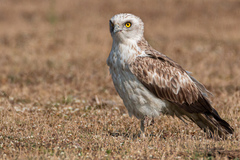
The short-toed snake eagle (Circaetus gallicus), also known as the short-toed eagle, is a medium-sized bird of prey in the family Accipitridae, which also includes many other diurnal raptors such as kites, buzzards and harriers. The genus name Circaetus is from the Ancient Greek kirkos, a type of hawk, and aetos, "eagle". The specific gallicus means "of Gallia".

The short-toed snake eagle was formally described in 1788 by the German naturalist Johann Friedrich Gmelin in his revised and expanded edition of Carl Linnaeus's Systema Naturae. He placed it with the falcons, eagles and their relatives in the genus Falco and coined the binomial name Falco gallicus. Gmelin based his description on the "Jean le Blanc" that had been described by the English ornithologist John Latham and the French ornithologists Mathurin Jacques Brisson and the Comte de Buffon. The short-toed snake eagle is now placed in the genus Circaetus that was introduced in 1816 by the French ornithologist Louis Pierre Vieillot. The genus name is from the Ancient Greek kirkos, a type of hawk, and aetos, "eagle". The specific epithet gallicus is Latin for "Gaul" ie France.

Two subspecies are recognised: C... Wikipedia →

Sounds

Call1:30

Italy · 2023

© Francesco Sottile · XC820178 · CC BY-NC-SA 4.0

Flight call1:12

Greece · 2022

© Leconte Michel · XC727570 · CC BY-NC-SA 4.0

Begging call0:44

Italy · 2021

© Gianluca Congi · XC679399 · CC BY-NC-SA 4.0

Global Distribution

Parks Where Found

# Park Country Daily sighting probability
1 Cévennes National Park 🇫🇷 France
~30%
2 Monfragüe National Park 🇪🇸 Spain
~20%
3 Ecrins National Park 🇫🇷 France
~20%
4 Picos de Europa National Park 🇪🇸 Spain
~20%
5 Pyrénées National Park 🇫🇷 France
~20%
6 Aigüestortes National Park 🇪🇸 Spain
~20%
7 Vanoise National Park 🇫🇷 France
~10%
8 Ordesa y Monte Perdido National Park 🇪🇸 Spain
~10%
9 Camargue 🇫🇷 France
~10%
10 Kiskunság National Park 🇭🇺 Hungary
~10%
11 Doñana National Park 🇪🇸 Spain
~10%
12 Manas National Park 🇮🇳 India
~10%
13 Mercantour National Park 🇫🇷 France
~10%
14 Sierra Nevada National Park 🇪🇸 Spain
~10%
15 Hortobágy National Park 🇭🇺 Hungary
<5%
16 Sierra de Guadarrama National Park 🇪🇸 Spain
<5%
17 Bandipur National Park 🇮🇳 India
<5%
18 Kaziranga National Park 🇮🇳 India
<5%
19 Komodo National Park 🇮🇩 Indonesia
<5%
20 Nagarhole National Park 🇮🇳 India
<5%
21 Ranthambore National Park 🇮🇳 India
<5%
22 Sundarbans National Park 🇮🇳 India
<5%
23 Satpura National Park 🇮🇳 India
<5%
24 Niokolo-Koba National Park 🇸🇳 Senegal
<5%
25 Eravikulam National Park 🇮🇳 India
<5%
26 Bandhavgarh National Park 🇮🇳 India
<5%
27 Keoladeo National Park 🇮🇳 India
<5%
28 Mudumalai National Park 🇮🇳 India
<5%
29 Biebrza National Park 🇵🇱 Poland
<5%
30 Kanha National Park 🇮🇳 India
<5%

Cities Where Found

# City Country Daily sighting probability
1 Ramallah 🇵🇸 Palestine
~10%
2 Istanbul 🇹🇷 Turkey
~10%
3 Vasai-Virar 🇮🇳 India
~10%
4 Jerusalem 🇮🇱 Israel
~10%
5 Jeddah 🇸🇦 Saudi Arabia
<5%
6 Bhopal 🇮🇳 India
<5%
7 Dushanbe 🇹🇯 Tajikistan
<5%
8 Tel Aviv 🇮🇱 Israel
<5%
9 Marrakesh 🇲🇦 Morocco
<5%
10 Indore 🇮🇳 India
<5%

Zoos & Centres Where Found

# Zoo / Centre Country
1 Parc des oiseaux 🇫🇷 France In captivity
2 Zoobotánico Jerez 🇪🇸 Spain In captivity
3 Jerusalem Biblical Zoo 🇮🇱 Israel In captivity
4 Zoo Santo Inácio 🇵🇹 Portugal In captivity
5 Midbarium 🇮🇱 Israel In captivity
6 Marcelle Natureza 🇪🇸 Spain In captivity
7 Zoopark Limpopo 🇷🇺 Russia In captivity
8 Odesa Zoo 🇺🇦 Ukraine In captivity
9 Zoo de Córdoba 🇪🇸 Spain In captivity
10 Les Aigles du Léman 🇫🇷 France In captivity
11 Affenberg Landskron 🇦🇹 Austria In captivity
12 VigoNature 🇪🇸 Spain In captivity
13 Zoo Koki (Parque zoológico y botánico) 🇪🇸 Spain In captivity
14 Castellar Zoo 🇪🇸 Spain In captivity
15 Adlerarena Burg Landskron 🇦🇹 Austria In captivity
16 Hôpital faune sauvage Garrigues - Cévennes 🇫🇷 France In captivity
17 Donjon des aigles 🇫🇷 France In captivity
18 Greifvogelwarte Riegersburg 🇦🇹 Austria In captivity

Before you go

What are the chances of seeing a Short-toed Eagle in Dushanbe?

Rare

Under 5% of wildlife watchers report a Short-toed Eagle sighting in Dushanbe on a given day, based on 9 verified sightings from GBIF citizen-science data. It is the 76th most-seen of the 96 birds we can rate there. Over three days the chance rises to about 10%, if each day is a fresh chance.

When is the best time to see a Short-toed Eagle in Dushanbe?

April

In that month about 10% of wildlife watchers report a Short-toed Eagle in Dushanbe on a given day, against under 5% in May to March, the lowest months. That is one of Dushanbe's wettest months, with about 50 mm of rain against almost none in August.

What time of day is best to see a Short-toed Eagle?

Between 9 am and noon

Across all the parks we cover, that three-hour window holds the most Short-toed Eagle sightings with a recorded time, and about 9 in 10 of them come between 6 am and 6 pm: it is a daytime animal.

Is Dushanbe the best place to see a Short-toed Eagle?

7th of 24

Of the 24 cities where we can rate Short-toed Eagle sightings, Dushanbe ranks 7th at under 5%. The best odds are in Ramallah (Palestine, about 10%), Istanbul (Turkey, about 10%) and Vasai-Virar (India, about 10%).

Which relatives of the Short-toed Eagle live in Dushanbe?

Same family: Accipitridae

The closest relatives of the Short-toed Eagle that you can see in Dushanbe (family Accipitridae, Hawks, Eagles, and Kites) are Eurasian Sparrowhawk (about 10%), Egyptian Vulture (about 10%) and Black Kite (about 10%), with each one's daily chance of a sighting.

Where does the Short-toed Eagle sighting chance come from?

GBIF citizen-science records

It is estimated from how often the Short-toed Eagle is recorded against all the birds logged in Dushanbe (9 verified sightings), calibrated against known sighting rates. Figures are rounded to the nearest 10% because citizen-science data supports honest approximations, not decimals, and months with records from fewer than five people show "—". How it works.

← Back to Dushanbe