Blue-gray Gnatcatcher

Blue-gray Gnatcatcher

Polioptila caerulea

Silhouette: Sheatherius · PhyloPic

LCLeast ConcernNTVUENCR
Daily sighting probability <5% · Rare
at Las Vegas

In 3 days <5% in a week ~10%

22 Verified sightings at Las Vegas
35,020 In all 40 parks From 2019 to 2026
December Best month
☀️ Diurnal When it's spotted

About the Blue-gray Gnatcatcher

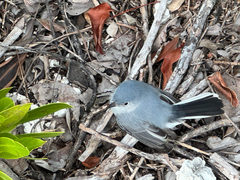
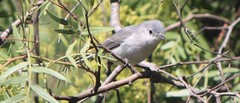
The blue-gray gnatcatcher (Polioptila caerulea) is a very small gnatcatcher native to North America. It is 10–13 cm (3.9–5.1 in) in length, 6.3 in (16 cm) in wingspan, and weighing only 5–7 g (0.18–0.25 oz). Adult males are blue-gray on the upperparts with white underparts, slender dark bill, and a long black tail edged in white. Females are less blue, while juveniles are greenish-gray. Both sexes have a white eye ring.

The blue-gray gnatcatcher's breeding habitat includes open deciduous woods and shrublands in southern Ontario, the eastern and southwestern United States, and Mexico. Though gnatcatcher species are common and increasing in number while expanding to the northeast, it is the only one to breed in Eastern North America. They migrate to the southern United States, Mexico, northern Central America (Belize, Guatemala, and Honduras), Cuba, the Bahamas, the Turks and Caicos Islands, and the Cayman Islands.

Blue-gray gnatcatchers prefer humid areas with large leaves, woodlands, and more open sandy areas with sparse trees where they mainly eat insects, insect eggs, and spiders. The males often work to build... Wikipedia →

Sounds

Call0:16

Mexico · 2026

© Manuel Grosselet · XC1084268 · CC BY-NC-SA 4.0

Song0:12

Bahamas · 2025

© Brendan Sloan · XC1003281 · CC BY-NC-ND 4.0

Begging call0:43

United States · 2021

© Paul Marvin · XC670951 · CC BY-NC-SA 4.0

Global Distribution

Parks Where Found

# Park Country Daily sighting probability
1 Arrecifes de Cozumel National Park 🇲🇽 Mexico
~70%
2 Big Cypress National Preserve 🇺🇸 United States
~60%
3 Point Pelee National Park 🇨🇦 Canada
~60%
4 Cañón del Sumidero National Park 🇲🇽 Mexico
~50%
5 Congaree National Park 🇺🇸 United States
~50%
6 Everglades National Park 🇺🇸 United States
~50%
7 Big Bend National Park 🇺🇸 United States
~40%
8 Cabo Pulmo National Park 🇲🇽 Mexico
~40%
9 Bahía de Loreto National Park 🇲🇽 Mexico
~40%
10 Cumbres de Monterrey National Park 🇲🇽 Mexico
~40%
11 Zion National Park 🇺🇸 United States
~40%
12 Guadalupe Mountains National Park 🇺🇸 United States
~30%
13 Biotopo Cerro Cahuí 🇬🇹 Guatemala
~20%
14 Ciénaga de Zapata 🇨🇺 Cuba
~20%
15 Great Smoky Mountains National Park 🇺🇸 United States
~20%
16 Merritt Island National Wildlife Refuge 🇺🇸 United States
~20%
17 Channel Islands National Park 🇺🇸 United States
~20%
18 Grand Canyon National Park 🇺🇸 United States
~20%
19 El Vizcaíno Biosphere Reserve 🇲🇽 Mexico
~20%
20 Death Valley National Park 🇺🇸 United States
~20%
21 Tikal National Park 🇬🇹 Guatemala
~20%
22 Badlands National Park 🇺🇸 United States
~20%
23 Shenandoah National Park 🇺🇸 United States
~10%
24 El Triunfo 🇲🇽 Mexico
~10%
25 Calakmul Biosphere Reserve 🇲🇽 Mexico
~10%
26 Celaque National Park 🇭🇳 Honduras
~10%
27 Ría Lagartos Biosphere Reserve 🇲🇽 Mexico
~10%
28 Joshua Tree National Park 🇺🇸 United States
~10%
29 Saguaro National Park 🇺🇸 United States
~10%
30 Celestún Biosphere Reserve 🇲🇽 Mexico
<5%
31 Montes Azules Biosphere Reserve 🇲🇽 Mexico
<5%
32 Yosemite National Park 🇺🇸 United States
<5%
33 Sequoia and Kings Canyon National Parks 🇺🇸 United States
<5%
34 Pico Bonito National Park 🇭🇳 Honduras
<5%
35 Sian Ka'an Biosphere Reserve 🇲🇽 Mexico
<5%
36 Cockscomb Basin Wildlife Sanctuary 🇧🇿 Belize
<5%
37 Padre Island National Seashore 🇺🇸 United States
<5%
38 Rocky Mountain National Park 🇺🇸 United States
<5%
39 Acadia National Park 🇺🇸 United States
<5%
40 Olympic National Park 🇺🇸 United States
<5%

Cities Where Found

# City Country Daily sighting probability
1 Orlando 🇺🇸 United States
~60%
2 Monterrey 🇲🇽 México
~50%
3 Miami 🇺🇸 United States
~40%
4 León 🇲🇽 México
~40%
5 Mexico City 🇲🇽 México
~40%
6 Guadalajara 🇲🇽 México
~40%
7 Puebla 🇲🇽 México
~40%
8 Houston 🇺🇸 United States
~30%
9 Toluca 🇲🇽 México
~30%
10 Havana 🇨🇺 Cuba
~20%

Zoos & Centres Where Found

# Zoo / Centre Country
1 Ralph Perkins II Wildlife Center and Woods Garden 🇺🇸 United States In captivity

Before you go

What are the chances of seeing a Blue-gray Gnatcatcher in Las Vegas?

Rare

Under 5% of wildlife watchers report a Blue-gray Gnatcatcher sighting in Las Vegas on a given day, based on 22 verified sightings from GBIF citizen-science data. It is the 148th most-seen of the 201 birds we can rate there. Over three days the chance rises to under 5%, and over a week to about 10%, if each day is a fresh chance.

When is the best time to see a Blue-gray Gnatcatcher in Las Vegas?

Any time of year

In every month with enough records, under 5% of wildlife watchers report a Blue-gray Gnatcatcher in Las Vegas on a given day, so our monthly data shows no clear season.

What time of day is best to see a Blue-gray Gnatcatcher?

Between 8 and 11 am

Across all the parks we cover, that three-hour window holds the most Blue-gray Gnatcatcher sightings with a recorded time, and about 9 in 10 of them come between 6 am and 6 pm: it is a daytime animal.

Is Las Vegas the best place to see a Blue-gray Gnatcatcher?

35th of 36

Of the 36 cities where we can rate Blue-gray Gnatcatcher sightings, Las Vegas ranks 35th at under 5%. The best odds are in Orlando (United States, about 60%), Monterrey (México, about 50%) and Miami (United States, about 40%).

Where does the Blue-gray Gnatcatcher sighting chance come from?

GBIF citizen-science records

It is estimated from how often the Blue-gray Gnatcatcher is recorded against all the birds logged in Las Vegas (22 verified sightings), calibrated against known sighting rates. Figures are rounded to the nearest 10% because citizen-science data supports honest approximations, not decimals, and months with records from fewer than five people show "—". How it works.

← Back to Las Vegas