Pectoral Sandpiper

Pectoral Sandpiper

Calidris melanotos

Silhouette: Edwin Price · PhyloPic

LCLeast ConcernNTVUENCR
Daily sighting probability <5% · Rare
at Los Angeles

In 3 days <5%

513 Verified sightings at Los Angeles
1,118 In all 31 parks From 2019 to 2026
September Best month
☀️ Diurnal When it's spotted

About the Pectoral Sandpiper

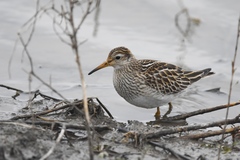
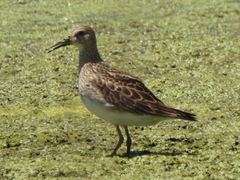
The pectoral sandpiper (Calidris melanotos), often abbreviated pec, is a small, migratory wader that breeds in arctic regions of North America and Asia, wintering in South America and Oceania. It eats small invertebrates. Its nest, a hole scraped in the ground and with a thick lining, is deep enough to protect its four eggs from the cool breezes of its breeding grounds. The pectoral sandpiper is 19–23 cm (7.5–9.1 in) long, with a wingspan of 38–46 cm (15–18 in).

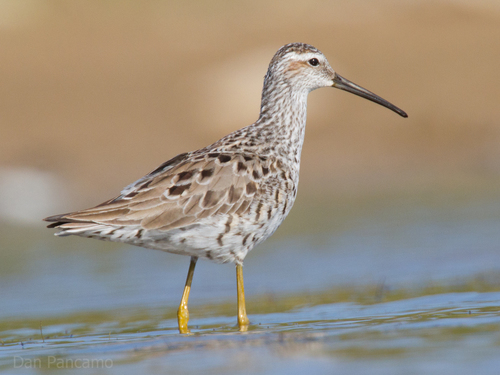
In the past widely seen as most closely related to sharp-tailed sandpiper, more recent genetic evidence has shown more complex relationships between the species of Calidris, with its closest genetic relatives probably the semipalmated sandpiper and western sandpiper species pair.

Cox's sandpiper, originally described as a new species Calidris paramelanotos, has proven to be a stereotyped hybrid between this species and the curlew sandpiper. This does not prove a particularly close relationship between these two species, as far more distantly related waders have produced hybrids.

The scientific name is from Ancient Greek. The genus name kalidris or skalidris, is a term used by Aristotle for some... Wikipedia →

Sounds

Call0:07

France · 2026

© Sébastien Reeber · XC1185094 · CC BY-NC-SA 4.0

Duet0:06

Brazil · 2025

© JAYRSON ARAUJO DE OLIVEIRA · XC1050169 · CC BY-NC-SA 4.0

Flight call0:05

United States · 2023

© Valerie Heemstra · XC836010 · CC BY-NC-SA 4.0

Global Distribution

Parks Where Found

# Park Country Daily sighting probability
1 Isla del Coco National Park 🇨🇷 Costa Rica
~20%
2 Caroni Swamp 🇹🇹 Trinidad and Tobago
~10%
3 Kluane National Park 🇨🇦 Canada
~10%
4 El Impenetrable National Park 🇦🇷 Argentina
~10%
5 Amacayacu National Natural Park 🇨🇴 Colombia
<5%
6 Yasuní National Park 🇪🇨 Ecuador
<5%
7 Palo Verde National Park 🇨🇷 Costa Rica
<5%
8 Iberá National Park 🇦🇷 Argentina
<5%
9 Lauca National Park 🇨🇱 Chile
<5%
10 Padre Island National Seashore 🇺🇸 United States
<5%
11 Kiskunság National Park 🇭🇺 Hungary
<5%
12 Pacific Rim National Park Reserve 🇨🇦 Canada
<5%
13 Celestún Biosphere Reserve 🇲🇽 Mexico
<5%
14 Manu National Park 🇵🇪 Peru
<5%
15 Parque Estadual Encontro das Águas 🇧🇷 Brazil
<5%
16 Bastimentos Island National Marine Park 🇵🇦 Panama
<5%
17 La Amistad International Park (Panama) 🇵🇦 Panama
<5%
18 Point Pelee National Park 🇨🇦 Canada
<5%
19 Great Bear Rainforest 🇨🇦 Canada
<5%
20 El Vizcaíno Biosphere Reserve 🇲🇽 Mexico
<5%
21 Arrecifes de Cozumel National Park 🇲🇽 Mexico
<5%
22 Tambopata National Reserve 🇵🇪 Peru
<5%
23 Olympic National Park 🇺🇸 United States
<5%
24 Carara National Park 🇨🇷 Costa Rica
<5%
25 Merritt Island National Wildlife Refuge 🇺🇸 United States
<5%
26 iSimangaliso Wetland Park 🇿🇦 South Africa
<5%
27 Acadia National Park 🇺🇸 United States
<5%
28 Wadden Sea National Park 🇩🇪 Germany
<5%
29 Everglades National Park 🇺🇸 United States
<5%
30 Channel Islands National Park 🇺🇸 United States
<5%
31 Soberanía National Park 🇵🇦 Panama
<5%

Cities Where Found

# City Country Daily sighting probability
1 Santa Cruz de la Sierra 🇧🇴 Bolivia
<5%
2 Cochabamba 🇧🇴 Bolivia
<5%
3 Lima 🇵🇪 Peru
<5%
4 Asuncion 🇵🇾 Paraguay
<5%
5 Havana 🇨🇺 Cuba
<5%
6 Anchorage 🇺🇸 United States
<5%
7 Chicago 🇺🇸 United States
<5%
8 Caracas 🇻🇪 Venezuela
<5%
9 Panama City 🇵🇦 Panama
<5%
10 São Paulo 🇧🇷 Brazil
<5%

Before you go

What are the chances of seeing a Pectoral Sandpiper in Los Angeles?

Rare

Under 5% of wildlife watchers report a Pectoral Sandpiper sighting in Los Angeles on a given day, based on 513 verified sightings from GBIF citizen-science data. It is the 265th most-seen of the 426 birds we can rate there. Over three days the chance rises to under 5%, if each day is a fresh chance.

When is the best time to see a Pectoral Sandpiper in Los Angeles?

Any time of year

In every month with enough records, under 5% of wildlife watchers report a Pectoral Sandpiper in Los Angeles on a given day, so our monthly data shows no clear season.

What time of day is best to see a Pectoral Sandpiper?

Between 9 am and noon

Across all the parks we cover, that three-hour window holds the most Pectoral Sandpiper sightings with a recorded time, and about 9 in 10 of them come between 6 am and 6 pm: it is a daytime animal.

Is Los Angeles the best place to see a Pectoral Sandpiper?

Among the best

Of the 45 cities where we can rate Pectoral Sandpiper sightings, Los Angeles ranks 18th at under 5%, level with the leaders once rounded. The best odds are in Santa Cruz de la Sierra (Bolivia, under 5%), Cochabamba (Bolivia, under 5%) and Lima (Peru, under 5%).

Which relatives of the Pectoral Sandpiper live in Los Angeles?

Same genus: Calidris

The closest relatives of the Pectoral Sandpiper that you can see in Los Angeles (genus Calidris, Calidris Sandpipers) are Least Sandpiper (about 10%) and Western Sandpiper (about 10%), with each one's daily chance of a sighting.

Where does the Pectoral Sandpiper sighting chance come from?

GBIF citizen-science records

It is estimated from how often the Pectoral Sandpiper is recorded against all the birds logged in Los Angeles (513 verified sightings), calibrated against known sighting rates. Figures are rounded to the nearest 10% because citizen-science data supports honest approximations, not decimals, and months with records from fewer than five people show "—". How it works.

← Back to Los Angeles