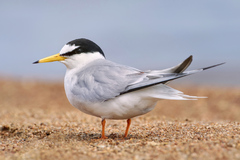
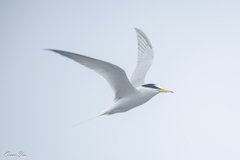

Little Tern

Little Tern

Sternula albifrons

Silhouette: Sheatherius · PhyloPic

LCLeast ConcernNTVUENCR
Daily sighting probability <5% · Rare
at Manchester

In 3 days <5%

7 Verified sightings at Manchester
2,463 In all 24 parks From 2019 to 2026
May Best month
☀️ Diurnal When it's spotted

About the Little Tern

The little tern (Sternula albifrons) is a small seabird of the family Laridae. It is widely distributed breeding on the coasts and inland waterways of Europe, Asia, north and west Africa, and eastern Australia. It winters in the subtropical and tropical oceans as far south as South Africa and Australia.

The little tern was formally described in a sales catalogue by the German naturalist Peter Simon Pallas in 1764 under the binomial name Sterna albifrons. The type locality is Holland in the Netherlands. The species was moved to the genus Sternula when the genus Sterna was restricted to the larger typical terns. The genus name Sternula is a diminutive of Sterna, 'tern', while the specific name albifrons is from Latin albus, 'white', and frons, 'forehead'.

Four subspecies are recognised: Wikipedia →

Sounds

Call0:08

Mongolia · 2026

© Ding Li Yong · XC1142596 · CC BY-NC-ND 4.0

Nocturnal flight call0:10

France · 2025

© Julien Piette · XC1033144 · CC BY-NC-SA 4.0

Alarm call1:06

Ireland · 2024

© Anthony McGeehan · XC920894 · CC BY-NC-SA 4.0

Global Distribution

Parks Where Found

# Park Country Daily sighting probability
1 Bali Barat National Park 🇮🇩 Indonesia
~30%
2 Sundarbans National Park 🇮🇳 India
~20%
3 Yala National Park 🇱🇰 Sri Lanka
~20%
4 Bako National Park 🇲🇾 Malaysia
~20%
5 West Coast National Park 🇿🇦 South Africa
~10%
6 iSimangaliso Wetland Park 🇿🇦 South Africa
~10%
7 Camargue 🇫🇷 France
~10%
8 Doñana National Park 🇪🇸 Spain
~10%
9 Noosa National Park 🇦🇺 Australia
~10%
10 Wilpattu National Park 🇱🇰 Sri Lanka
~10%
11 Satpura National Park 🇮🇳 India
~10%
12 Wadden Sea National Park 🇩🇪 Germany
~10%
13 Udawalawe National Park 🇱🇰 Sri Lanka
<5%
14 Komodo National Park 🇮🇩 Indonesia
<5%
15 Ningaloo Marine Park 🇦🇺 Australia
<5%
16 Cape Range 🇦🇺 Australia
<5%
17 Wilsons Promontory National Park 🇦🇺 Australia
<5%
18 Tangkoko Nature Reserve 🇮🇩 Indonesia
<5%
19 Raja Ampat 🇮🇩 Indonesia
<5%
20 Minneriya National Park 🇱🇰 Sri Lanka
<5%
21 Kinabatangan Wildlife Sanctuary 🇲🇾 Malaysia
<5%
22 Daintree National Park 🇦🇺 Australia
<5%
23 Nagarhole National Park 🇮🇳 India
<5%
24 Monfragüe National Park 🇪🇸 Spain
<5%

Cities Where Found

# City Country Daily sighting probability
1 Denpasar 🇮🇩 Indonesia
~30%
2 Manama 🇧🇭 Bahrain
~30%
3 Makassar 🇮🇩 Indonesia
~20%
4 Dakar 🇸🇳 Senegal
~20%
5 Novosibirsk 🇷🇺 Russia
~10%
6 Kuching 🇲🇾 Malaysia
~10%
7 Naha 🇯🇵 Japan
~10%
8 Karachi 🇵🇰 Pakistan
~10%
9 Nizhny Novgorod 🇷🇺 Russia
~10%
10 Kuwait City 🇰🇼 Kuwait
~10%

Before you go

What are the chances of seeing a Little Tern in Manchester?

Rare

Under 5% of wildlife watchers report a Little Tern sighting in Manchester on a given day, based on 7 verified sightings from GBIF citizen-science data. It is the 161st most-seen of the 167 birds we can rate there. Over three days the chance rises to under 5%, if each day is a fresh chance.

When is the best time to see a Little Tern in Manchester?

Any time of year

In every month with enough records, under 5% of wildlife watchers report a Little Tern in Manchester on a given day, so our monthly data shows no clear season.

What time of day is best to see a Little Tern?

Between 9 am and noon

Across all the parks we cover, that three-hour window holds the most Little Tern sightings with a recorded time, and about 8 in 10 of them come between 6 am and 6 pm: it is a daytime animal.

Is Manchester the best place to see a Little Tern?

55th of 60

Of the 60 cities where we can rate Little Tern sightings, Manchester ranks 55th at under 5%. The best odds are in Denpasar (Indonesia, about 30%), Manama (Bahrain, about 30%) and Makassar (Indonesia, about 20%).

Which relatives of the Little Tern live in Manchester?

Same family: Laridae

The closest relatives of the Little Tern that you can see in Manchester (family Laridae, Gulls, Terns, and Skimmers) are Black-headed Gull (about 70%), Lesser Black-backed Gull (about 60%) and European Herring Gull (about 50%), with each one's daily chance of a sighting.

Where does the Little Tern sighting chance come from?

GBIF citizen-science records

It is estimated from how often the Little Tern is recorded against all the birds logged in Manchester (7 verified sightings), calibrated against known sighting rates. Figures are rounded to the nearest 10% because citizen-science data supports honest approximations, not decimals, and months with records from fewer than five people show "—". How it works.

← Back to Manchester