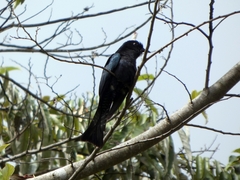
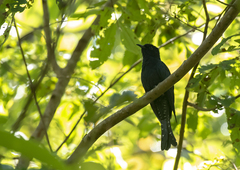
Asian Drongo-Cuckoo

Asian Drongo-Cuckoo

Surniculus lugubris

Silhouette: Nicolas Huet le Jeune and Jean-Gabriel Prêtre (vectorized by T. Michael Keesey) · PhyloPic

LCLeast ConcernNTVUENCR
Daily sighting probability <5% · Rare
at Mumbai

In 3 days <5%

45 Verified sightings at Mumbai
3,954 In all 33 parks From 2019 to 2026
June Best month
🌅 Crepuscular When it's spotted

About the Asian Drongo-Cuckoo

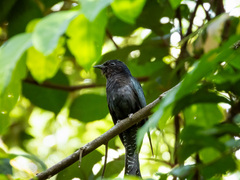
The square-tailed drongo-cuckoo (Surniculus lugubris) is a species of cuckoo that resembles a black drongo. It is found along the Himalayas extending east into Southeast Asia. The calls are series of piercing sharp whistles rising in pitch but shrill and choppily delivered. In the past, the species S. lugubris also included the subspecies dicruroides, which is now treated as a separate species, the fork-tailed drongo-cuckoo.

The square-tailed drongo-cuckoo can be easily distinguished by its downcurved beak and the white barred vent and outer undertail, and the tail only notched with slightly flared tips. In flight, a white wing-stripe is visible from below. It is a brood parasite on small babblers. It is not known how or whether the drongo-like appearance benefits this species but it is suspected that it aids in brood-parasitism just as hawk-cuckoos appear like hawks.

The square-tailed drongo-cuckoo was formerly considered conspecific with the fork-tailed drongo-cuckoo (together known as the Asian drongo-cuckoo), but vocal and morphological differences suggested that the species should be split. Wikipedia →

Sounds

Song0:37

Philippines · 2026

© Kelle Moreau · XC1161664 · CC BY-NC-SA 4.0

Call0:16

China · 2012

© Geoff Carey · XC814573 · CC BY-NC-SA 4.0

Song0:32

Malaysia · 2026

© Ding Li Yong · XC1077536 · CC BY-NC-ND 4.0

Global Distribution

Parks Where Found

# Park Country Daily sighting probability
1 Khao Luang National Park 🇹🇭 Thailand
~30%
2 Taman Negara National Park 🇲🇾 Malaysia
~30%
3 Cat Tien National Park 🇻🇳 Vietnam
~20%
4 Kaeng Krachan National Park 🇹🇭 Thailand
~20%
5 Wilpattu National Park 🇱🇰 Sri Lanka
~20%
6 Royal Manas National Park 🇧🇹 Bhutan
~20%
7 Danum Valley Conservation Area 🇲🇾 Malaysia
~10%
8 Minneriya National Park 🇱🇰 Sri Lanka
~10%
9 Sepilok 🇲🇾 Malaysia
~10%
10 Way Kambas National Park 🇮🇩 Indonesia
~10%
11 Yala National Park 🇱🇰 Sri Lanka
~10%
12 Manas National Park 🇮🇳 India
~10%
13 Kinabatangan Wildlife Sanctuary 🇲🇾 Malaysia
~10%
14 Kerinci Seblat National Park 🇮🇩 Indonesia
~10%
15 Cuc Phuong National Park 🇻🇳 Vietnam
~10%
16 Kanha National Park 🇮🇳 India
~10%
17 Bali Barat National Park 🇮🇩 Indonesia
~10%
18 Gunung Leuser National Park 🇮🇩 Indonesia
<5%
19 Jim Corbett National Park 🇮🇳 India
<5%
20 Bandhavgarh National Park 🇮🇳 India
<5%
21 Doi Inthanon National Park 🇹🇭 Thailand
<5%
22 Royal Bardia National Park 🇳🇵 Nepal
<5%
23 Khao Yai National Park 🇹🇭 Thailand
<5%
24 Periyar National Park 🇮🇳 India
<5%
25 Khao Sok National Park 🇹🇭 Thailand
<5%
26 Nagarhole National Park 🇮🇳 India
<5%
27 Namdapha National Park 🇮🇳 India
<5%
28 Udawalawe National Park 🇱🇰 Sri Lanka
<5%
29 Sinharaja Forest Reserve 🇱🇰 Sri Lanka
<5%
30 Kinabalu Park 🇲🇾 Malaysia
<5%
31 Satpura National Park 🇮🇳 India
<5%
32 Chitwan National Park 🇳🇵 Nepal
<5%
33 Kaziranga National Park 🇮🇳 India
<5%

Cities Where Found

# City Country Daily sighting probability
1 Bandar Lampung 🇮🇩 Indonesia
~30%
2 Kuala Lumpur 🇲🇾 Malaysia
~10%
3 Singapore 🇸🇬 Singapore
<5%
4 Jakarta 🇮🇩 Indonesia
<5%
5 Dehradun 🇮🇳 India
<5%
6 Kochi 🇮🇳 India
<5%
7 Kolkata 🇮🇳 India
<5%
8 Kozhikode 🇮🇳 India
<5%
9 Guangzhou 🇨🇳 China
<5%
10 Lucknow 🇮🇳 India
<5%

Zoos & Centres Where Found

# Zoo / Centre Country
1 Night Safari 🇸🇬 Singapore In captivity
2 Singapore Zoo 🇸🇬 Singapore In captivity
3 River Wonders 🇸🇬 Singapore In captivity

Before you go

What are the chances of seeing an Asian Drongo-Cuckoo in Mumbai?

Rare

Under 5% of wildlife watchers report an Asian Drongo-Cuckoo sighting in Mumbai on a given day, based on 45 verified sightings from GBIF citizen-science data. It is the 209th most-seen of the 283 birds we can rate there. Over three days the chance rises to under 5%, if each day is a fresh chance.

When is the best time to see an Asian Drongo-Cuckoo in Mumbai?

June

In that month about 10% of wildlife watchers report an Asian Drongo-Cuckoo in Mumbai on a given day, against under 5% in July to May, the lowest months. That is one of Mumbai's wettest months, with about 540 mm of rain against almost none in January.

What time of day is best to see an Asian Drongo-Cuckoo?

Between 2 and 5 am

Across all the parks we cover, that three-hour window holds the most Asian Drongo-Cuckoo sightings with a recorded time, and about 7 in 10 of them come between 6 pm and 6 am: it is most active around dawn and dusk.

Is Mumbai the best place to see an Asian Drongo-Cuckoo?

11th of 17

Of the 17 cities where we can rate Asian Drongo-Cuckoo sightings, Mumbai ranks 11th at under 5%. The best odds are in Bandar Lampung (Indonesia, about 30%), Kuala Lumpur (Malaysia, about 10%) and Singapore (Singapore, under 5%).

Which relatives of the Asian Drongo-Cuckoo live in Mumbai?

Same family: Cuculidae

The closest relatives of the Asian Drongo-Cuckoo that you can see in Mumbai (family Cuculidae, Cuckoos) are Asian Koel (about 60%) and Greater Coucal (about 40%), with each one's daily chance of a sighting.

Where does the Asian Drongo-Cuckoo sighting chance come from?

GBIF citizen-science records

It is estimated from how often the Asian Drongo-Cuckoo is recorded against all the birds logged in Mumbai (45 verified sightings), calibrated against known sighting rates. Figures are rounded to the nearest 10% because citizen-science data supports honest approximations, not decimals, and months with records from fewer than five people show "—". How it works.

← Back to Mumbai