Blackcap

Blackcap

Sylvia atricapilla

Silhouette: Alexis Lours · PhyloPic

LCLeast ConcernNTVUENCR
Daily sighting probability ~30% · Possible
at Munich

In 3 days ~70% in a week ~90%

771 Verified sightings at Munich
14,204 In all 38 parks From 2019 to 2026
June Best month
☀️ Diurnal When it's spotted

About the Blackcap

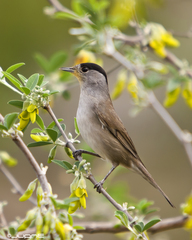
The Eurasian blackcap (Sylvia atricapilla) is a bird usually known simply as the blackcap. It is a common and widespread warbler. It has mainly olive-grey upperparts and pale grey underparts, and differences across the five subspecies are small. Both sexes have a neat coloured cap to the head, black in the male and reddish-brown in the female. The male's typical song is a rich musical warbling, often ending in a loud high-pitched crescendo, but a simpler song is given in some isolated areas, such as valleys in the Alps. The blackcap's closest relative is the garden warbler, which looks quite different but has a similar song.

The blackcap breeds in much of Europe, western Asia and northwestern Africa, and its preferred habitat is mature deciduous woodland. The male holds a territory when breeding, which is defended against garden warblers as well as other blackcaps. The nest is a neat cup, built low in brambles or scrub, and the clutch is typically 4–6 mainly buff eggs, which hatch in about 11 days. The chicks fledge in 11–12 days, but are cared for by both adults for some time after leaving the nest. The blackcap is a partial migrant; birds from the colder areas of its range winter in scrub or trees in northwestern Europe, around the Mediterranean and in tropical Africa. Some birds from Germany and western continental Europe have adapted to spending the winter in gardens in Great Britain and Ireland. Insects are the main food in the breeding season, but, for the rest of the year, blackcaps survive primarily on small fruit. Garden birds also eat bread, fat and peanuts in winter.

Despite extensive hunting in Mediterranean countries and the natural hazards of predation and disease, the blackcap has been extending its range for several decades, and is classified by the International Union for Conservation of Nature as least concern. Its rich and varied song has led to it being described as the "mock nightingale" and it has featured in literature, films and music. In Messiaen's opera Saint François d'Assise, the saint is represented by themes based on the blackcap's song. Wikipedia →

Sounds

Alarm call0:18

France · 2026

© Thierry THOMAS · XC1185361 · CC BY-NC-SA 4.0

Song1:20

Italy · 2026

© Francesco Sottile · XC1155470 · CC BY-NC-SA 4.0

Subsong1:26

Netherlands · 2026

© Joost van Bruggen · XC1107787 · CC BY-NC-ND 4.0

Global Distribution

Parks Where Found

# Park Country Daily sighting probability
1 Białowieża National Park 🇵🇱 Poland
~60%
2 Plitvice Lakes National Park 🇭🇷 Croatia
~60%
3 Sierra Nevada National Park 🇪🇸 Spain
~60%
4 Tatra National Park 🇸🇰 Slovakia
~50%
5 Picos de Europa National Park 🇪🇸 Spain
~50%
6 Triglav National Park 🇸🇮 Slovenia
~50%
7 Biebrza National Park 🇵🇱 Poland
~50%
8 Cévennes National Park 🇫🇷 France
~50%
9 Bavarian Forest National Park 🇩🇪 Germany
~50%
10 Ecrins National Park 🇫🇷 France
~50%
11 Fertő-Hanság National Park 🇭🇺 Hungary
~40%
12 Pyrénées National Park 🇫🇷 France
~40%
13 Aigüestortes National Park 🇪🇸 Spain
~40%
14 Mercantour National Park 🇫🇷 France
~40%
15 Ordesa y Monte Perdido National Park 🇪🇸 Spain
~40%
16 Sierra de Guadarrama National Park 🇪🇸 Spain
~30%
17 Hohe Tauern National Park 🇦🇹 Austria
~30%
18 Monfragüe National Park 🇪🇸 Spain
~30%
19 Vanoise National Park 🇫🇷 France
~30%
20 Hortobágy National Park 🇭🇺 Hungary
~30%
21 Snowdonia National Park 🇬🇧 United Kingdom
~30%
22 Gauja National Park 🇱🇻 Latvia
~20%
23 Kiskunság National Park 🇭🇺 Hungary
~20%
24 Doñana National Park 🇪🇸 Spain
~20%
25 Wadden Sea National Park 🇩🇪 Germany
~10%
26 Cairngorms National Park 🇬🇧 United Kingdom
~10%
27 Camargue 🇫🇷 France
~10%
28 Aberdare National Park 🇰🇪 Kenya
~10%
29 Ngorongoro Conservation Area 🇹🇿 Tanzania
<5%
30 Nairobi National Park 🇰🇪 Kenya
<5%
31 Arusha National Park 🇹🇿 Tanzania
<5%
32 Vatnajokull National Park 🇮🇸 Iceland
<5%
33 Tsavo West National Park 🇰🇪 Kenya
<5%
34 Bwindi Impenetrable National Park 🇺🇬 Uganda
<5%
35 Tarangire National Park 🇹🇿 Tanzania
<5%
36 Samburu National Reserve 🇰🇪 Kenya
<5%
37 Masai Mara National Reserve 🇰🇪 Kenya
<5%
38 Serengeti National Park 🇹🇿 Tanzania
<5%

Cities Where Found

# City Country Daily sighting probability
1 Jerusalem 🇮🇱 Israel
~80%
2 Turin 🇮🇹 Italy
~50%
3 Lisbon 🇵🇹 Portugal
~50%
4 Ramallah 🇵🇸 Palestine
~50%
5 Porto 🇵🇹 Portugal
~50%
6 Rome 🇮🇹 Italy
~40%
7 Lyon 🇫🇷 France
~40%
8 Athens 🇬🇷 Greece
~40%
9 Milan 🇮🇹 Italy
~40%
10 Naples 🇮🇹 Italy
~40%

Zoos & Centres Where Found

# Zoo / Centre Country
1 Alpenzoo Innsbruck 🇦🇹 Austria In captivity

Before you go

What are the chances of seeing a Blackcap in Munich?

Possible

About 30% of wildlife watchers report a Blackcap sighting in Munich on a given day, based on 771 verified sightings from GBIF citizen-science data. It is the 19th most-seen of the 113 birds we can rate there. Over three days the chance rises to about 70%, and over a week to about 90%, if each day is a fresh chance.

When is the best time to see a Blackcap in Munich?

June

In that month about 80% of wildlife watchers report a Blackcap in Munich on a given day, against under 5% in December to February, the lowest months. That is one of Munich's wettest months, with about 140 mm of rain against 60 mm in February.

What time of day is best to see a Blackcap?

Between 9 am and noon

Across all the parks we cover, that three-hour window holds the most Blackcap sightings with a recorded time, and about 9 in 10 of them come between 6 am and 6 pm: it is a daytime animal.

Is Munich the best place to see a Blackcap?

18th of 70

Of the 70 cities where we can rate Blackcap sightings, Munich ranks 18th at about 30%. The best odds are in Jerusalem (Israel, about 80%), Turin (Italy, about 50%) and Lisbon (Portugal, about 50%).

Where does the Blackcap sighting chance come from?

GBIF citizen-science records

It is estimated from how often the Blackcap is recorded against all the birds logged in Munich (771 verified sightings), calibrated against known sighting rates. Figures are rounded to the nearest 10% because citizen-science data supports honest approximations, not decimals, and months with records from fewer than five people show "—". How it works.

← Back to Munich