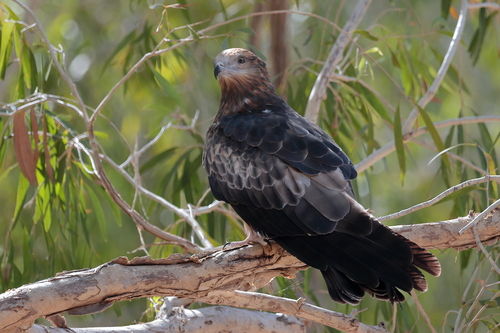
Black-shouldered Kite

Black-shouldered Kite

Elanus axillaris

Silhouette: Andy Wilson · PhyloPic

LCLeast ConcernNTVUENCR Endemic
Daily sighting probability <5% · Rare
at Perth

In 3 days ~10% in a week ~20%

337 Verified sightings at Perth
826 In all 17 parks From 2019 to 2026
April Best month
☀️ Diurnal When it's spotted

About the Black-shouldered Kite

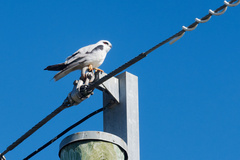
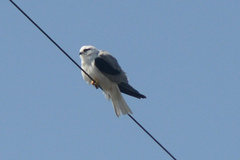
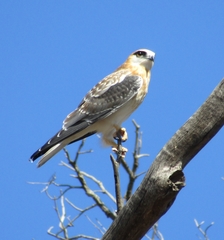
The black-shouldered kite (Elanus axillaris), also known as the Australian black-shouldered kite, is a small raptor found in open habitats throughout Australia. It resembles similar species found in Africa, Eurasia and North America, including the black-winged kite, a species that has in the past also been called "black-shouldered kite". Measuring around 35 cm (14 in) in length, with a wingspan of 80–100 cm (31–39 in), the adult black-shouldered kite has predominantly grey-white plumage and prominent black markings above its red eyes. It gains its name from the black patches on its wings. The primary call is a clear whistle, uttered in flight and while hovering. It can be confused with the related letter-winged kite in Australia, which is distinguished by the striking black markings under its wings.

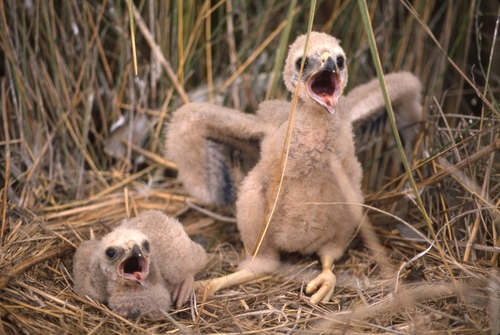
The species forms monogamous pairs, breeding between August and January. The birds engage in aerial courtship displays which involve high circling flight and ritualised feeding mid-air. Three or four eggs are laid and incubated for around thirty days. Chicks are fully fledged within five weeks of hatching and can hunt for mice within a week of leaving the nest. Juveniles disperse widely from their home territory. The black-shouldered kite hunts in open grasslands, searching for its prey by hovering and systematically scanning the ground. It mainly eats small rodents, particularly the introduced house mouse, and has benefitted from the modification of the Australian landscape by agriculture. It is rated as least concern on the International Union for Conservation of Nature (IUCN)'s Red List of Threatened Species. Wikipedia →

Sounds

Call0:16

Australia · 2020

© Marc Anderson · XC679518 · CC BY-NC-ND 4.0

Call0:23

Australia · 2017

© Greg McLachlan · XC387031 · CC BY-NC-SA 4.0

Call0:23

Australia · 2014

© nick talbot · XC330187 · CC BY-NC-SA 4.0

Global Distribution

Parks Where Found

# Park Country Daily sighting probability
1 Cape Range 🇦🇺 Australia
~10%
2 Ningaloo Marine Park 🇦🇺 Australia
~10%
3 Great Otway National Park 🇦🇺 Australia
~10%
4 Wilsons Promontory National Park 🇦🇺 Australia
~10%
5 Flinders Chase 🇦🇺 Australia
~10%
6 Rottnest Island 🇦🇺 Australia
~10%
7 Flinders Ranges National Park 🇦🇺 Australia
~10%
8 Booderee National Park 🇦🇺 Australia
<5%
9 Hattah-Kulkyne National Park 🇦🇺 Australia
<5%
10 Daintree National Park 🇦🇺 Australia
<5%
11 Kosciuszko National Park 🇦🇺 Australia
<5%
12 Royal National Park 🇦🇺 Australia
<5%
13 Uluru-Kata Tjuta National Park 🇦🇺 Australia
<5%
14 Grampians National Park 🇦🇺 Australia
<5%
15 Lamington National Park 🇦🇺 Australia
<5%
16 Blue Mountains National Park 🇦🇺 Australia
<5%
17 Kakadu National Park 🇦🇺 Australia
<5%

Cities Where Found

# City Country Daily sighting probability
1 Melbourne 🇦🇺 Australia
~10%
2 Brisbane 🇦🇺 Australia
~10%
3 Perth 🇦🇺 Australia
<5%
4 Sydney 🇦🇺 Australia
<5%

Zoos & Centres Where Found

# Zoo / Centre Country
1 Arizona-Sonora Desert Museum 🇺🇸 United States In captivity

Before you go

What are the chances of seeing a Black-shouldered Kite in Perth?

Rare

Under 5% of wildlife watchers report a Black-shouldered Kite sighting in Perth on a given day, based on 337 verified sightings from GBIF citizen-science data. It is the 87th most-seen of the 162 birds we can rate there. Over three days the chance rises to about 10%, and over a week to about 20%, if each day is a fresh chance.

When is the best time to see a Black-shouldered Kite in Perth?

March to May

In those months about 10% of wildlife watchers report a Black-shouldered Kite in Perth on a given day, against under 5% in June to February, the lowest months.

What time of day is best to see a Black-shouldered Kite?

Between 1 and 4 pm

Across all the parks we cover, that three-hour window holds the most Black-shouldered Kite sightings with a recorded time, and nearly all of them come between 6 am and 6 pm: it is a daytime animal.

Is Perth the best place to see a Black-shouldered Kite?

3rd of 4

Of the 4 cities where we can rate Black-shouldered Kite sightings, Perth ranks 3rd at under 5%. The best odds are in Melbourne (Australia, about 10%) and Brisbane (Australia, about 10%).

Which relatives of the Black-shouldered Kite live in Perth?

Same family: Accipitridae

The closest relatives of the Black-shouldered Kite that you can see in Perth (family Accipitridae, Hawks, Eagles, and Kites) are Swamp Harrier (about 10%) and Whistling Kite (about 10%), with each one's daily chance of a sighting.

Where does the Black-shouldered Kite sighting chance come from?

GBIF citizen-science records

It is estimated from how often the Black-shouldered Kite is recorded against all the birds logged in Perth (337 verified sightings), calibrated against known sighting rates. Figures are rounded to the nearest 10% because citizen-science data supports honest approximations, not decimals, and months with records from fewer than five people show "—". How it works.

← Back to Perth