Wedge-tailed Eagle

Wedge-tailed Eagle

Aquila audax

Silhouette: Gabriela Palomo-Munoz · PhyloPic

LCLeast ConcernNTVUENCR Endemic
Daily sighting probability <5% · Rare
at Perth

In 3 days <5%

12 Verified sightings at Perth
2,185 In all 21 parks From 2019 to 2026
January Best month
☀️ Diurnal When it's spotted

About the Wedge-tailed Eagle

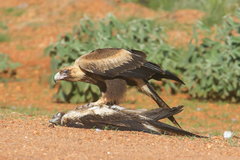
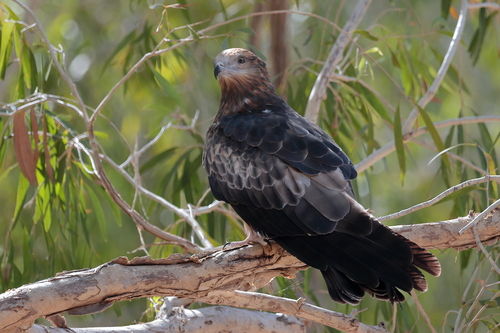
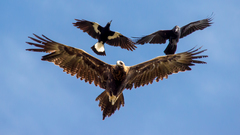
The wedge-tailed eagle (Aquila audax) is the largest bird of prey in the continent of Australia. It is also found in southern New Guinea to the north and is distributed as far south as the state of Tasmania. Adults of the species have long, broad wings, fully feathered legs, an unmistakable wedge-shaped tail, an elongated upper mandible, a strong beak and powerful feet. The wedge-tailed eagle is one of 12 species of large, predominantly dark-coloured booted eagles in the genus Aquila found worldwide. Genetic research has clearly indicated that the wedge-tailed eagle is fairly closely related to other, generally large members of the Aquila genus. A large brown-to-black bird of prey, it has a maximum reported wingspan of 2.84 m (9 ft 4 in) and a length of up to 1.06 m (3 ft 6 in).

The wedge-tailed eagle is one of its native continent's most generalised birds of prey. They reside in most habitats present in Australia, ranging from desert and semi-desert to plains to mountainous areas to forest, even sometimes tropical rainforests. Preferred habitats, however, tend towards those that have a fairly varied topography including rocky areas, some open terrain and native woodlots such as Eucalyptus stands.

The wedge-tailed eagle is one of the world's most powerful avian predators. Although a true generalist, which hunts a wide range of prey, including birds, reptiles and, rarely, other taxa, the species is, by and large, a mammal predator. The introduction of the European rabbit (Oryctolagus cuniculus) has been a boon to the wedge-tailed eagle and they hunt these and other invasive species in large volume, although the wedge-tailed eagle otherwise generally lives on marsupials, including many surprisingly large macropods. Additionally, wedge-tailed eagles often eat carrion, especially while young. The species tends to pair for several years, possibly mating for life.

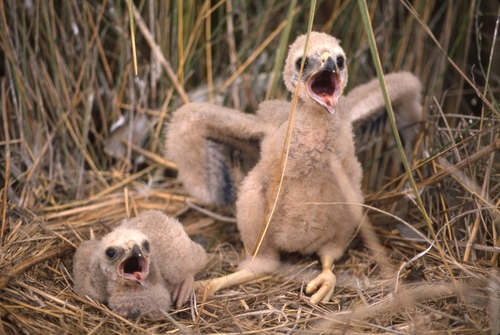
Wedge-tailed eagles usually construct a large stick nest in an ample tree, normally the largest in a stand, and lay one to four eggs, though typically only two. Usually, breeding efforts manage to produce one or two fledglings which, after a few months more, tend to disperse widely. Nesting failures are usually attributable to human interference, such as logging activity and other alterations, which both degrade habitats and cause disturbances. Wikipedia →

Sounds

Begging call0:08

Australia · 2014

© Nigel Jackett · XC184703 · CC BY-NC-SA 4.0

Call0:08

Australia · 2020

© Marc Anderson · XC679527 · CC BY-NC-ND 4.0

Recording0:06

Australia · 2026

© rhenaravanderhaar · iNaturalist · CC BY-NC 4.0

Global Distribution

Parks Where Found

# Park Country Daily sighting probability
1 Flinders Ranges National Park 🇦🇺 Australia
~60%
2 Maria Island National Park 🇦🇺 Australia
~30%
3 Cape Range 🇦🇺 Australia
~20%
4 Ningaloo Marine Park 🇦🇺 Australia
~20%
5 Kosciuszko National Park 🇦🇺 Australia
~20%
6 Flinders Chase 🇦🇺 Australia
~20%
7 Grampians National Park 🇦🇺 Australia
~20%
8 Cradle Mountain-Lake St Clair National Park 🇦🇺 Australia
~10%
9 Great Otway National Park 🇦🇺 Australia
~10%
10 Hattah-Kulkyne National Park 🇦🇺 Australia
~10%
11 Wilsons Promontory National Park 🇦🇺 Australia
~10%
12 Lamington National Park 🇦🇺 Australia
~10%
13 Kakadu National Park 🇦🇺 Australia
~10%
14 Freycinet National Park 🇦🇺 Australia
<5%
15 Litchfield National Park 🇦🇺 Australia
<5%
16 Nitmiluk National Park 🇦🇺 Australia
<5%
17 Springbrook National Park 🇦🇺 Australia
<5%
18 Royal National Park 🇦🇺 Australia
<5%
19 Blue Mountains National Park 🇦🇺 Australia
<5%
20 Booderee National Park 🇦🇺 Australia
<5%
21 Daintree National Park 🇦🇺 Australia
<5%

Cities Where Found

# City Country Daily sighting probability
1 Hobart 🇦🇺 Australia
<5%
2 Melbourne 🇦🇺 Australia
<5%
3 Brisbane 🇦🇺 Australia
<5%
4 Perth 🇦🇺 Australia
<5%
5 Sydney 🇦🇺 Australia
<5%

Zoos & Centres Where Found

# Zoo / Centre Country
1 Australia Zoo 🇦🇺 Australia In captivity
2 Alice Springs Desert Park 🇦🇺 Australia In captivity
3 Healesville Sanctuary 🇦🇺 Australia In captivity
4 Taronga Zoo 🇦🇺 Australia In captivity
5 Currumbin Wildlife Sanctuary 🇦🇺 Australia In captivity
6 Melbourne Zoo 🇦🇺 Australia In captivity
7 Lone Pine Koala Sanctuary 🇦🇺 Australia In captivity
8 Phillip Island Wildlife Park 🇦🇺 Australia In captivity
9 Moonlit Sanctuary Wildlife Conservation Park 🇦🇺 Australia In captivity
10 Gorge Wildlife Park 🇦🇺 Australia In captivity
11 Symbio Wildlife Park 🇦🇺 Australia In captivity
12 Featherdale Sydney Wildlife Park 🇦🇺 Australia In captivity
13 Tralaga Wildlife park 🇦🇺 Australia In captivity
14 Rockhampton Zoo 🇦🇺 Australia In captivity
15 Ipswich Nature Centre 🇦🇺 Australia In captivity
16 Caversham Wildlife Park 🇦🇺 Australia In captivity
17 Kangaroo Island Wildlife Park 🇦🇺 Australia In captivity
18 Trowunna Wildlife Park 🇦🇺 Australia In captivity

Before you go

What are the chances of seeing a Wedge-tailed Eagle in Perth?

Rare

Under 5% of wildlife watchers report a Wedge-tailed Eagle sighting in Perth on a given day, based on 12 verified sightings from GBIF citizen-science data. It is the 141st most-seen of the 162 birds we can rate there. Over three days the chance rises to under 5%, if each day is a fresh chance.

When is the best time to see a Wedge-tailed Eagle in Perth?

Any time of year

In every month with enough records, under 5% of wildlife watchers report a Wedge-tailed Eagle in Perth on a given day, so our monthly data shows no clear season.

What time of day is best to see a Wedge-tailed Eagle?

Between noon and 3 pm

Across all the parks we cover, that three-hour window holds the most Wedge-tailed Eagle sightings with a recorded time, and nearly all of them come between 6 am and 6 pm: it is a daytime animal.

Is Perth the best place to see a Wedge-tailed Eagle?

Among the best

Of the 5 cities where we can rate Wedge-tailed Eagle sightings, Perth ranks 4th at under 5%, level with the leaders once rounded. The best odds are in Hobart (Australia, under 5%), Melbourne (Australia, under 5%) and Brisbane (Australia, under 5%).

Which relatives of the Wedge-tailed Eagle live in Perth?

Same family: Accipitridae

The closest relatives of the Wedge-tailed Eagle that you can see in Perth (family Accipitridae, Hawks, Eagles, and Kites) are Swamp Harrier (about 10%) and Whistling Kite (about 10%), with each one's daily chance of a sighting.

Where does the Wedge-tailed Eagle sighting chance come from?

GBIF citizen-science records

It is estimated from how often the Wedge-tailed Eagle is recorded against all the birds logged in Perth (12 verified sightings), calibrated against known sighting rates. Figures are rounded to the nearest 10% because citizen-science data supports honest approximations, not decimals, and months with records from fewer than five people show "—". How it works.

← Back to Perth