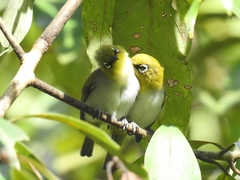


Indian White-eye

Indian White-eye

Zosterops palpebrosus

Silhouette: Ferran Sayol · PhyloPic

LCLeast ConcernNTVUENCR
Daily sighting probability ~20% · Possible
at Ranchi

In 3 days ~50% in a week ~80%

25 Verified sightings at Ranchi
11,178 In all 27 parks From 2019 to 2026
January Best month
☀️ Diurnal When it's spotted

About the Indian White-eye

The Indian white-eye (Zosterops palpebrosus), formerly the Oriental white-eye, is a small species of passerine bird in the white-eye family. It is a resident breeder in open woodland on the Indian subcontinent. They forage in small groups, feeding on nectar and small insects. The distinctive white eye-ring and overall yellowish upperparts easily identify them. The range previously extended eastwards to Southeast Asia, Indonesia, and Malaysia. Their name was recently changed because previous members of Zosterops palpebrosus in Southeast Asia were reclassified as a new species, making the Indian White-eye a more geographically accurate term for this species.

The Indian white-eye was described by the Dutch zoologist Coenraad Jacob Temminck in 1824, based on a specimen collected in Bengal. He coined the binomial name Sylvia palpebrosa. The English and scientific names refer to the conspicuous ring of white feathers round the eyes, palpebrosus being Neo-Latin for "having prominent eyelids", from the Latin palpebrae "eyelids".

The English name of this species was changed from "Oriental white-eye" to "Indian white-eye" to more accurately reflect the geographic range following... Wikipedia →

Sounds

Recording0:12

India · 2025

© Ashwin A · iNaturalist · CC BY 4.0

Recording0:10

China · 2022

© Yi-Shan Zhao · iNaturalist · CC BY-NC 4.0

Recording0:17

India · 2025

© Sarvesh Arun · iNaturalist · CC BY-NC 4.0

Global Distribution

Parks Where Found

# Park Country Daily sighting probability
1 Eravikulam National Park 🇮🇳 India
~60%
2 Gir National Park 🇮🇳 India
~40%
3 Jim Corbett National Park 🇮🇳 India
~40%
4 Bandhavgarh National Park 🇮🇳 India
~40%
5 Mudumalai National Park 🇮🇳 India
~40%
6 Royal Manas National Park 🇧🇹 Bhutan
~40%
7 Royal Bardia National Park 🇳🇵 Nepal
~40%
8 Kanha National Park 🇮🇳 India
~30%
9 Sundarbans National Park 🇮🇳 India
~30%
10 Satpura National Park 🇮🇳 India
~30%
11 Udawalawe National Park 🇱🇰 Sri Lanka
~30%
12 Bandipur National Park 🇮🇳 India
~30%
13 Ranthambore National Park 🇮🇳 India
~20%
14 Sinharaja Forest Reserve 🇱🇰 Sri Lanka
~20%
15 Manas National Park 🇮🇳 India
~20%
16 Periyar National Park 🇮🇳 India
~20%
17 Minneriya National Park 🇱🇰 Sri Lanka
~20%
18 Doi Inthanon National Park 🇹🇭 Thailand
~20%
19 Keoladeo National Park 🇮🇳 India
~10%
20 Chitwan National Park 🇳🇵 Nepal
~10%
21 Kaziranga National Park 🇮🇳 India
~10%
22 Nagarhole National Park 🇮🇳 India
~10%
23 Langtang National Park 🇳🇵 Nepal
~10%
24 Yala National Park 🇱🇰 Sri Lanka
~10%
25 Wilpattu National Park 🇱🇰 Sri Lanka
~10%
26 Horton Plains National Park 🇱🇰 Sri Lanka
<5%
27 Namdapha National Park 🇮🇳 India
<5%

Cities Where Found

# City Country Daily sighting probability
1 Dehradun 🇮🇳 India
~60%
2 Nashik 🇮🇳 India
~50%
3 Islamabad 🇵🇰 Pakistan
~50%
4 Solapur 🇮🇳 India
~40%
5 Bengaluru 🇮🇳 India
~40%
6 Bhopal 🇮🇳 India
~30%
7 Pune 🇮🇳 India
~30%
8 Lucknow 🇮🇳 India
~30%
9 Kanpur 🇮🇳 India
~30%
10 Jabalpur 🇮🇳 India
~30%

Zoos & Centres Where Found

# Zoo / Centre Country
1 Pairi Daiza 🇧🇪 Belgium In captivity
2 Philadelphia Zoo 🇺🇸 United States In captivity

Before you go

What are the chances of seeing an Indian White-eye in Ranchi?

Possible

About 20% of wildlife watchers report an Indian White-eye sighting in Ranchi on a given day, based on 25 verified sightings from GBIF citizen-science data. It is the 22nd most-seen of the 76 birds we can rate there. Over three days the chance rises to about 50%, and over a week to about 80%, if each day is a fresh chance.

When is the best time to see an Indian White-eye in Ranchi?

January and June–August

In those months about 30% of wildlife watchers report an Indian White-eye in Ranchi on a given day, against about 10% in May, September and November, the lowest months. Those are among Ranchi's wettest months, with about 220 mm of rain a month against 5 mm in November.

What time of day is best to see an Indian White-eye?

Between 7 and 10 am

Across all the parks we cover, that three-hour window holds the most Indian White-eye sightings with a recorded time, and about 9 in 10 of them come between 6 am and 6 pm: it is a daytime animal.

Is Ranchi the best place to see an Indian White-eye?

18th of 46

Of the 46 cities where we can rate Indian White-eye sightings, Ranchi ranks 18th at about 20%. The best odds are in Dehradun (India, about 60%), Nashik (India, about 50%) and Islamabad (Pakistan, about 50%).

Which relatives of the Indian White-eye live in Ranchi?

Same order: Passeriformes

The closest relatives of the Indian White-eye that you can see in Ranchi (order Passeriformes, Perching Birds) are Black Drongo (about 90%), House Crow (about 80%) and Indian Pied Starling (about 70%), with each one's daily chance of a sighting.

Where does the Indian White-eye sighting chance come from?

GBIF citizen-science records

It is estimated from how often the Indian White-eye is recorded against all the birds logged in Ranchi (25 verified sightings), calibrated against known sighting rates. Figures are rounded to the nearest 10% because citizen-science data supports honest approximations, not decimals, and months with records from fewer than five people show "—". How it works.

← Back to Ranchi